
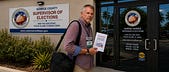

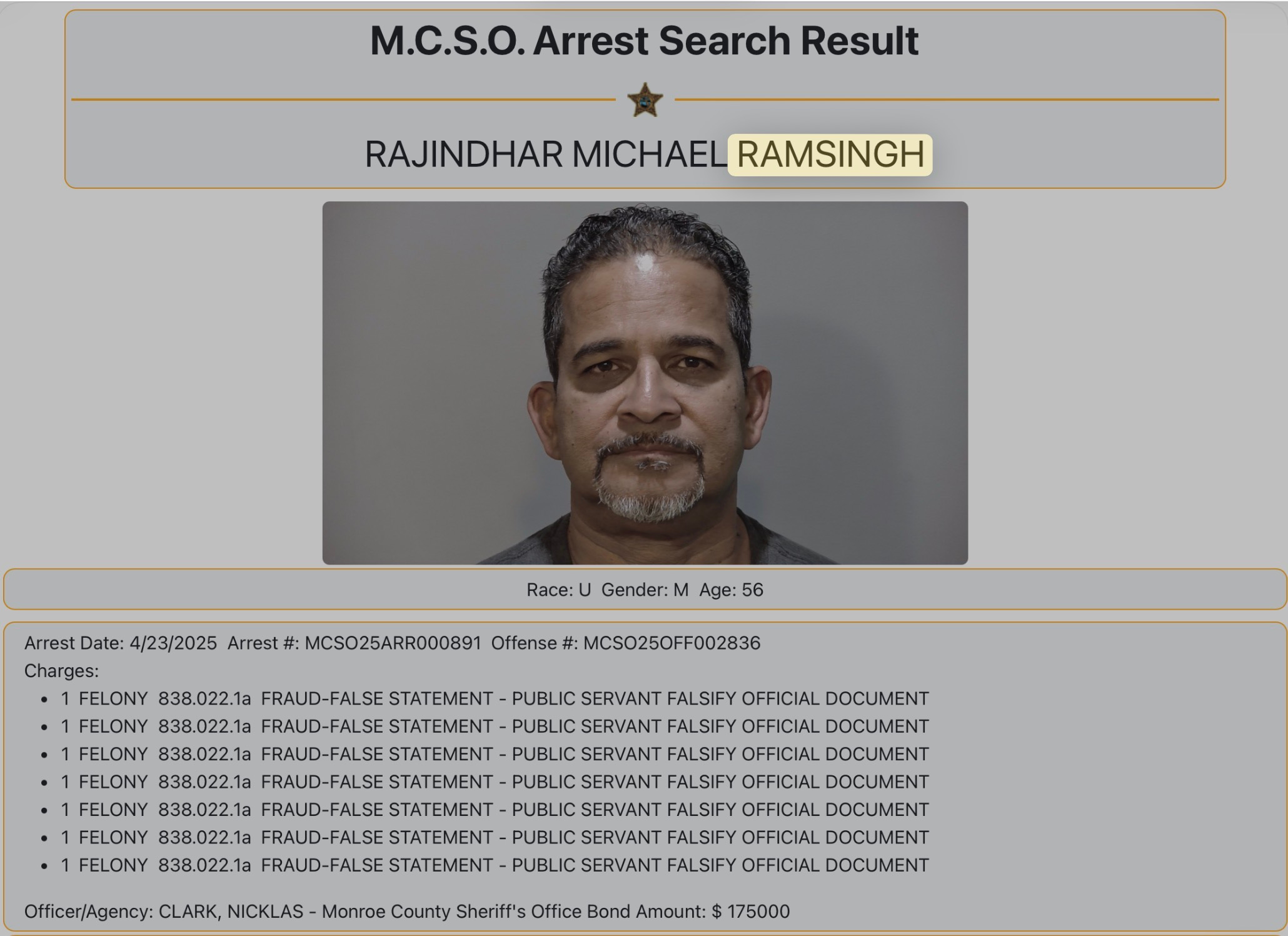
Monroe County State Attorney Dennis Ward’s office is pushing back against an attempt by former Key West Chief Building Official Rajindhar “Raj” Ramsingh to suppress evidence seized from his cellphone, arguing in a newly filed response that investigators lawfully obtained two search warrants during what prosecutors described as a sprawling, “constantly evolving” public corruption investigation.
The response, filed Tuesday by Major Crimes Assistant State Attorney Colleen Dunne on behalf of the State Attorney’s Office, asks Circuit Judge Mark Jones to deny Ramsingh’s motion to suppress evidence tied to multiple felony cases stemming from the ongoing City Hall corruption investigation that has engulfed 1300 White St. for more than a year following a scathing Grand Jury report.

A hearing on the suppression motion and response is currently scheduled for Fri., May 29 at 1 p.m. before Jones. However, based on the complexity of the legal and constitutional issues involved, a ruling is not expected immediately following the hearing. Legal observers familiar with lengthy suppression proceedings say it would not be unusual for Jones to take several weeks before issuing a written order.
At the center of the dispute are two separate cellphone search warrants obtained during the investigation by the Monroe County State Attorney’s Office and the FBI.
In the filing, prosecutors argue the warrants were supported by probable cause and complied with constitutional requirements even if portions of the affidavits are challenged by the defense.
“The defense has not made a showing that any of the statements within the affidavit are false and were made knowingly, intentionally, or with disregard for the truth,” Dunne wrote in the filing.
The response offers one of the most detailed public looks yet at how investigators say the case evolved from initial concerns over Sunshine Law violations and political maneuvering surrounding the termination of former City Manager Al Childress into a broader public corruption and organized fraud probe involving building permits, construction projects and alleged concealment of public records.

According to the filing, the investigation began after authorities reviewed text messages and public records involving city commissioners and then-City Attorney Ronald Ramsingh, Raj Ramsingh’s brother, concerning efforts to remove Childress.
The filing states investigators became interested in communications surrounding the Corradino Report, an independent review commissioned by Childress that allegedly identified questionable practices within the city’s Building Department while Raj Ramsingh served as chief building official.
“At the forefront of the discussions for the removal of the City Manager was the defendant’s brother, Ronald Ramsingh,” the filing states.

Prosecutors said investigators issued subpoenas seeking cellphone logs and text messages from city officials and commissioners connected to the matter. According to the response, investigators later compared those productions against cellphone carrier records and allegedly found discrepancies in what Raj Ramsingh provided.
The State argues those discrepancies established probable cause for the first cellphone warrant, which focused on allegations of official misconduct tied to the alleged concealment, destruction or falsification of public records.
“What was discovered when reviewing the carrier records and what was provided in response to the subpoenas were many text messages that were not provided by the defendant,” prosecutors wrote.
The filing repeatedly emphasizes that the broader corruption and Sunshine Law allegations referenced in the warrant affidavits served primarily as “background” to explain the origins of the investigation rather than the direct basis for probable cause.
That distinction could become significant as Ramsingh’s attorneys attempt to challenge the warrants under the U.S. Supreme Court’s ruling in Franks v. Delaware, which allows defendants to attack warrants by alleging investigators included false or misleading statements that were necessary to establish probable cause.
Under that legal standard, even if a court finds portions of an affidavit were flawed, judges must determine whether sufficient probable cause still exists after the disputed material is removed.
The State’s response repeatedly argues that standard is satisfied in this case.
“Even if the Court were to excise the statements referenced by the defense, there would still be sufficient evidence for a finding of probable cause,” the filing states.
The second warrant focused on allegations tied to Ramsingh’s work as chief building official and his private construction company.
According to prosecutors, investigators reviewing city permit records and subpoenaed documents discovered Ramsingh allegedly approved projects connected to his own company while simultaneously profiting from construction work within the city despite allegedly agreeing, upon his hiring in 2021, that neither he nor his company would perform work in Key West.
The filing alleges investigators uncovered projects in which Ramsingh’s company performed work while permit records identified different contractors.
The State also points to a permit associated with 1101 Simonton St., alleging records fraudulently identified another contractor while Ramsingh’s company allegedly performed the work and received payment.
The response further reveals that prosecutors obtained an indictment against Ramsingh on organized fraud charges on May 7, 2025, after presenting evidence gathered through subpoenas, homeowner interviews and permit records.
In defending the breadth of the cellphone searches, prosecutors compared various areas within a smartphone to rooms within a house, arguing investigators reasonably sought locations where evidence could exist.
Still, the filing also appears to narrow the practical scope of at least one search.
“Although the search warrant authorized a search of various areas in the defendant’s phone, the only area searched … was text messages,” prosecutors wrote regarding the first warrant.
The State argues that even if portions of the warrant are later deemed overly broad, the actual evidence seized — text messages tied to alleged official misconduct — should remain admissible.

The suppression fight is shaping up as one of the most consequential legal battles yet in the sprawling City Hall corruption cases involving Raj Ramsingh, former City Attorney Ronald Ramsingh and former Code Enforcement Director Jim Young, collectively dubbed the “Bubba Bozo Trio” by critics of City Hall.
The outcome could determine whether key digital evidence gathered during the investigation remains available to prosecutors as the cases move toward trial.
Jones will hear the issue on Fri., May 29 at 1 p.m. with a possible ruling several weeks later.
All defendants are presumed innocent unless proven guilty in a court of law.
This is an evolving story. Watch this space.
Are these the missing texts that allegedly have the mayor connected?