


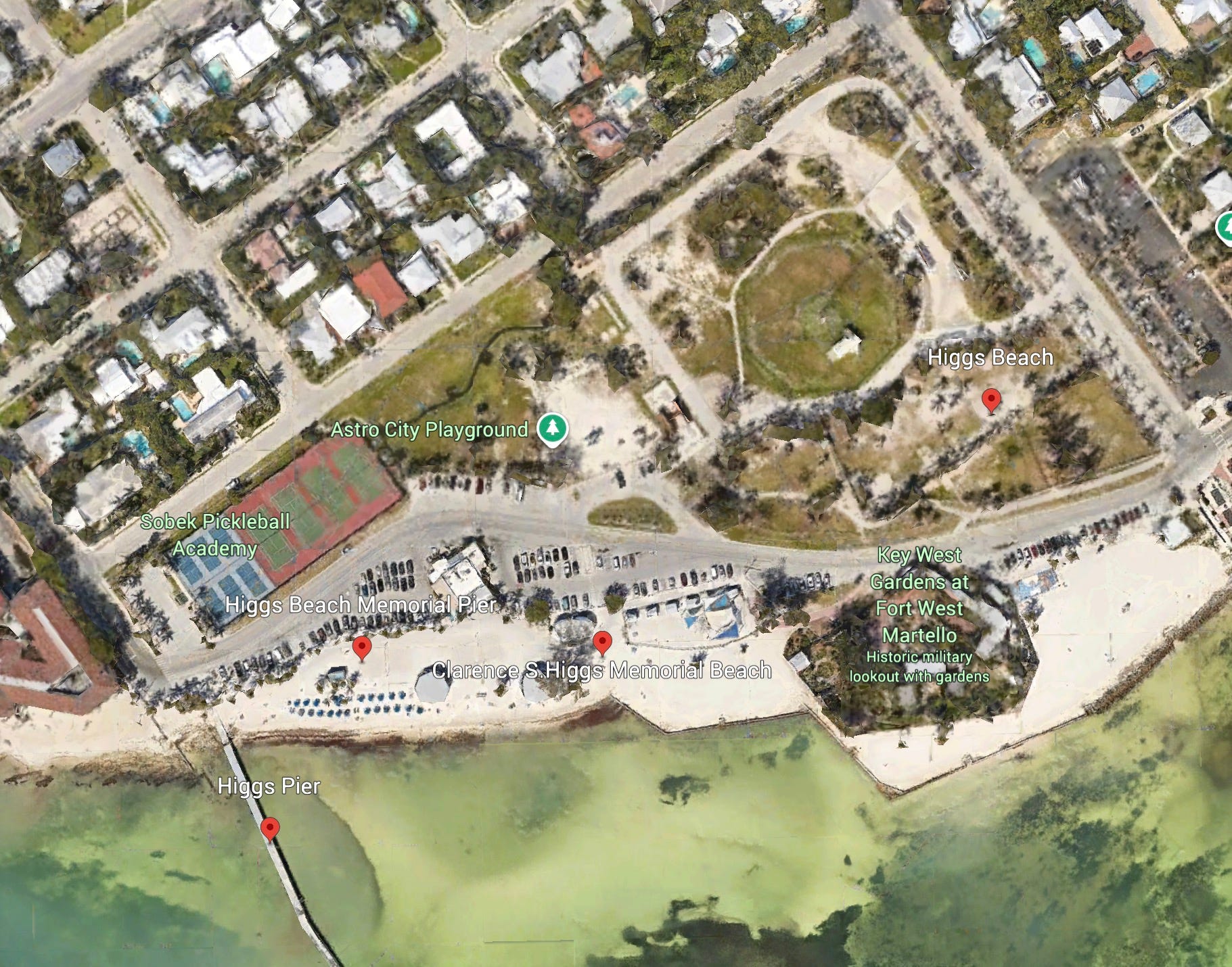
When Key West took control of Higgs Beach on May 1, city officials said local ownership would give residents a greater voice in the future of one of the island’s most important public spaces.
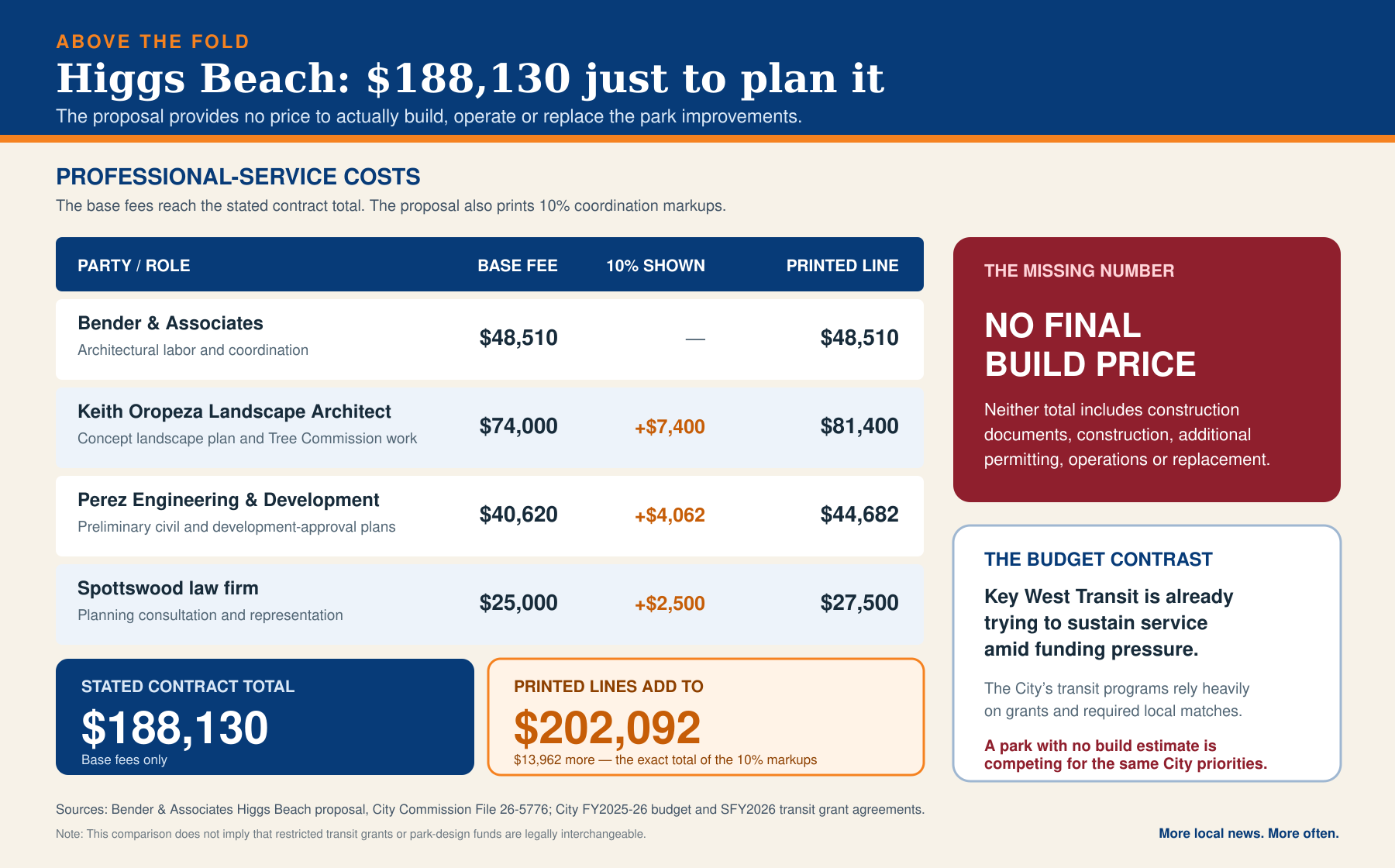
Four months later, the City Commission is being asked to spend $188,130 moving a detailed redevelopment concept through schematic design and planning approvals.
What remains unclear is who selected those uses, what evidence supported them and how much influence the public had over the plan.
The city held a two-hour community meeting July 8 to discuss current and future projects at Higgs Beach and answer questions. But the available records do not show that residents were presented with competing designs, asked to rank priorities or shown how their comments changed the plan.
Six days later, Engineering Director Doug Bradshaw presented a detailed city sketch during an internal meeting. A subsequent proposal from landscape architect Keith Oropeza says the conceptual master plan will be based on a city-provided “bubble diagram of use areas.”
The records show the starting plan came from city staff. They do not identify who originally drew it, who chose its individual elements or whether alternatives were considered.
The proposal now before commissioners would take that concept through the Development Review Committee, Tree Commission, Planning Board, Historic Architectural Review Commission and, ultimately, the City Commission.
Once those choices enter the formal development process, however, future public participation could be reduced to modifying a plan the city has already selected instead of deciding what the park should become.
Why 17 Pickleball Courts?

The largest change would turn Higgs Beach into what the consultant’s proposal calls a “higher-quality regional destination” for pickleball.
The concept includes 16 standard courts and one tournament court along the northwestern side of the park near Casa Marina Court. Landscaping would be added along the northern boundary to address views and sound.
But the city has not published a court-utilization study, demand analysis, neighborhood noise study, traffic plan or public survey supporting a 17-court complex.
It has not explained who requested that number of courts, what other configurations were considered or what existing uses, trees or open space could be displaced.
A regional tournament destination would also carry consequences beyond the court boundaries. Tournaments could bring concentrated noise, additional traffic, parking demand, vendors and pressure for longer operating hours.
The current concept says the courts would not be lighted, but that does not answer whether tournaments, leagues or reservations would receive priority over residents using a public park.
Those are policy decisions—not merely design details.
The Parks Board Was Bypassed
A review of the Parks and Recreation Advisory Board’s published 2026 agendas and minutes found no recommendation on the Higgs Beach plan.
The board’s January, March and May agendas did not include it and its July 23 meeting was canceled because it lacked a quorum.
Now, commissioners are scheduled to vote Thursday on disbanding the board altogether.
A number of its appointed members became frustrated after feeling their recommendations were repeatedly ignored by city staff on a variety of issues. Public stakeholders involved in recreation planning have expressed similar concerns.
The absence of a parks board recommendation is particularly striking because nearly every major question surrounding the Higgs Beach plan involves recreation policy: the number of pickleball courts, the future of the hockey rink, the balance between organized facilities and open space, the use of artificial turf and whether the park should become a regional tournament destination.
If commissioners eliminate the board, it is unclear what citizen body — if any — other than City staff and hired guns, will provide that review in the future.
What Happens to the Hockey Rink?
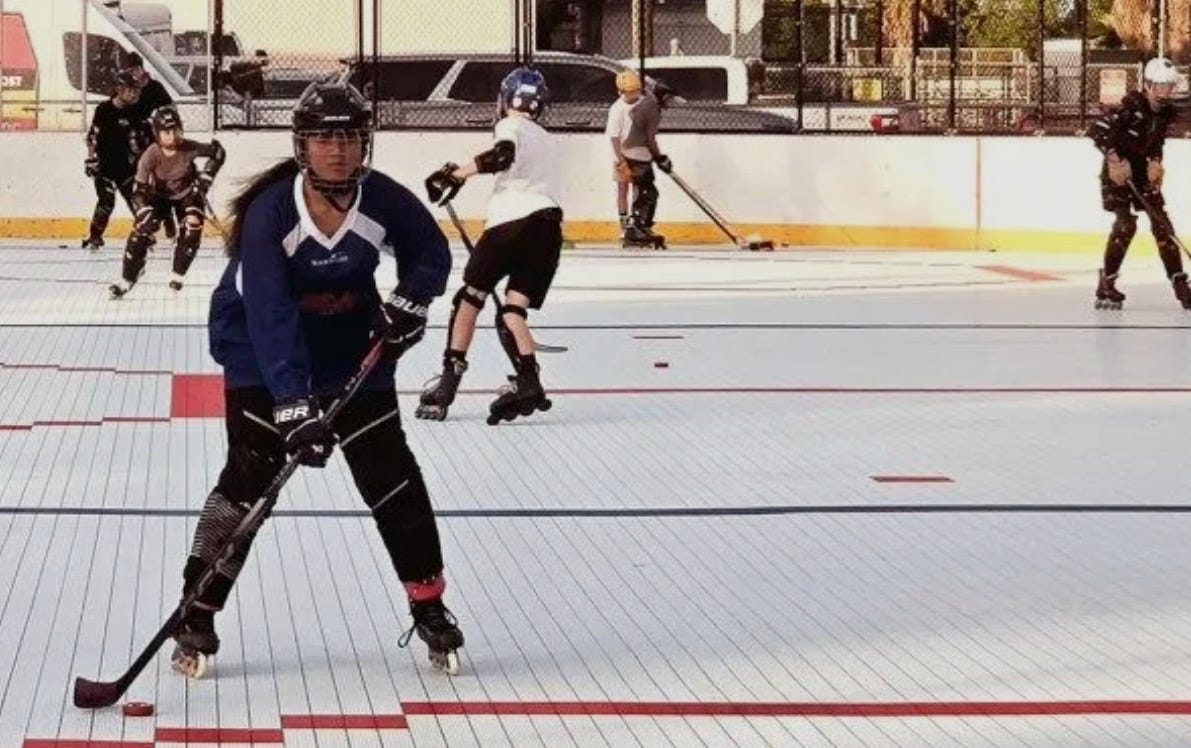
The city sketch also shows a 120-by-200-foot covered hockey rink at Higgs Beach; Key West already has an active rink at 1800 Bertha St., next to Key West High School. That facility received a new modular Matéflex tile surface completed in December 2025. In March, the manufacturer described it as a solution expected to last more than 20 years.
If relocation is the plan, commissioners should know what the city spent on the Bertha Street improvements, whether removing and reinstalling the tiles would affect their warranty and what would happen to the existing site.
The hockey club, nearby residents, taxpayers and the public at large should not have to infer the answer from a drawing — but to date no rationale has been given as to why the rink was a) rebuilt without a roof and b) why it would need to be moved from its current location.
Artificial Turf in the Dog Park
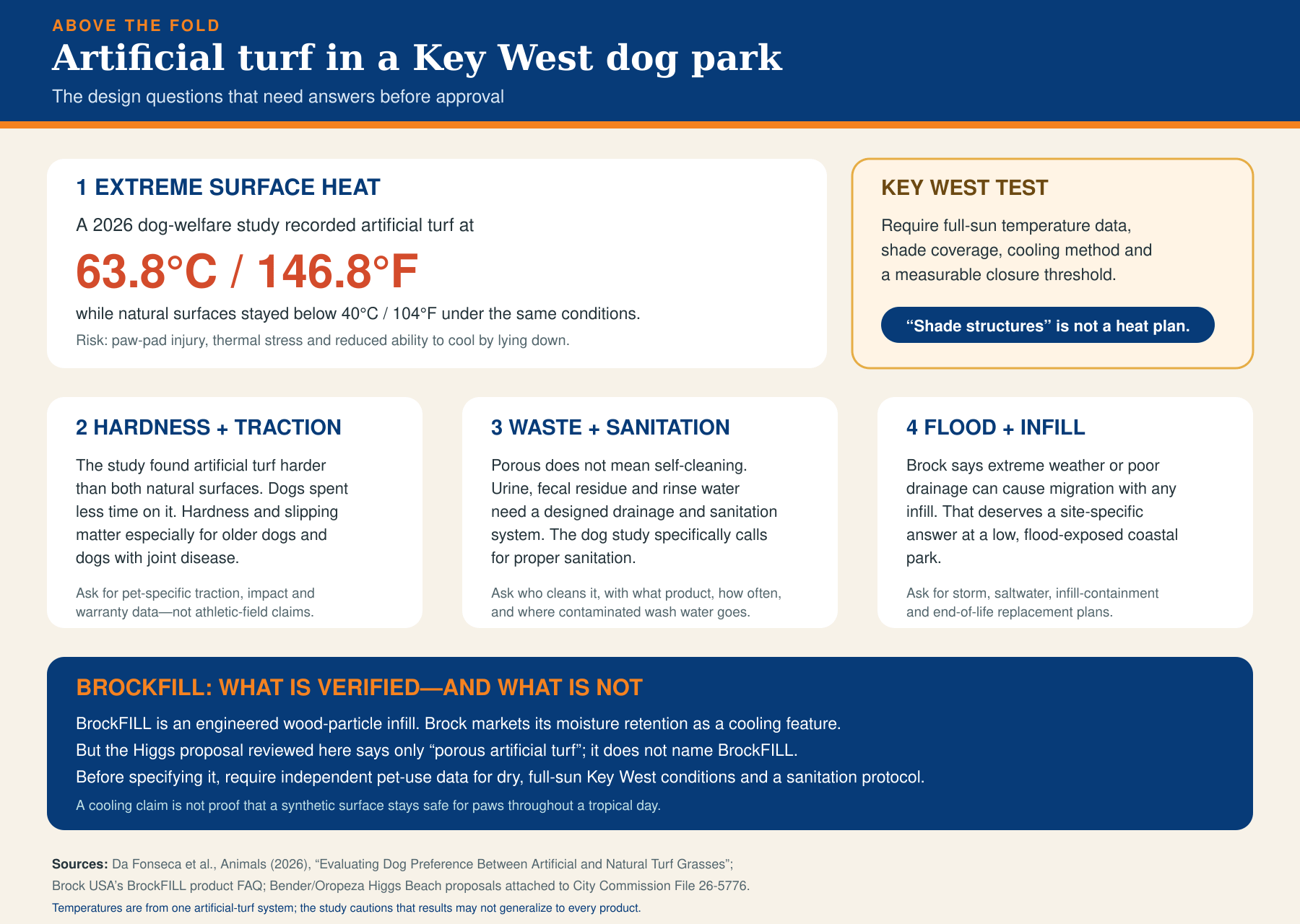
The dog park would be divided into large- and small-dog areas with shade structures, seating and porous artificial turf.
The turf, however, raises questions about heat, drainage and sanitation—particularly in Key West’s climate.
A 2026 peer-reviewed dog-welfare study found that one artificial-turf surface reached 146.8 degrees while natural surfaces tested under the same conditions remained below 104 degrees. The artificial surface was also harder and used less frequently by the dogs.
That does not establish how every turf product would perform at Higgs Beach, but it does show why product-specific testing under local conditions should occur before the city commits to using it not only for the public but also for the dogs’ sake.

Sanitation presents another problem. Artificial turf does not absorb and naturally break down urine and other waste the way soil and living grass can. The city has not disclosed how fecal residue, urine, odors and cleaning water would be handled, or how frequently the surface would be disinfected.
Those questions become more complicated because graves have been identified within the dog-park area. The proposal prohibits excavation and requires improvements to be built above the existing grade — making drainage, attachment, waste removal, flooding and storm performance central planning questions, not details to be resolved after the plan is approved.
The documents do not name BrockFILL, which is the City’s primary supplier of infill products for artificial turf fields, but if the city is considering a specialty product marketed as cooler than conventional crumb rubber or organic-based infills, commissioners should still require independent testing of the complete turf system for pet use in tropical sun.

A Pattern Reminiscent of Bayview Park

The process, along with disregard for public stakeholder input eerily resembles the controversy surrounding the redux of Bayview Park on Truman Avenue.
In June 2025, commissioners approved $987,738 for artificial turf at Pepe Hernandez Field. A companion proposal asking the city to delay the turf and preserve $317,808 for a professional master plan developed with community involvement failed.
The turf, as seems to happen on an increasingly worrisome basis, moved forward first.
Nearly a year later, the city listed the turf as installed while a broader second phase—including restrooms, a pro shop, maintenance facilities, basketball improvements, tennis shade and sidewalks—remained at 95% design with an estimated construction cost of $2.5 million.
The criticism was not that every resident opposed every improvement. It was that a major material choice and spending commitment came before a transparent, comprehensive plan.
Higgs Beach risks following the same path on a larger and more sensitive property.
The Numbers Do Not Add Up
The $188,130 proposal itself also contains an apparent mathematical inconsistency.
Bender & Associates lists $48,510 for its work. Consultant charges, including the 10% coordination markups shown in the proposal, are listed as $81,400, $44,682 and $27,500.
Together, those figures total $202,092—not $188,130.
The $13,962 difference equals the combined 10% markups shown for the three consultants. The payment schedule, however, totals $188,130.
Commissioners should require a corrected fee schedule and a clear explanation of whether those markups will be charged before approving the contract.
The proposal also excludes construction documents and construction administration. Permitting through the South Florida Water Management District, a new tree survey, most state or federal permitting and planning work beyond the stated allowance could cost more.
And there is still no published estimate for constructing the complete plan—or maintaining it over the next 20 years.
More than that, the plan ignores one fundamental principal according to Mayor Sam Kaufman heading into his first commission meeting in the big chair: Before you start coming up with a master plan, how about you fix what is broken first and figure out how you are going to pay for it.
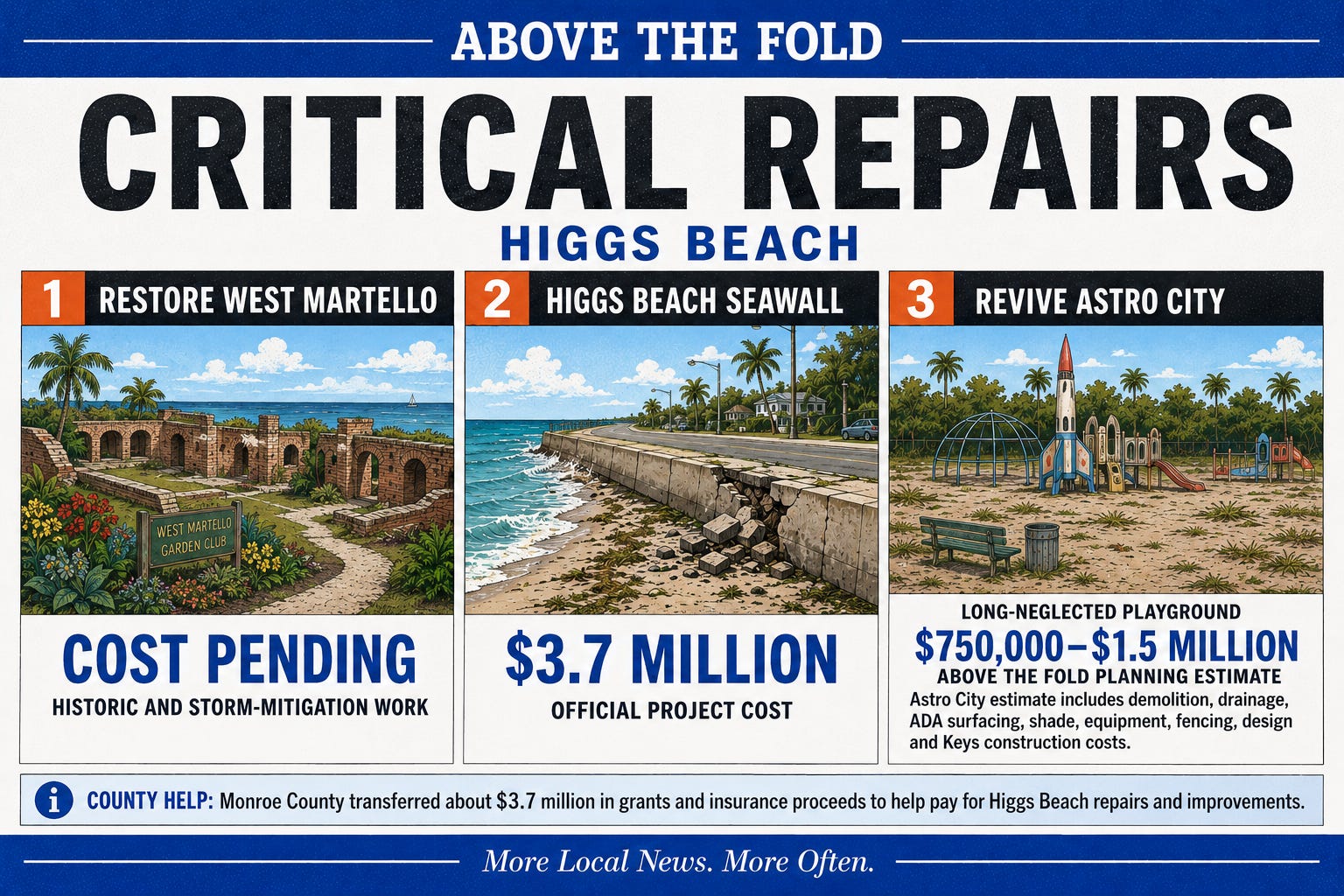
Among the most urgent needs are repairs to the roof at Fort West Martello, a separate county-owned historic property near the airport with a project cost of about $989,000; replacement of the crumbling Higgs Beach seawall, now estimated by the city at $3.7 million; and the rehabilitation or replacement of Astro City, the long-neglected children’s playground.
No separate construction estimate has been released for Astro City, but an Above the Fold planning estimate places the likely cost at $750,000 to $1.5 million, including demolition, drainage, accessible safety surfacing, new equipment, shade structures, fencing, design and the higher cost of construction in the Keys.
The county’s financial incentives helped persuade Key West to take over Higgs Beach, but that money will eventually run out. The city and its taxpayers will remain responsible for maintaining whatever is built.
And none of this is cheap even in Des Moines — let alone the Southernmost City.
The vote Thursday is therefore about more than a $188,130 consulting agreement.
It is about whether Key West will ask the public what it wants from Higgs Beach before staff choices become an official plan — and whether commissioners will demand answers about cost, traffic and noise in the surrounding neighborhood, artificial turf, sanitation, historic graves, flooding, trees and long-term maintenance.
Before those choices are decided on by City staff and become difficult and expensive to reverse.
Don’t want to become a paid subscriber?
It would seem affluent, white pickleball players are more important, unfortunately. This is a poorly thought out idea that needs to be revisited, IMHO.
Thank you. I am still tweaking… Substack won’t let me use the infographic as a link button and offer a full view of the graphic… so still working that out.