


KEY WEST, Fla. — Federal immigration enforcement continued across Key West on Friday, with three separate Key West police officers assisting in operations stretching from Patterson Avenue to White Street.
The latest actions are part of a broader surge by U.S. Customs and Border Protection and other federal immigration authorities in Key West and the Lower Keys. At least 60 immigrants have been apprehended in the area in recent weeks, according to information compiled by Above the Fold. The number across all of Monroe County could be significantly higher.
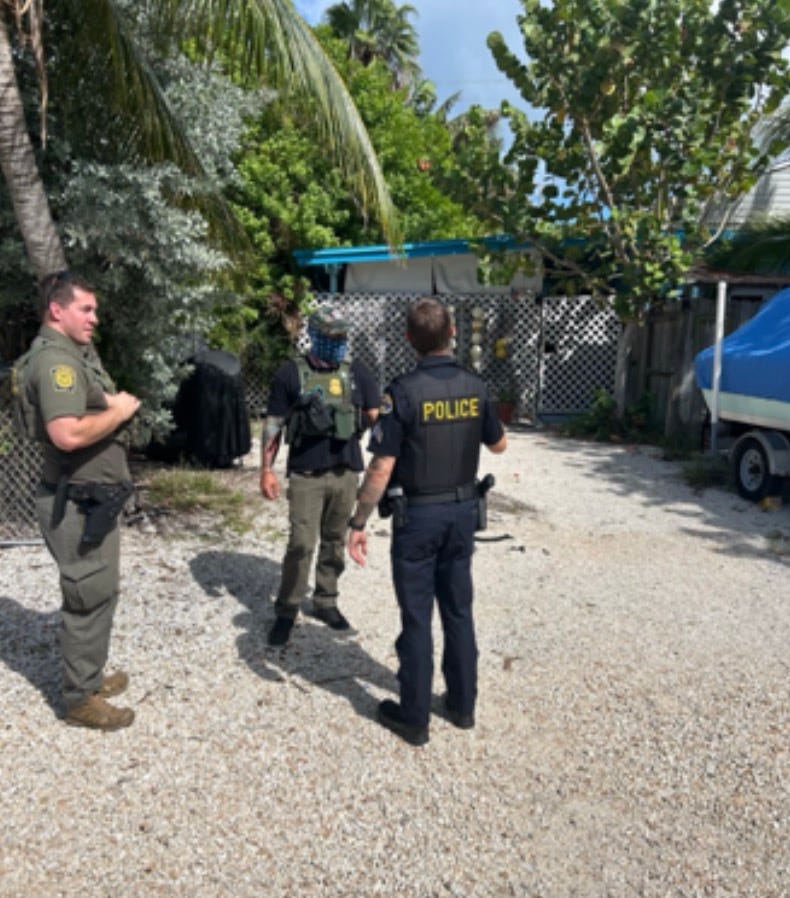
Friday’s activity also underscored the growing involvement of the Key West Police Department in federal immigration enforcement. The department operates under a 287(g) agreement with U.S. Immigration and Customs Enforcement that authorizes specially trained local officers to perform certain federal immigration functions under ICE supervision.
Images from Haiti are too graphic to share here. Click here to view AP’s coverage but be warned that the video and images are graphic in nature.
It was not immediately clear whether the three officers involved Friday were acting under that agreement or providing other assistance to federal agents. CBP and ICE are separate Department of Homeland Security agencies, and the 287(g) program is administered by ICE.
Emails seeking clarification from KWPD Chief Sean Brandenburg and City Manager Brian Barroso were not returned by deadline.
Immigration Arrest Surge Reaches Into Key West And The Florida Keys

In the video above, Key West Police Officer William Howell assists Customs and Border Patrol in an immigration arrest at the corner of Catherine and Varela Streets on Sat., Aug 23, 2026. / CONTRIBUTED
Still, the visible involvement of local officers marks a change in how immigration enforcement is unfolding on the island.
The operations also appear increasingly likely to occur on weekends, when attorneys, advocacy organizations and government offices may be more difficult to reach. At least eight people were reportedly detained during one recent Saturday operation in Key West after about six others were taken into custody in the preceding days.
Friday’s enforcement came as the humanitarian and security crisis in Haiti continued to deteriorate.
At least 47 people were killed and more than 50 kidnapped in a gang attack on Kenscoff, a community in the hills near Port-au-Prince, according to the United Nations. Five children were among those killed, and 22 people were executed inside a church where they had sought refuge. Twenty-five homes were burned, and more than 2,600 people were displaced.
A gang leader has threatened to execute the hostages if police kill gang members while attempting to secure the community.
Big Day for Border Patrol: At Least Eight Detained in Key West

KEY WEST, Fla. — U.S. Border Patrol agents took at least eight people into custody Saturday during a series of enforcement actions in Key West, including a forceful detention outside Tavern N Town that w…
Armed gangs now control an estimated 70% of Port-au-Prince. More than 1.5 million Haitians have been displaced, and more than 3,000 people were killed during the first half of 2026.
Despite those conditions, the United States has continued deporting Haitians. A deportation flight carrying more than 50 people, including children, arrived Thursday in Cap-Haitien because Port-au-Prince’s international airport was considered too dangerous.
The contradiction is difficult to ignore: The United States maintains a Level 4 “Do Not Travel” advisory for Haiti and prohibits U.S. commercial flights to Port-au-Prince because of violence and instability, yet it continues sending Haitians back.
If Haiti is considered safe enough for deportation, it raises an obvious question: Why is the country’s capital considered too dangerous for ordinary commercial flights?
The answer is visible in Kenscoff — bodies in the streets, families driven from their homes, people executed inside a church and more than 50 hostages facing the threat of death.
Key West Attorney Warns In-Person Immigration Hearings Put Haitian Clients at Risk

KEY WEST, Fla. — A Key West immigration attorney is warning that Haitian asylum-seekers and others are being forced to choose between tra…
Hearings Become a Risk
The danger is not limited to what awaits immigrants if they are deported. For some Haitians and other immigrants in the Florida Keys, simply complying with the American immigration system may expose them to arrest.
Key West immigration attorney Wayne Dapser said immigration judges have increasingly required applicants, formally called respondents, to appear in person at the immigration court in Miami even when their attorneys have been permitted to participate remotely through Webex.
That forces immigrants living in Key West and the Florida Keys to make a roughly 160-mile trip through a narrow island chain with limited routes to the mainland.
Dapser said those travelers face the possibility of roadblocks and driver’s-license checks along the Overseas Highway, immigration screening at airports and apprehension while traveling to court or after arriving for their proceedings.
In other words, immigrants are being ordered to appear in Miami to comply with the legal process while facing the possibility of being detained on the way to court or at the courthouse.
The result is a system in which appearing can carry a risk of detention, while failing to appear can result in an immigration judge issuing a removal order in the person’s absence.
For Haitians in the Keys, the stakes are especially severe. Those taken into custody may ultimately be returned to a country the United States warns its own citizens not to visit — and to a capital so dangerous that U.S. commercial aircraft cannot fly there.
Meanwhile, the increased presence of federal agents and KWPD officers is being felt across Key West, from residential streets to major intersections and shopping areas.
The full scale of the operation remains unknown. The Department of Homeland Security does not communicate apprehension numbers with the public or the media, operating almost like secret police in a Banana Republic.
Federal authorities have not released a comprehensive accounting of how many people have been apprehended in Key West, the Lower Keys or Monroe County; their immigration status; whether they had work permits or pending applications; or how many had criminal records.
That secrecy makes it impossible for the public to determine the full scale of the enforcement campaign, who is being taken into custody or how extensively local officers are participating.
What is known is that the enforcement footprint is expanding, local police are becoming more visible in the operations and at least 60 people have already been taken into custody in Key West and the Lower Keys.
Increasingly, those operations are happening on weekends.
Ed. note: The Associated Press contributed to this report. Above the Fold’s reporting on immigration enforcement in Key West and Monroe County was conducted independently.