


In the video above, Key West Police Officer William Howell assists Customs and Border Patrol in an immigration arrest at the corner of Catherine and Varela Streets on Sat., Aug 23, 2026. / CONTRIBUTED
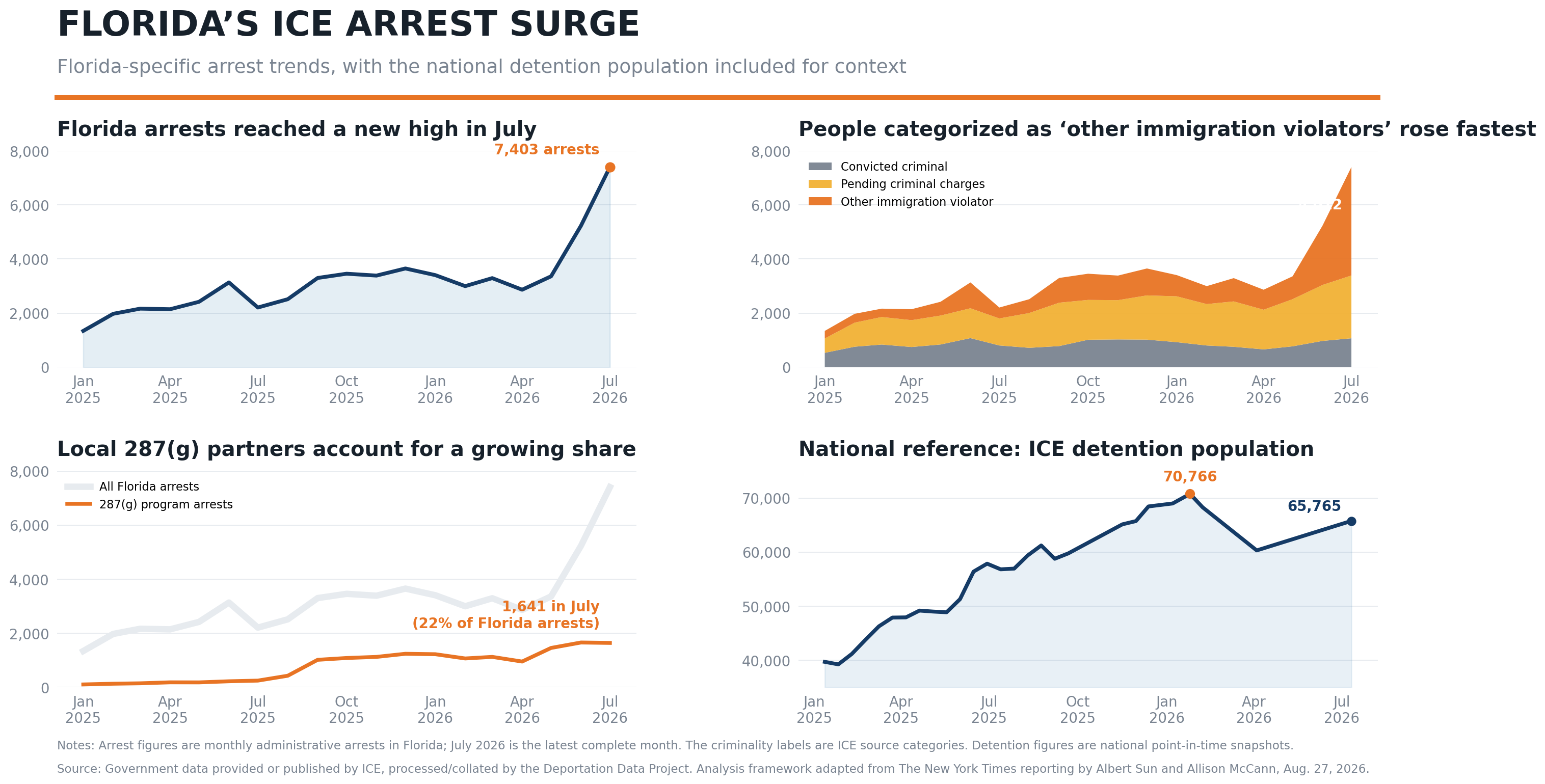
KEY WEST, Fla. — A national surge in immigration arrests is playing out with particular force in Florida, providing broader context for the traffic stops, workplace encounters and highly visible detentions that have unsettled immigrant families throughout Key West and the Florida Keys.
Immigration and Customs Enforcement recorded approximately 43,000 arrests nationwide in June and 49,000 in July, according to federal data obtained by the Deportation Data Project through a public-records lawsuit and analyzed by Albert Sun and Allison McCann of The New York Times.
The Times found that most immigrants arrested in July had been accused of civil immigration violations but had not been charged with or convicted of a crime. Fewer than 4% had a previous violent-crime conviction.
In other words, having no criminal history does not necessarily mean a person has lawful immigration status. Immigration violations are generally civil matters, however, and the data shows the administration’s enforcement campaign has expanded well beyond its initial emphasis on people convicted of serious crimes.
In Florida, hat shift is especially significant.
ICE is now averaging more than 230 arrests a day in the state, an increase of more than 100 daily arrests since the spring, according to the Times’ analysis. Only Texas, with more than 380 arrests a day, recorded a higher daily total.
The available data does not provide a separate arrest count for Monroe County. Neither ICE nor U.S. Customs and Border Protection routinely releases a comprehensive local accounting of immigration arrests in the Keys, making it difficult to determine how many people have been detained, where the encounters occurred or how many had criminal histories.
Because of the cone of silince surrounding the secret police, numbers being thrown about are well educated guesses based on personal interactions and observations by members of immigrant support networks.
BACKGROUND
Navy Sailor’s Father Detained in Key West Immigration Operation

KEY WEST, Fla. — A U.S. Navy sailor serving aboard the troubled USS Abraham Lincoln learned over the weekend that his father had been detained by federal immigration authorities in Key West as the sailor completed an extended deployment in the Middle East.
A Crackdown Felt Locally
The national findings mirror what immigrant families, attorneys and advocates have described in the Florida Keys: a broader enforcement campaign that reaches people at workplaces, shopping centers and during routine travel along U.S. 1.
One of the most prominent recent cases involved Luis Manuel Aviles Roa, a Nicaraguan immigrant and longtime Key West resident who was detained by Border Patrol agents during a traffic stop Aug. 22.
Aviles Roa had lived in the United States for 19 years and had a work permit, driver’s license and Social Security number, according to his family. He was pursuing permanent residency when he was taken into federal custody.
His son, Joshua Aviles, is a U.S. citizen and Navy sailor who had spent more than nine months deployed aboard the USS Abraham Lincoln.
The detention attracted national attention after Joshua Aviles described learning that his father had been arrested while he was completing the extended deployment. The case was dismissed by an immigration judge, and Aviles Roa was released from custody Tuesday.
Key West Attorney Warns In-Person Immigration Hearings Put Haitian Clients at Risk

KEY WEST, Fla. — A Key West immigration attorney is warning that Haitian asylum-seekers and others are being forced to choose between traveling through an expanding federal enforcement presence to attend court in Miami or staying home and risking deportation orders.
Federal officials had initially said Aviles Roa entered the country unlawfully and would remain in custody pending removal proceedings. The Department of Homeland Security has not publicly explained why the case was dismissed or why he was released so quickly.
That is an important feature of the expanded enforcement campaign: A person may possess permission to work, a driver’s license or a pending immigration application and still face detention if the government alleges an underlying immigration violation.
It also highlights the growing role of Border Patrol in interior enforcement. Although The Times’ analysis specifically examined ICE arrests, Border Patrol, ICE and deputized state and local officers increasingly operate as parts of the same broader immigration-enforcement system.
BACKGROUND
Father of Navy Sailor Released From ICE Custody

KEY WEST, Fla. — The father of a U.S. Navy sailor serving aboard the USS Abraham Lincoln was released from federal immigration custody Tuesday, according to a family member who spoke with CBS News.
Local Police Partnerships Expand
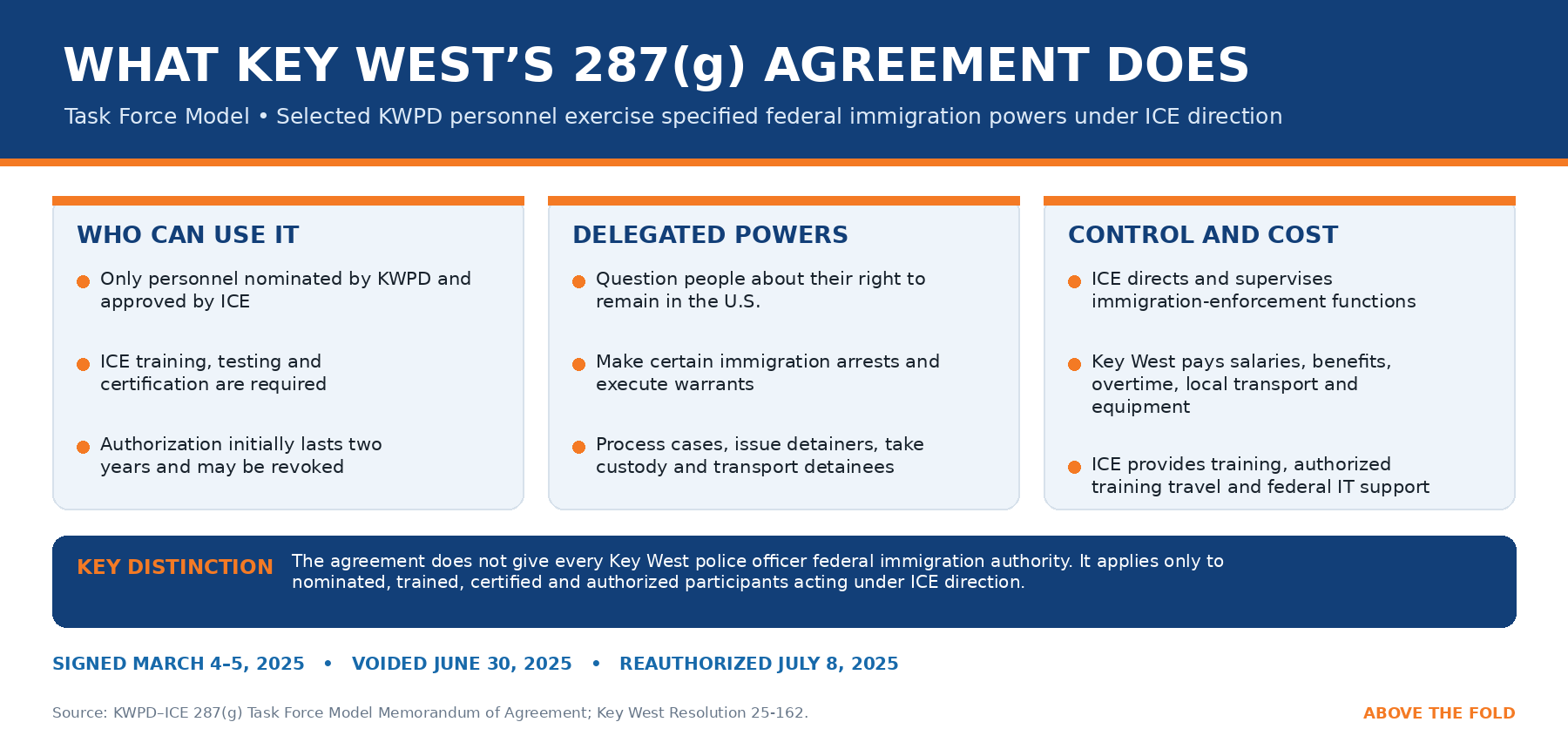
The Times found that state and local law-enforcement agencies are carrying out a growing share of immigration arrests through the federal 287(g) program.
The program allows selected state and local officers to receive federal training and authority to perform certain immigration-enforcement functions under ICE supervision.
Approximately 14% of ICE arrests nationwide are now connected to 287(g) partnerships, according to the federal data. Florida has recorded at least 15,000 arrests through the program since President Donald Trump returned to office, more than any other state.
Both the Key West Police Department and Monroe County Sheriff’s Office have entered task-force-model agreements with ICE.
BACKGROUND
BREAKING NEWS: Key West Flip Flop, and We’re Not Talking Kinos

Key West approves 287(g) agreement to allow KWPD to cooperate with Customs and Border Patrol and ICE by 4-2 vote while Kaufman was out of town for special meeting.
Key West commissioners voted in June 2025 to void the city’s agreement amid strong public opposition. The commission reversed that decision days later after Florida Attorney General James Uthmeier warned city officials they could face removal from office or other consequences.
The reinstatement passed 4-2.
The city now maintains an immigration-enforcement information page containing the Key West and Monroe County agreements, city resolutions and correspondence with state officials.
Key West says its police department continues to enforce city and state laws and provides assistance when requested by county, state and federal partners.
The existence of the agreements does not establish that local officers participated in every immigration detention reported in the Keys. It does mean trained local officers can play a formal role in federal enforcement under the terms of the agreements.
Enforcement No Longer Focused On Criminal Convictions
The Times’ findings offer the clearest evidence yet that the administration’s campaign has moved beyond people convicted of violent or other serious crimes.
Immigrants with no criminal charges or convictions accounted for the fastest-growing category of arrests during the summer. Those arrested included spouses of U.S. citizens, asylum applicants, people who entered the country legally and immigrants whose temporary protections were revoked or challenged by the administration.
The Department of Homeland Security told The Times that the administration was fulfilling its commitment to arrest and deport people with criminal records. The department also said anyone unlawfully present in the country could be targeted.
That broader standard leaves nearly any immigrant with disputed, expired or unresolved status exposed to arrest—even when the person has no criminal record, possesses work authorization or is attempting to legalize his or her status through the courts.
More Officers And More Detention Space
The increase is being driven partly by a rapid expansion of the federal enforcement workforce.
ICE had approximately 29,000 employees in June, up from about 21,000 when Trump returned to office, according to federal personnel data cited by the Times.
The administration has also added local law-enforcement partners, expanded detention capacity and improved the systems used to locate and process immigrants.
ICE arrests were approaching 2,000 a day by early August.
The federal immigration detention population had climbed to approximately 66,000 people, while the administration continued working toward a stated goal of 100,000 detention beds.
Deportations have averaged more than 1,000 people a day since last summer, according to the Times. At least 329 deportation flights left the United States in July, the highest monthly number recorded by ICE Flight Monitor, a tracking project operated by Human Rights First.
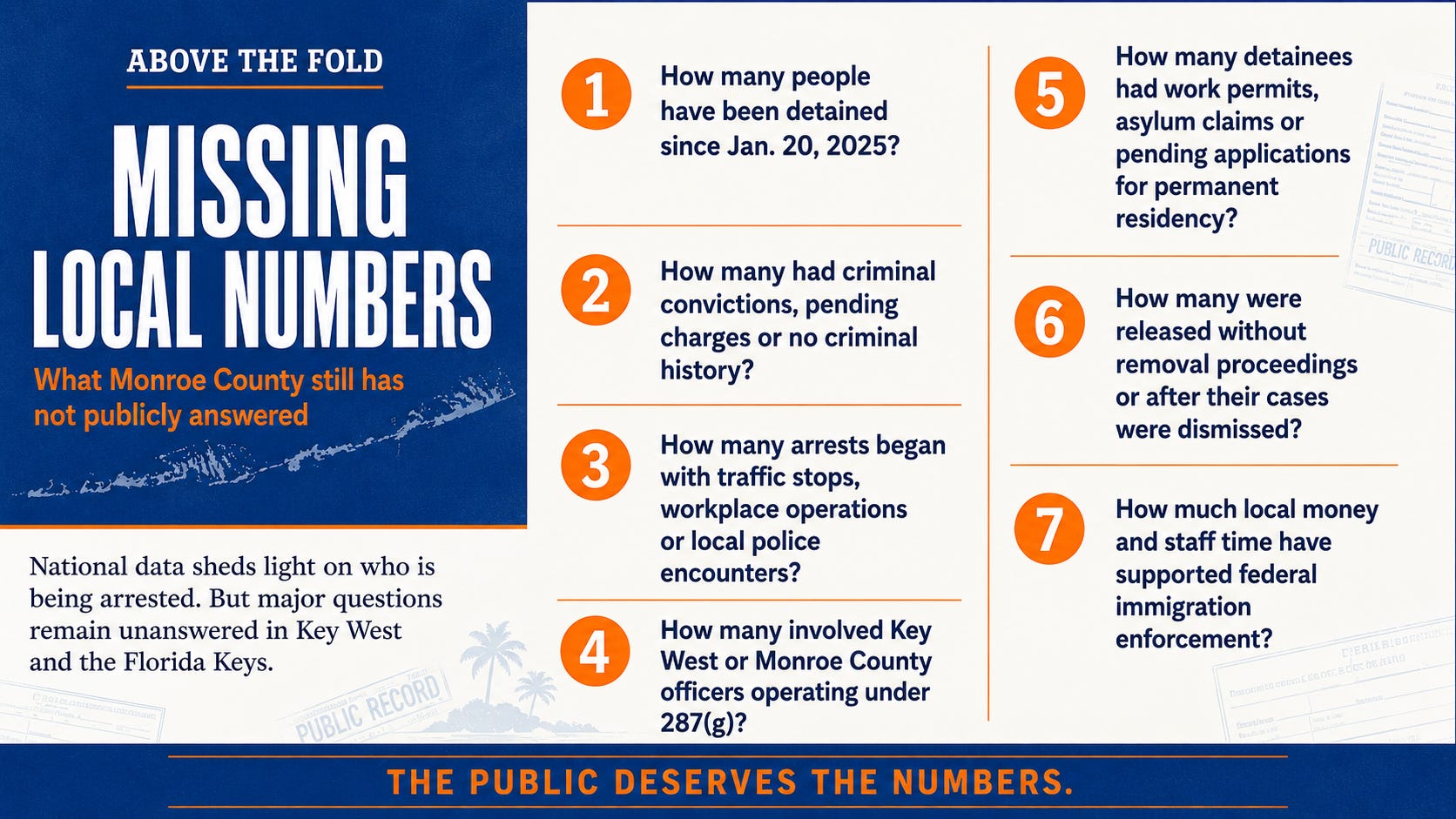
Until ICE, Border Patrol and their local partners release those figures, the public is left to reconstruct the scope of enforcement through individual families, attorneys, videos and scattered agency statements.
What is now clear from the federal data is that the arrests occurring in the Keys are part of a much larger shift.
The enforcement campaign is growing rapidly. Florida is one of its primary centers. And increasingly, the people being taken into custody have no criminal record.
This is an evolving story. Watch this space.
Ed. Note: National statistics and trends in this report are attributed to “ICE Arrests Soar as People With No Criminal Record Are Increasingly Targeted,” by Albert Sun and Allison McCann, published Aug. 27, 2026, by The New York Times. The Times analyzed federal arrest data obtained by the Deportation Data Project. Local reporting and context were added independently.


