


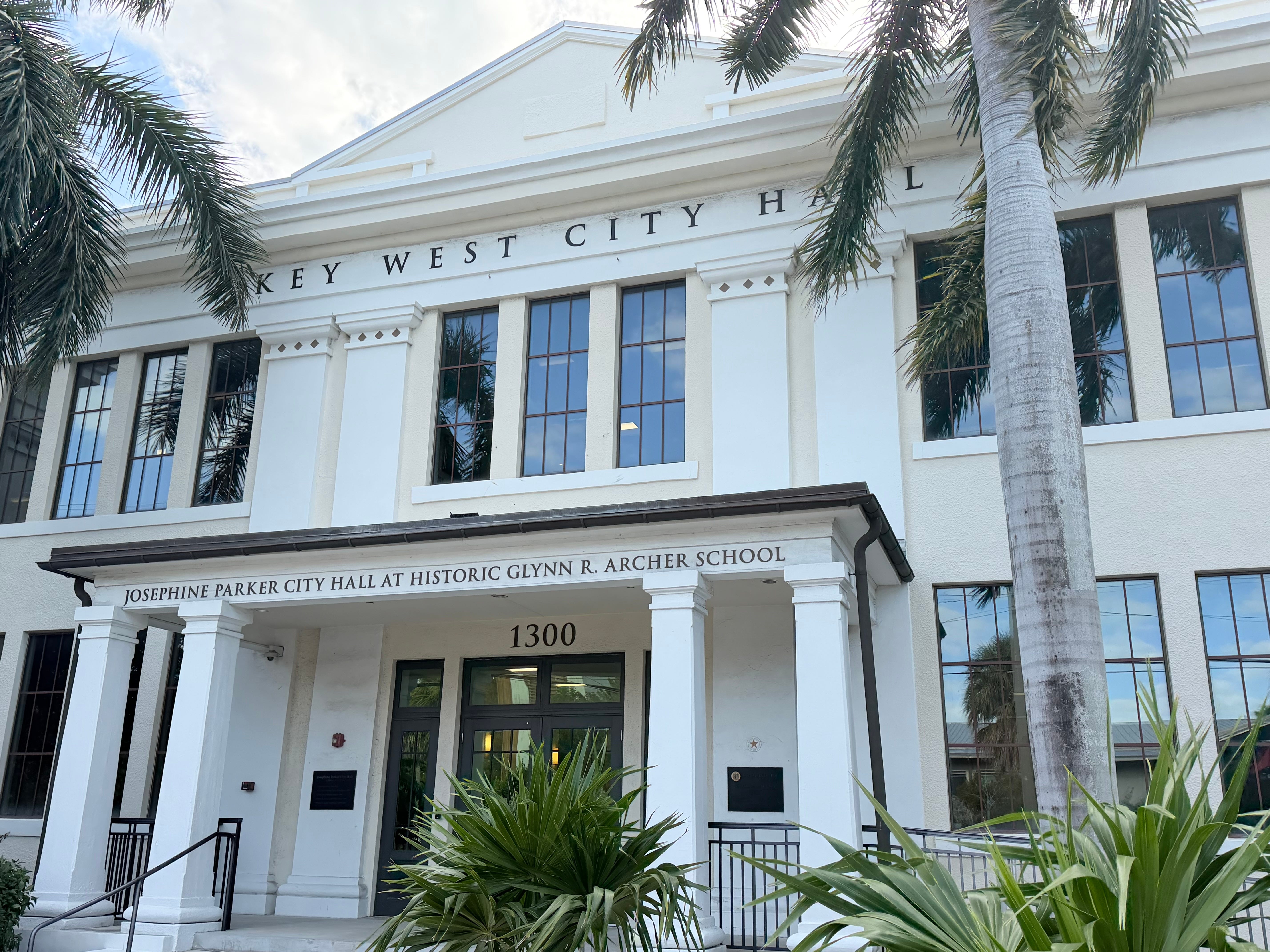

KEY WEST, Fla. — There is a peculiar bit of bureaucratic logic headed for the Key West City Commission on Thursday.
The city has a Parks and Recreation Advisory Board that hasn’t been adequately empowered to challenge Parks and Recreation, Public Works or City Engineering.
So naturally, City Manager Brian Barroso’s solution is to kill the board.
You can’t make this stuff up.
Instead of asking why a citizen advisory board hasn’t been given enough influence over decisions involving millions of dollars and some of the most valuable public land on a very small island, commissioners are being asked to replace it with an informal public-input process administered by the Parks and Recreation Department.
In other words, the department would administer the public’s advice to the department.
And the rationale offered by outgoing Commissioner Lissette Carey may be even more troubling than the proposal itself.
Carey has argued that eliminating the board would make the process more efficient and free it from the burden of Florida’s Sunshine Law.
The burden of the Sunshine Law.
There it is.
That pesky law requiring government business to be conducted where citizens can watch it, records are created and the people making recommendations can’t gather privately and work everything out among themselves.
Yes, Sunshine can be inconvenient.
That’s the point.
Democracy is inconvenient. Public notice is inconvenient. Minutes are inconvenient. Residents showing up and asking uncomfortable questions can be spectacularly inconvenient.
The alternative is certainly more efficient.
So is deciding everything in the parking lot.
Florida’s Sunshine Law exists because efficiency isn’t the only thing that matters when government conducts the public’s business.
And Carey, of all people, should know a little something about that.
The “Burden” of Sunshine
Carey wasn’t some distant observer of the investigation that began with possible Sunshine Law violations and ultimately produced a sprawling grand jury examination of Key West City Hall.
Her own communications became part of the record.
The grand jury report reproduced a text from former City Attorney Ron Ramsingh telling Carey she could move to remove the Corradino report from a City Commission agenda. Carey responded that she would think about it.
BACKGROUND
What Is the Corradino Report?

Well before federal agents and state prosecutors began issuing subpoenas and conducting interviews at Key West City Hall, an independent consultant’s report documented the structural failures that would later form the backbone of a widening public-corruption investigation.
The Corradino report concerned allegations involving Ramsingh’s brother, then-Chief Building Official Raj Ramsingh, and the Building Department.
The grand jury ultimately recommended that Carey resign.
She did not.
The investigation also resulted in felony charges against Ron and Raj Ramsingh and former Code Compliance Director Jim Young. Subsequent cases brought additional charges against the Ramsingh brothers.
Those charges remain allegations unless and until proven in court, and the defendants are entitled to the presumption of innocence.
But the grand jury’s examination of how City Hall operated doesn’t disappear while the criminal cases remain unresolved.
So if anybody on the dais should understand why Florida conducts public business in the Sunshine, it is Lissette Carey.
She has seen firsthand what happens when government business, private influence and public decision-making become tangled together outside public view.
She has read the same grand jury report the rest of us have.
She appears in it.
Now she wants to describe Sunshine as a burden.
That’s quite a stretch.
Anyone who has read the reports and discovery in what we have affectionately come to call the Bubba Bozo affair understands precisely why Sunshine exists.
BACKGROUND
Three Key West Employees Indicted

The Key West City Commission will meet in a special session on Monday, April 21 at 5 p.m. The meeting will be televised.
The lesson wasn’t that Key West had too many public meetings.
It was that City Hall needed more sunlight, more records and more people willing to ask uncomfortable questions.
Yet here we are, barely removed from one of the most extraordinary examinations of Key West municipal government in recent memory, considering eliminating a citizen advisory board partly in the name of escaping open-government requirements.
When was the last time you heard of a city having two grand jury reports issued within a year’s time?
That’s not learning from history.
That’s sending history an engraved invitation to come back.
Kaufman Created the Board
There is another bit of history worth remembering.
The Parks and Recreation Advisory Board exists because of an initiative championed by then-Commissioner Kaufman.
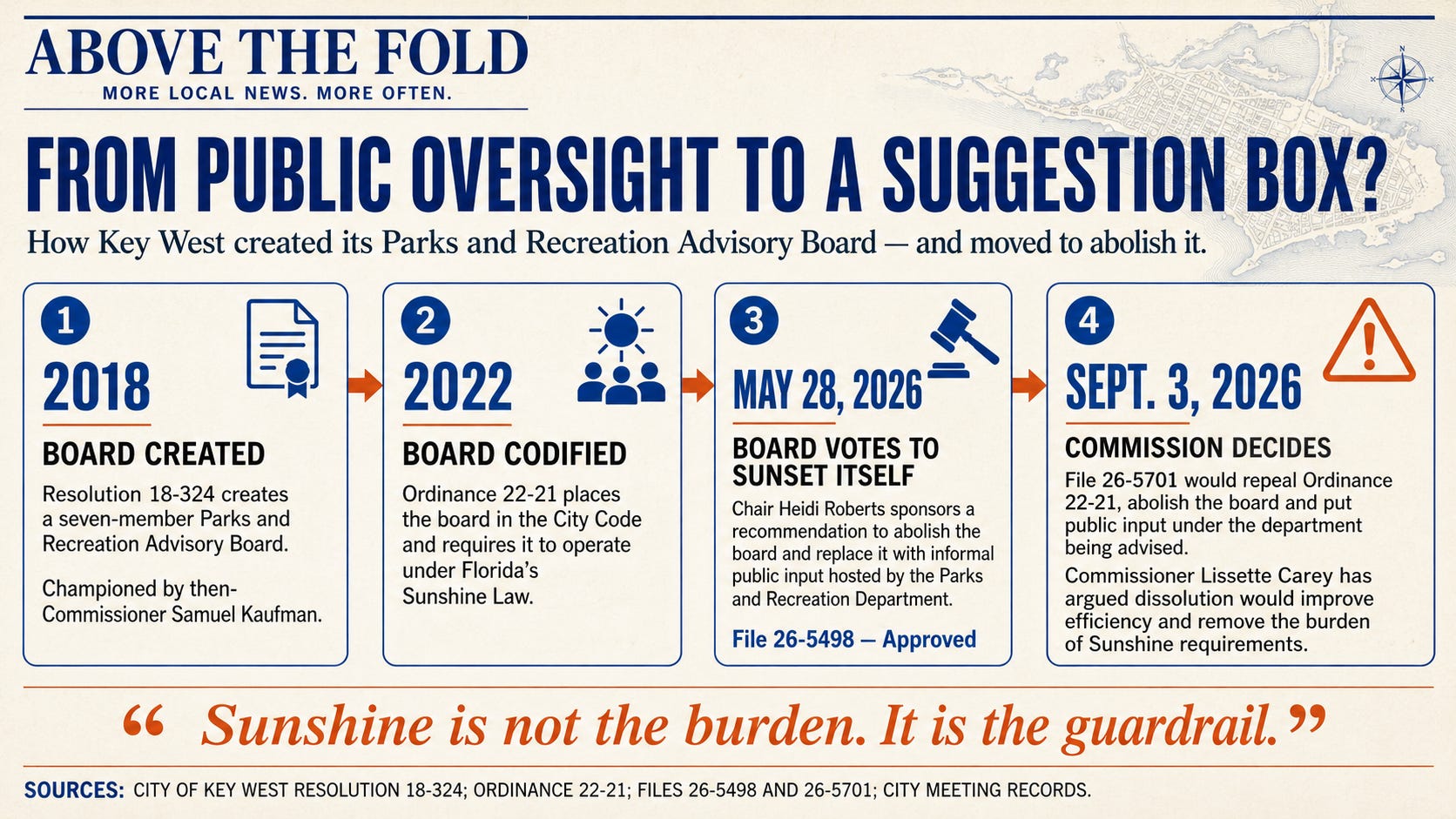
Resolution 18-324 created the seven-member board in 2018. Ordinance 22-21 later placed it in the City Code and required it to operate under Florida’s Sunshine Law.
The board’s stated mission is to promote the rehabilitation, conservation, development and best use of parks and recreational land and facilities within Key West.
That is precisely the work now confronting the city at Bayview Park and Higgs Beach.
On May 28, however, the board approved a proposal sponsored by Chair Heidi Roberts recommending that the City Commission sunset it and replace it with informal public input hosted by the Parks and Recreation Department.
The proposal is now embodied in File 26-5701, an ordinance sponsored administratively by City Manager Brian Barroso. It would repeal Ordinance 22-21, abolish the board and place public input under the department being advised.
The board didn’t fail because citizen oversight is unnecessary.
It failed because city staff too often treated its recommendations as optional background noise.
The answer to an advisory board being ignored isn’t to abolish the board.
It’s to make the advice harder to ignore.
And now Kaufman, newly sworn in as mayor, faces a direct test.
Will he allow City Hall to dismantle the public-oversight mechanism he helped create?
Or will he and the other six commissioners fix it?
Bayview Park Is Exhibit A
Bayview Park demonstrates why an empowered advisory board matters.
For years, the city discussed a master plan. Residents were surveyed. Meetings were held. Neighbors and park users were asked what they wanted.
People participated.
They gave City Hall their two cents.
Then came the familiar pivot:
Thanks very much for your input. Here’s what you’re getting.
Bayview Park Plan Sparks Sharp Debate as City Attorney Confirms Open Carry Legal in Key West Parks

A Parks and Recreation Advisory Board meeting that began with routine approvals quickly turned tense Monday night, as members clashed over whether the City of Key West is advancing a Bayview Park redevelopment without a fully developed master plan. The friction emerged shortly after Assistant City Attorney Ryan Waterhouse delivered a stark reminder that…
In June 2025, the City Commission approved $987,738 to purchase and install artificial turf at Pepe Hernandez Field.
Then-Commissioner Kaufman tried to postpone the project and preserve $317,808 for a professional master plan addressing Bayview Park comprehensively — its elements, costs and phases — with community involvement and long-term planning.
That effort failed.
The turf went in.
When the $987,738 purchase later appeared before the Parks and Recreation Advisory Board, staff withdrew the item.
The city’s own agenda — not Above the Fold’s characterization — said the purchase would be made through a Sourcewell contract “without formal competitive procurement” under the city’s cooperative-purchasing exemption.
As of today, the fake grass is the only visible piece of that grand Bayview Park vision City Hall has completed.
The broader second phase — including restrooms, a pro shop, maintenance facilities, basketball improvements, tennis shade and sidewalks — remained in design with an estimated construction cost of $2.5 million in the city records reviewed by Above the Fold.
Residents were invited to help imagine a better Bayview Park.
City staff listened carefully, nodded thoughtfully and built the one thing nobody seemed to want except, curiously, the department determined to push it forward:
The fake grass.
Welcome to the Astroturf Reckoning
We’ve been down this plastic road before.
In 2021, Key West approved $674,000 for AstroTurf at George Mira Field.
Community Services, which includes Public Works and Parks and Recreation, has been on what increasingly looks like a mission to replace every square inch of living grass on the island with artificial turf, frequently sold on promises of reduced maintenance, reduced watering and long-term savings.
Fine.
Show us.
How much money has Key West actually saved?
Not projected savings.
Not manufacturer claims.
Not consultant estimates.
Not a PowerPoint.
Actual savings.
Show taxpayers the maintenance costs before and after. Show us the water savings. Show us what it costs to clean, disinfect and repair artificial turf. Show us the expected replacement costs.
And if eliminating mowing was supposed to reduce labor costs, how many positions have been eliminated or reassigned because those fields no longer need mowing?
Show us the receipts.
Perhaps Public Works would be better served inventing a shovel that can stand up by itself.
The MyPillow Guy of Artificial Turf
Then there is Marcus Davila’s starring turn as the MyPillow guy of artificial turf.
Davila, Key West’s senior director of Community Services, appeared on a city athletic field wearing a City of Key West polo shirt and delivered what Brock USA itself labeled a “testimonial” for its Brock shock pads and BrockFILL organic infill.
This wasn’t a neutral city presentation comparing products, prices or competing turf systems.
It was a commercial endorsement.
“BrockFILL has been a game changer for the City of Key West,” Davila said. “I would never use rubber on any field — I would only use BrockFILL. I can’t thank you enough for putting a phenomenal product out there.”
All that was missing was a toll-free number and a promise to double the order if viewers called within the next 10 minutes.
Brock USA then used the city director’s name, title, municipal affiliation and endorsement to promote its products on YouTube, Facebook, Instagram and LinkedIn.
The company’s YouTube title left little room for ambiguity:
“Key West Community Services Director Marcus Davila’s Testimonial for Brock shock pads and infill.”
Testimonial.
Their word.
Not mine.
The City of Key West has policies governing employees’ official social-media activity, professional conduct and the use of city resources. Unless Davila’s appearance and the commercial redistribution of his endorsement were expressly authorized in writing, the video appears inconsistent with those policies.
So show us the authorization.
Who approved Davila’s participation? Was the city’s Public Information Office involved? Did anyone review the script or final video? Did the written approval authorize Brock USA to use Davila’s city title, city clothing, city facility and endorsement in commercial marketing across multiple social-media platforms?
Did the approval permit Davila to say he would “only use BrockFILL” when his department helps recommend products purchased with public money?
And did anybody at City Hall consider how that endorsement would look alongside Key West’s repeated artificial-turf purchases?
Maybe written authorization exists.
Great.
Produce it.
If it doesn’t, the city has a different problem.
Because a department director responsible for public facilities should not be moonlighting as the MyPillow guy for a company selling products to the government he serves.
That’s not an accusation.
That’s oversight.
And it’s precisely the kind of questioning an empowered Parks and Recreation Advisory Board ought to be doing.
Sourcewell on Speed Dial
The optics become more interesting when you examine how some of these purchases reached City Hall.
Key West has used cooperative-purchasing contracts, including Sourcewell, instead of conducting a separate local solicitation for each project.
Sourcewell is a Minnesota government cooperative that competitively solicits contracts for participating public agencies.
So the purchase wasn’t made without competition altogether.
But the underlying vendor competition occurred under Sourcewell’s solicitation in Minnesota — not under a separate solicitation designed and advertised by Key West for the specific project.
Sourcewell is headquartered in Staples, Minnesota, roughly 1,700 miles from Key West.
Apparently distance doesn’t matter when Community Services has Sourcewell on speed dial.
The purchasing mechanism may be perfectly legal.
But legal, wise and right aren’t always synonyms.
A competition conducted in Minnesota isn’t the same thing as putting a Key West project on the street and allowing local, regional and statewide businesses to offer alternatives.
Using Sourcewell can mean the basic vendor competition occurred before Key West decided to make the purchase, leaving less opportunity at the project level for competing contractors or suppliers to say:
We can do it better.
We can do it cheaper.
Or maybe you don’t need to do it this way at all.
When you’re spending hundreds of thousands of taxpayer dollars, those conversations are worth having.
Show taxpayers how the product was selected. Show us the Sourcewell competition. Show us the alternatives considered specifically for Key West. Show us the price comparisons, lifecycle costs and actual maintenance savings.
And explain the testimonial.
Because “we can buy it through Sourcewell” answers a procurement question.
It doesn’t answer the policy question.
Should we?
Then There Is Higgs Beach
Key West Advances $188,130 Higgs Beach Plan with No Estimate to Build It

When Key West took control of Higgs Beach on May 1, city officials said local ownership would give residents a greater voice in the future of one of the island’s most important public spaces.
If Bayview Park is the warning, Higgs Beach is the test.
The city has taken control of more than 16 acres at Higgs Beach, one of the most important pieces of public recreational land in Key West.
And other than the City Manager and former Mayor, as well as County Commissioner’s Craig Cates and Jim Scholl, it is not really clear who thought it was a good idea to take the dilapidated property.
On Thursday, commissioners are being asked to approve $188,130 in professional design services to advance a staff-generated concept through schematic design and planning approvals.
The concept includes 16 standard pickleball courts and one tournament court.
Seventeen pickleball courts.
Pickleball is popular.
Nobody disputes that.
But Key West is an island with finite public land. Every acre devoted to one use is unavailable for something else.
So demonstrate the demand.
How many players? At what times? How heavily are the existing courts used? Why 17? Why not 12? Why not eight? Why a tournament-scale facility? What other uses are displaced?
The city has not published a court-utilization study, demand analysis, neighborhood noise study, traffic plan or public survey supporting a 17-court complex.
Those aren’t anti-pickleball questions.
They’re planning questions.
And here’s another:
Why 17 pickleball courts and not one basketball court?
Zero.
I’ve traveled a fair amount, and I can’t remember seeing a public park of this size that found room for 17 pickleball courts but couldn’t find room for one basketball court.
Basketball is among the most accessible forms of public recreation there is.
A ball.
A hoop.
Open space.
The choices we make about what goes into public parks — and what doesn’t — say something about whose recreation we value and who we imagine using public space.
Maybe 17 pickleball courts and no basketball court is exactly what Key West wants.
But nobody should assume it.
Ask.
Apparently Even the Dogs Need Astroturf
Then there is the proposed dog park.
Artificial turf.
Again.
Apparently even the dogs are being drafted into the Astroturf revolution.
Before covering another piece of Key West in faux grass, somebody ought to ask how an artificial-turf dog park works in South Florida.
Where does the urine go? How frequently must the surface be flushed? What happens to bacteria and odor? What infill is proposed? How hot does it get in August? How will it be disinfected? Where does the cleaning water drain?
And what does all of that cost over the life of the surface?
Those questions become more important because historical African graves have been identified around the dog-park area. The proposal prohibits excavation and calls for improvements above the existing grade.
Drainage, attachment, waste removal, flooding and storm performance aren’t details to be figured out later.
They are central planning questions.
They are also precisely the questions taxpayers should expect somebody to ask before the city begins spending millions of dollars changing public land.
Then Rolling Stone Showed Up
This week provided an even better reason for City Hall to pump the brakes before getting too excited about “moving Higgs Beach forward.”
Somebody else is watching.
A little upstart publication that hasn’t ever influenced anything.
Rolling Stone magazine.

The Straits of Florida are glistening. The Key West Orchid Society is holding its annual show at West Martello. A purple flower is competing for a prize.
Just across the sidewalk is an unkempt patch of grass.
Beneath it are six unmarked graves.
Across Atlantic Boulevard are more than 100 more.
Dogs play nearby.
Wu does something City Hall desperately needs to do before drawing more lines on a Higgs Beach master plan.
He makes you look at the place differently.
This isn’t simply 16-plus acres of recreational real estate waiting to be divided among pickleball courts, a dog park, hockey rink, artificial turf, parking spaces and whatever else can be squeezed onto a rendering.
It’s a cemetery.
Wu reports that officials have known for years that Africans who died after being rescued from illegal slave ships were buried at Higgs Beach, including remains identified beneath or near areas later used for recreation.
Victoria Davies’ companion Rolling Stone piece provides the deeper historical account of the burial ground and the 295 Africans who died after arriving in Key West.
Together, the stories ought to be required reading before anyone votes to spend another dollar planning Higgs Beach.
Maybe this isn’t the moment to step on the accelerator.
Maybe it’s time to pump the brakes.
Mr. Mayor and Commissioners: This Is Your Opportunity
The new commission has an extraordinary opportunity to get right what Monroe County never could: meaningful recognition for the people buried in the African cemetery at Higgs Beach.
There are likely more graves than those already identified. The cemetery’s full extent may never be known with certainty, making the obligation to protect it even greater.
Please don’t give us another plaque people walk past.
Not another historical footnote wedged between recreational amenities.
Not another promise to deal with it someday.
Make the cemetery central to Higgs Beach.
Give those buried there the dignity, prominence and permanence that more than a century of Key West history denied them.
And if honoring an African cemetery means giving up the 14th, 15th, 16th or 17th pickleball court, so be it.
This isn’t an argument against pickleball.
It’s an argument against treating excess recreational capacity as more important than an African cemetery.
The cemetery should not be treated as an obstacle to be designed around, minimized or buried beneath another amenity.
The inconvenience isn’t the graves’ — or the slaves’ —fault.
It’s the consequence of a plan that failed to account for the people already there.
And let’s ask the uncomfortable question nobody at City Hall should be permitted to dodge:
If the people buried there were white, would we be having this conversation?
If this were the resting place of prominent 19th-century white Key West families, would we debate whether their graves were inconveniently located near the 14th, 15th, 16th and 17th pickleball courts?
Would we build a dog park over the Wharton or Spottswood Toppino graves at the Key West Cemetery?
Of course not.
Maybe Public Works could suggest putting plastic grass over the cemetery byways while we’re at it.
And use BrockFILL.
Think of the maintenance savings.
Absurd?
Exactly.
If these were the graves of prominent white Key West families, there would be monuments, landscaped grounds, interpretive signs and solemn speeches about preserving Key West history.
Marble edifices.
Nobody would dream of letting dogs run over their graves.
But these were Africans.
People brought across the Atlantic in the holds of slave ships, rescued from an illegal trade and brought ashore in Key West, only to die here and be buried far from home.
Most of them children.
Their resting place deserves no less dignity because of the color of the people buried there.
If anything, the ease with which their graves were forgotten makes Key West’s obligation greater.
The county had years to get this right.
It never did.
Now the City of Key West has the opportunity.
Don’t squander it.
Who Is Making the Decisions?
While we’re talking about whose priorities make it onto a city master plan, City Hall should take a look at itself.
Does the leadership of the City of Key West reflect the ethnic and racial diversity of the community it governs?
That’s not a question Above the Fold should answer by studying photographs and surnames and assigning people ethnicities.
It’s a question City Hall should answer with actual demographic data.
How many department directors and senior administrators identify as Black? How many as Hispanic or Latino? How many represent other minority communities? How does that compare with the people who live here?
Representation matters when government decides whether an African cemetery receives the recognition it deserves.
It matters when government decides a public park needs 17 pickleball courts and no basketball court — where all kids can play.
And it matters when residents say they want one thing and the bureaucracy decides they’re getting something else.
If City Hall’s leadership reflects Key West’s diversity, terrific.
Show us.
If it doesn’t, that’s another conversation worth having in the Sunshine.
The Barroso Reign of Error
This is bigger than parks.
For too long, Key West developed a governing culture in which residents, advisory boards and even elected commissioners could express their will, only to discover that the bureaucracy had ideas of its own.
Then came the message:
This is what you’re getting. That is the way we have always done things.
Now please like it so we can “keep the city moving forward.”
That became a hallmark of the Henriquez administration and City Manager Brian Barroso’s tenure.
Call it the Barroso reign of error.
There is a difference between moving a city forward and merely keeping the bureaucracy moving and completing projects, putting your name on it and calling it progress.
Government isn’t a runaway Conch Train where everybody must remain seated because somebody up front decided using the brakes would make the tour late.
Sometimes you need the brakes.
Sometimes somebody needs to yell that the bridge is out.
That’s what advisory boards can do.
That’s what residents can do.
We saw that on Aug. 18.
And, most importantly, that’s what commissioners are elected to do.
The days of employees being afraid to speak their minds because they worry the city manager might “go Barroso” on them need to end.
Employees and department heads should be able to speak candidly. Advisory-board members should challenge staff. Residents should question projects.
And when the City Commission gives lawful policy direction, the administration should carry it out.
Fear is a lousy management technique.
So is arrogance.
Obfuscation Learns Excel
Want an example of City Hall’s ability to declare an inconvenient problem solved?
You don’t even have to leave the city’s website.
The grand jury recommended that Commissioner Lissette Carey resign.
Carey did not resign.
Yet the city’s spreadsheet tracking its response to the grand jury recommendations marked the item calling for Carey’s resignation:
100% complete.
Mission accomplished.
Except for one tiny detail.
The Queen of Ummm still resides on the dais once a month, at least until the next District IV commissioner is seated following the November election.
If a grand jury recommends that a commissioner resign, the commissioner refuses and City Hall nevertheless marks the recommendation complete, what exactly does “complete” mean?
Perhaps the city received the recommendation.
Perhaps somebody put it into a spreadsheet.
Perhaps the cell turned green.
But it sure as hell doesn’t mean Lissette Carey resigned.
This is what obfuscation looks like when it learns Excel.
The New Commission’s First Test
The Henriquez Era is over.
Samuel Kaufman is mayor.
Thursday gives Kaufman and the new commission one of their first opportunities to demonstrate that the change voters demanded wasn’t merely a change of names behind the dais.
It was a change in who works for whom.
The city manager works for the City Commission.
The administration is accountable to the commission.
The commission works for the voters.
And City Hall works for the public.
That’s the chain of command.
Not the other way around.
The days of the City Commission serving as a rubber stamp for staff recommendations need to be over.
Staff advises.
Commissioners decide.
When staff arrives with a nearly finished plan, a preferred product and another demand to “keep the city moving forward,” commissioners should remember that asking questions isn’t obstruction.
It’s their job.
And it is also their job to read the backup on agenda items and come prepared.
So don’t abolish the Parks and Recreation Advisory Board.
Fix it.
Require significant parks projects to go before the board before staff has effectively selected the outcome.
Require Parks and Recreation, Public Works and Engineering to appear and answer questions.
Require major alternatives to be presented and genuine public participation before substantial money is committed.
Send the board’s recommendations directly to commissioners.
When staff rejects one, require a written explanation.
Put it in the record.
Put it in the Sunshine.
Replacing an independent citizen advisory board with a public-input process administered by the very department the public is supposed to advise isn’t reform.
It’s a suggestion box.
Sunshine isn’t the burden.
It’s the guardrail.
Bayview Park was the warning.
Higgs Beach is the test.
Don’t abolish the Parks and Recreation Advisory Board because City Hall failed to listen to it. Give it the authority to ask questions, challenge staff and force the answers into the public record.
Give it teeth.
Then let it chew.
The days of conducting the public’s business in the shade are over.
Let the Sunshine in.
The reef-safe sunscreen is on Aisle 6. Might be time for 1300 White Street to invest in a case.

Don’t want to become a paid subscriber?


