


KEY WEST, Fla. — “Facts are stubborn things,” John Adams told a jury in 1770, risking his life to defend British soldiers implicated in the Boston Massacre and urging jurors to weigh evidence rather than their feelings about the people involved.
For a long time, this has been one of my favorite historic quotes by a founding father — right up there with Ben Franklin saying “It looks like thunderstorms are rolling in.”
There are a couple of Key West city commissioners who should take a leaf from history and weigh the evidence rather than waxing nostolgic.
The Key West City Commission voted 4-3 Tuesday to authorize City Attorney Mayanne Downs to negotiate an “amicable separation agreement” with City Manager Brian Barroso.
Downs is directed to report on the talks at the Oct. 1 city commission meeting.
The resolution authorizing the negotiations was brought forward by hometown boy and Conch favorite Donie Lee, the vice mayor and former Key West police chief. This is how a faction of the Conch community — seemingly more concerned with convincing people they elected the wrong mayor than acknowledging they hired the wrong city manager — paid Lee back on social media:
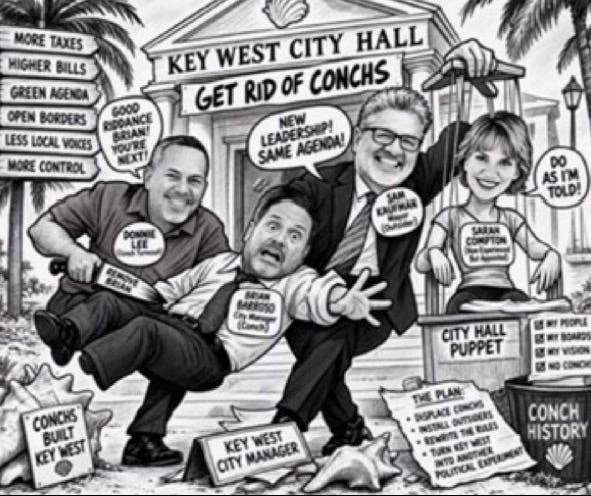
And I am sure the hate-filled, hurtful messages continue as I write this because Donie Lee tried to do what he thought was best for city hall, employees and residents of Key West.
While the vote did not remove Barroso or approve a settlement, it opened the door for another episode of “As the Conch Shell Turns.”
The War of the Roses (IMDB 1989)
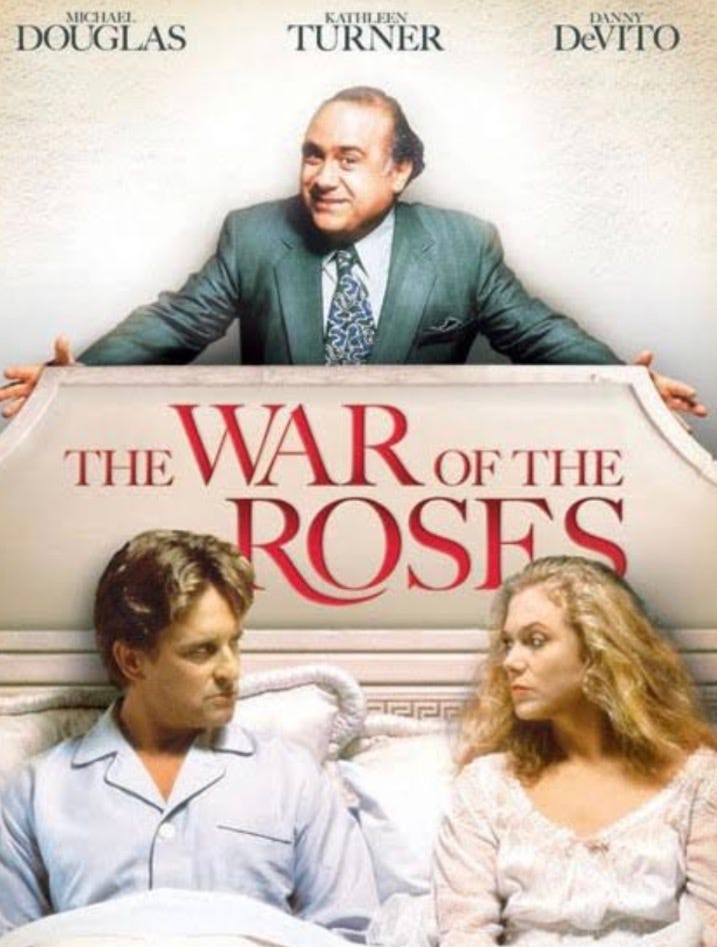
Although an agreement may offer a way forward, commissioners Lissette Carey, Aaron Castillo and Mark Rossi appear more interested in serving as marriage counselors for Barroso and Mayor Sam Kaufman — and telling Key West what a good person they believe Barroso to be — than in addressing the documents Kaufman has shared with the dais, Downs and Barroso.
The problem is that one of those involved, in his own words, practices divorce law for a living.
“This is not a personality conflict,” Kaufman told the commission. “I practice divorce law for a living. Nobody seems to want to read the facts that I documented over the last two years. I don’t want to litigate those facts here at this meeting, but they deserve investigation and you should read them.”
If they have read those documents, they should address their contents. If they have not, they should read them before deciding what terms the city might offer. Residents should read them, too, because they are compelling enough to suggest that termination for cause might be the best course of action.
Barroso weepily says — wringing every bit of sympathy out of his three allies on the dais — he wants to stay as Key West’s chief executive.
Unfortunately it would appear that ship has sailed. But that is another movie.
The election in November should settle Barroso’s fate once and for all.
Assuming Barroso is able to extend his reign of error, Sarah Compton deliver the vote to terminate him — one way or another. If Wayne Garcia wins, the votes may be there but it will likely be a slimmer margin given his hesitancy to vote against family.
Kaufman’s Account of Sept. 1
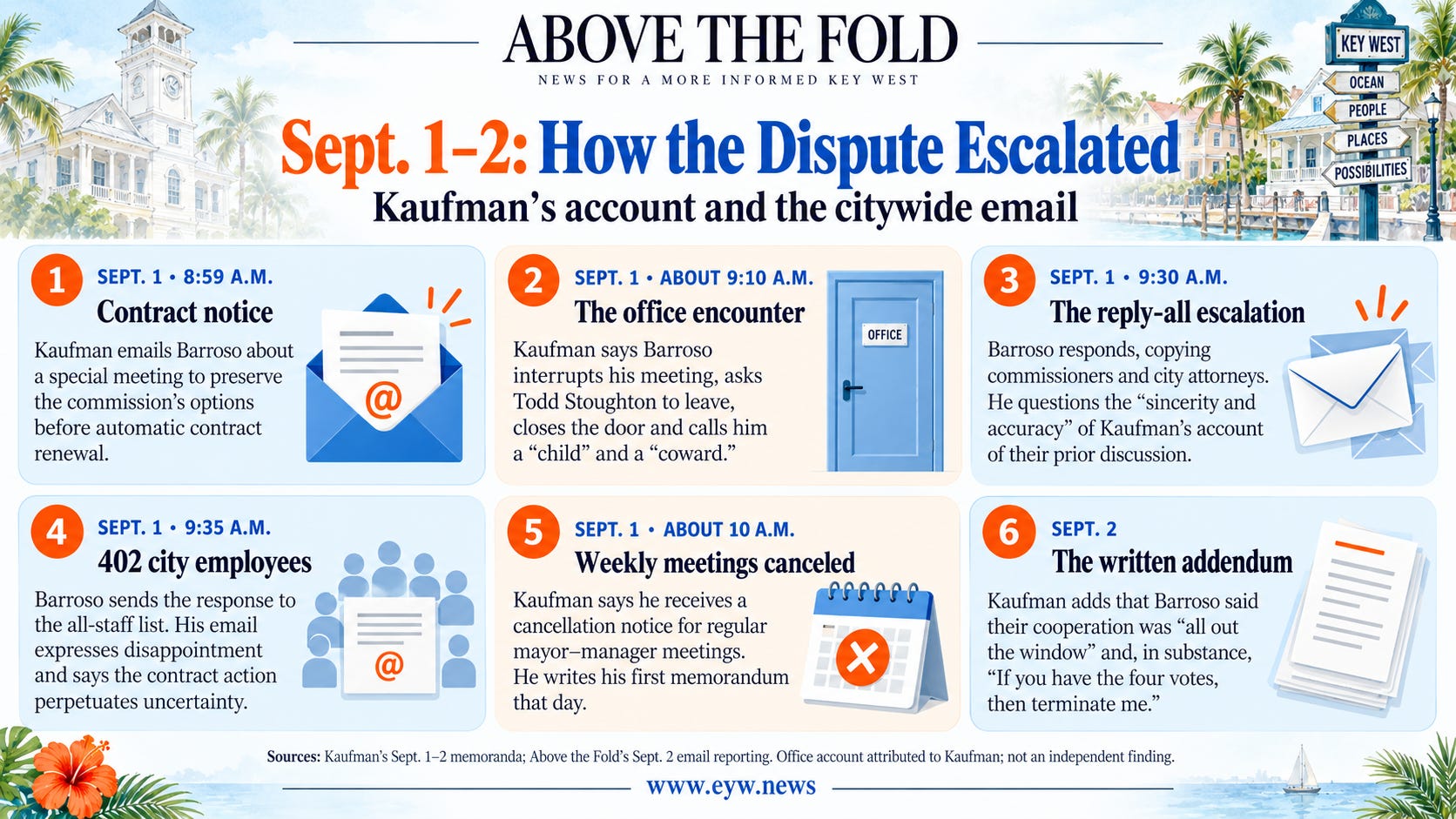
In a Sept. 1 memorandum and Sept. 2 addendum, Kaufman described an encounter shortly after he notified Barroso of a proposed meeting on the renewal provision in the manager’s contract.
Kaufman wrote that Barroso entered the mayor’s office while he was meeting with city employee Todd Stoughton, asked Stoughton to leave and closed the door. Kaufman said Barroso raised his voice, called him a “child” and a “coward,” and said their conversation the previous day about working together was “all out the window.” According to the addendum, Barroso also told Kaufman, in substance, “If you have the four votes, then terminate me.”
Kaufman wrote that he asked Barroso to leave and later received notice that their regular weekly meetings had been canceled. His memoranda are an account recorded close to the encounter, not an independent finding. Barroso’s response, the relevant communications and firsthand witnesses all matter.
The Contract Choice
Kaufman’s statement prepared for the Sept. 3 commission meeting explains why he sought that meeting. He wrote that Barroso’s contract would automatically renew for two years unless the city gave notice by Sept. 9. The proposed notice, Kaufman said, would preserve the commission’s options; it would not itself fire Barroso or change the agreement.
The proposal failed 4-3. Carey, Castillo, Rossi and Lee voted against giving notice. After that deadline passed, Lee proposed the separation talks the commission authorized Tuesday.
Commissioners should explain that sequence and scrutinize any proposed financial terms before approving an agreement at public expense.
The Questions Beyond a Separation Agreement
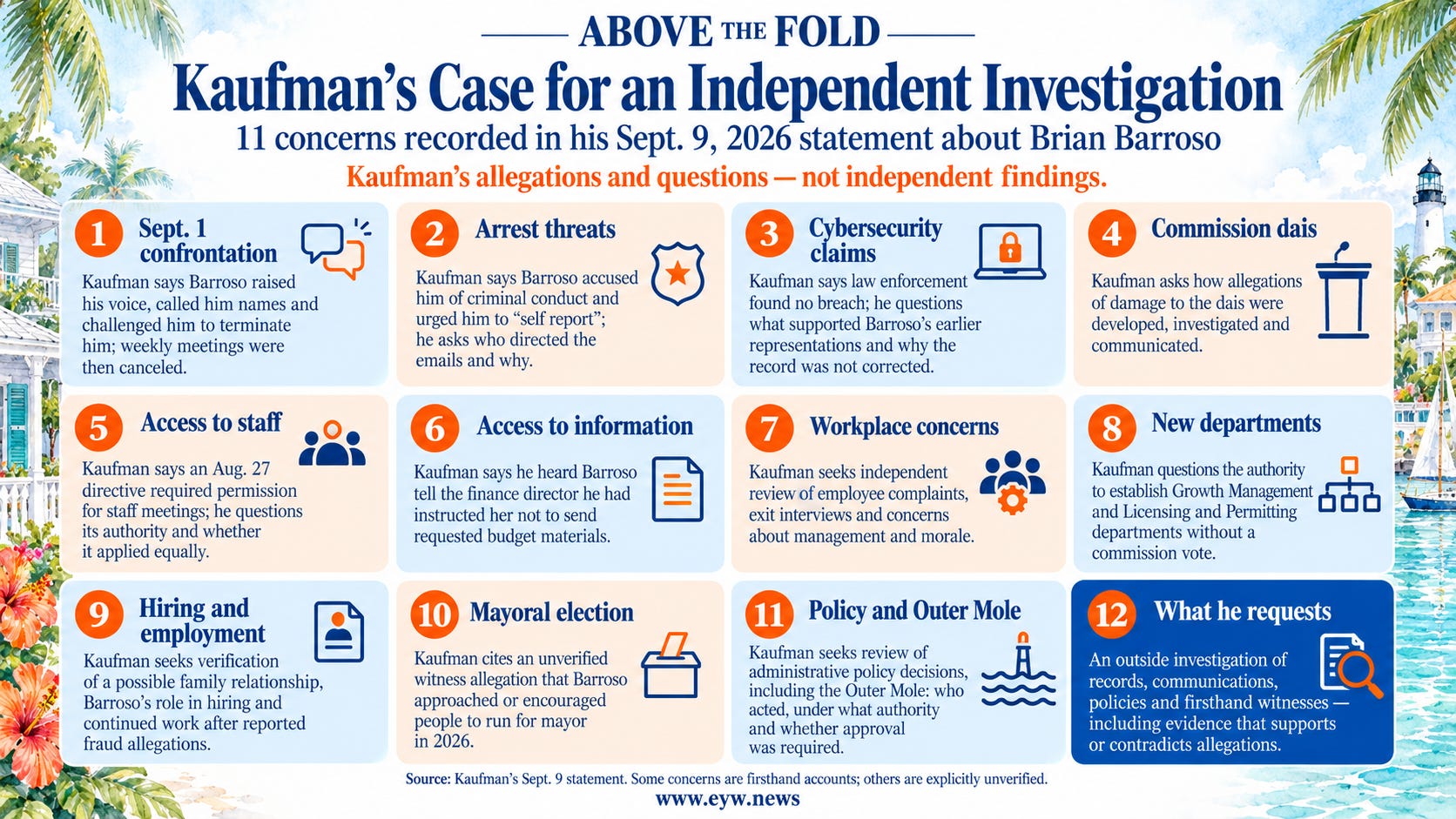
In his Sept. 9 statement, Kaufman requested an independent outside investigation. He raised questions about access to city staff and information, representations concerning an alleged cybersecurity breach, workplace concerns and the authority behind certain organizational, personnel and policy decisions.
Kaufman distinguishes matters he says he witnessed from allegations he has not independently established. He appears likely to continue seeking an independent investigation alongside the separation talks, including an examination of whether evidence could establish grounds for termination for cause. That is a potential course, not a finding that cause exists. An investigation would have to test the allegations fairly and consider evidence that supports or contradicts them. The commission would then have to decide what action, if any, the findings warrant.
Employee exit interviews and workplace complaints deserve examination alongside Kaufman’s other concerns. Any fresh review should assess the underlying records, witness accounts and conclusions of previous investigations, giving full weight to findings favorable to Barroso while identifying any questions left unanswered.
The commission should publicly select a qualified investigator, require disclosure of potential conflicts and establish a clear scope and reporting process. Responsibility for that selection should rest with the full commission rather than be left solely to part-time contract City Attorney Mayanne Downs. Independence must be demonstrated through the investigator’s relationships, authority and methods; hiring an outside law firm alone does not establish it.
A negotiated departure and an investigation answer different questions. The first addresses whether Barroso and the city can agree on terms. The second addresses what happened at City Hall. Pursuing one should not quietly dispose of the other.
The Grand Jury’s Warning
THE FRAUDULENT AND CORRUPT ACTS OF THE BUBBA BOZO TRIO

Well, the Monroe County State Attorneys Office released the grand jury report delving into corruption at 1300 White Street and the dirty dealings by the Bubba Bozo Trio of disgraced (and likely disbarred) City Attorney Ron Ramsingh, his brother, former Chief Building Officer Raj Ramsingh, and now retired small-time thug, former Code Enforcement Director…
The Monroe County grand jury’s 2025 report criticized commissioners who relied on other people’s explanations rather than reading consequential documents and forming their own judgments. It specifically faulted Carey for failing to read the Corradino Report before acting to remove it from a commission agenda. It also criticized former commissioners who admitted they had not read, or had not thoroughly read, that report.
The grand jury’s indictments of former City Attorney Ronald Ramsingh, former Chief Building Official Rajindhar “Raj” Ramsingh and former Code Enforcement Director James Young preceded its final report. Those cases do not establish the truth of any allegation against Barroso. The grand jury’s warning about independent judgment does apply to how commissioners approach the records before them now.
Carey, Castillo and Rossi may admire Barroso and disagree with Kaufman. They still owe residents answers grounded in the documents. Before the commission approves a separation agreement — or decides whether to investigate possible cause for termination — the public should know what its members have read, what they dispute and how they reached their conclusions.
As Adams said, “Whatever may be our wishes, our inclinations, or the dictates of our passions, they cannot alter the state of facts and evidence.”
Facts are, after all, very stubborn things.
