

KEY WEST, Fla. — One of the most contentious mayoral elections in Key West history ended Tuesday with a decisive rejection of the incumbent and a dramatic reshuffling of political power at City Hall.
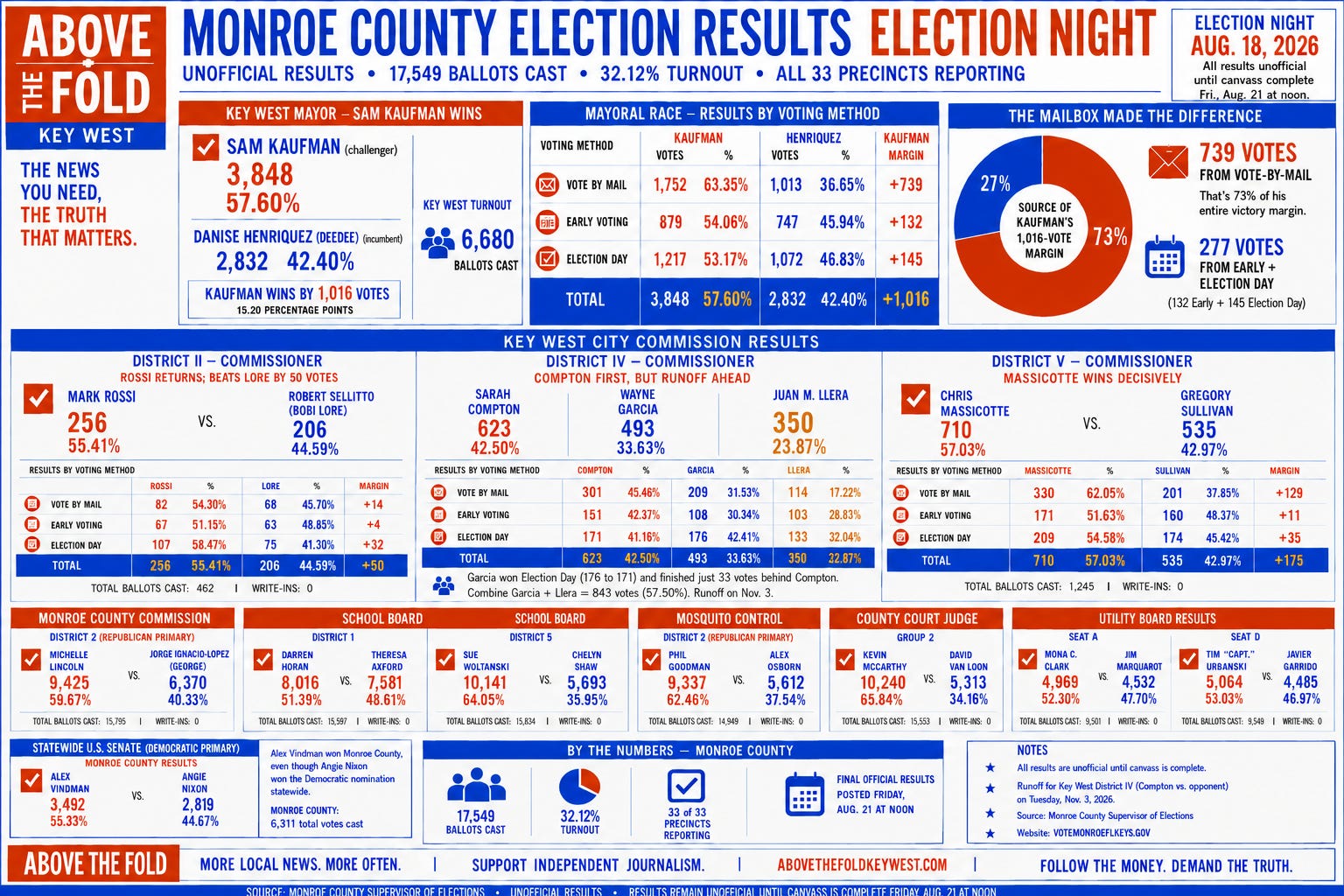
Commissioner Sam Kaufman defeated Mayor Danise Henriquez, 3,848 votes to 2,832, according to unofficial election-night results, ending a bruising campaign that had become about far more than two candidates competing for the mayor’s gavel.
Kaufman finished with 57.60% of the vote to Henriquez’s 42.40%, a margin of 1,016 votes, or 15.2 percentage points.
The campaign unfolded against months of bitter political divisions, extraordinary campaign spending, political committee involvement and increasingly sharp arguments over the direction of Key West government.
By Election Day, the contest had become a referendum not only on Henriquez’s first term, but on City Hall itself.
And voters delivered an unmistakable answer.
Kaufman won through every major method of voting.
He carried vote-by-mail ballots 1,752 to 1,013, building a 739-vote advantage before most Election Day voters ever reached the polls. He also won early voting, 879-747, and Election Day voting, 1,217-1,072.
The victory denied Henriquez a second term and elevated Kaufman from the District II commission seat he has held for a decade to the mayor’s chair.
It was the culmination of a mayoral campaign that will likely be remembered among the most contentious in the island’s long and frequently colorful political history.
Results were certified by Monroe County Supervisor of Elections, Sherie Hodies Friday afternoon.
A Campaign That Went Far Beyond Two Candidates
The battle for mayor played out amid a wider struggle over the future direction of Key West.
Political committees and business interests became increasingly visible during the campaign, spending money on advertising, mailers, text messages and other efforts intended to influence voters.
The result was an election season in which the traditional lines between individual candidate campaigns and the broader political machinery surrounding them became a significant part of the story.
Whether Tuesday actually ends that fight remains an open question.
The election results are scheduled to be certified Aug. 21. Until then, they remain unofficial.
And even after certification, another question hangs over the Key West results.
It remains unclear whether a well-funded political committee will seek to contest any of the city elections following a campaign in which PAC money played an unusually prominent role.
As of Friday morning, Above the Fold had confirmed no formal election contest or challenge.
Any potential challenge would also confront dramatically different margins. Kaufman defeated Henriquez by 1,016 votes, while the District II commission race was decided by just 50 votes.
The certification at noon on Friday made the results official. Whether it also brings an end to one of Key West’s most bruising election seasons remains to be seen.
Rossi Returns, Massicotte Wins, District IV Heads to November
The political realignment extended beyond the mayor’s race.
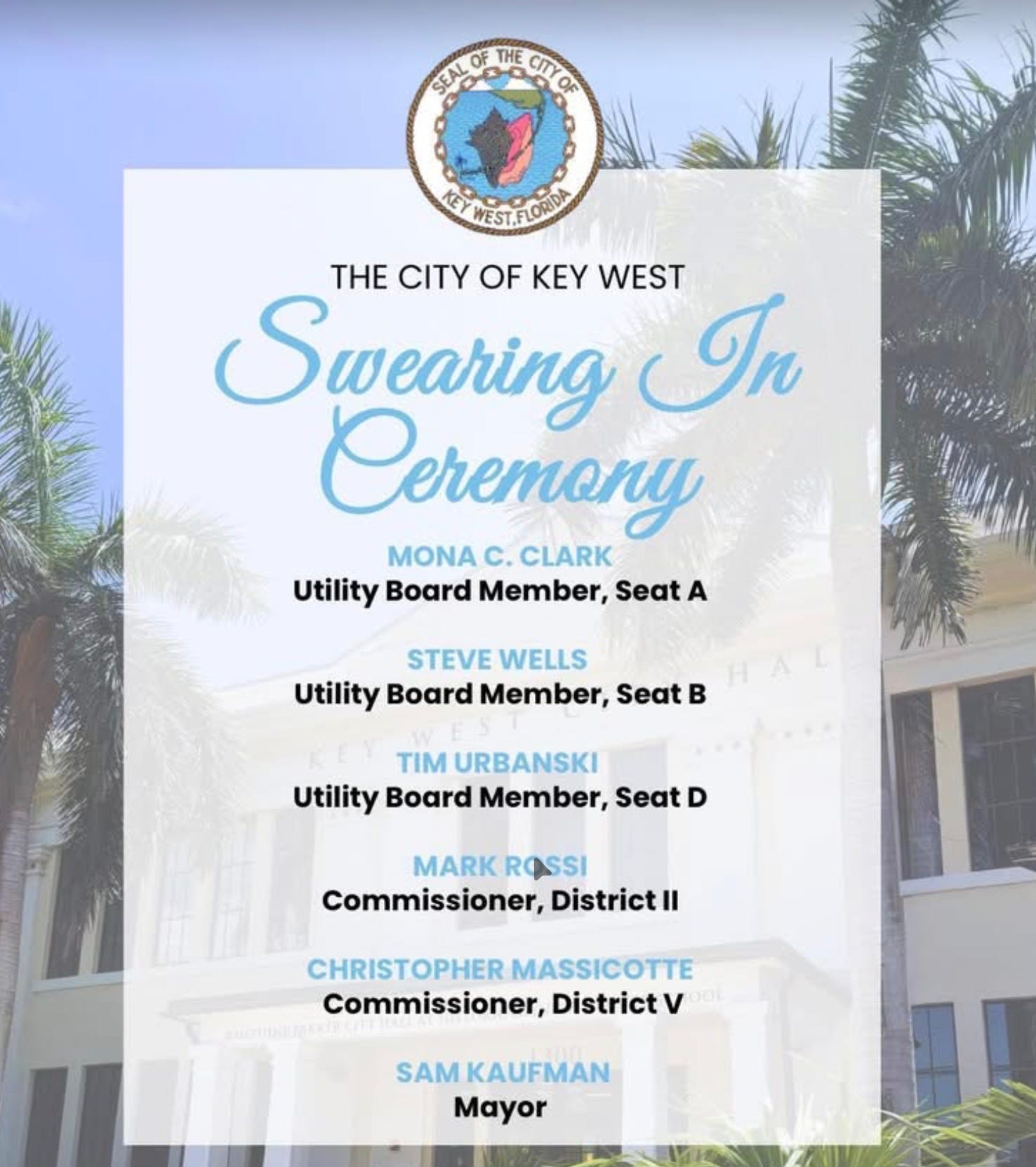
Kaufman’s move to the mayor’s chair opened District II, where former Commissioner Mark Rossi defeated Bobi Lore, 256-206.
Rossi received 55.41% to Lore’s 44.59%, winning by just 50 votes and producing the closest of Key West’s head-to-head city races.
In District V, Chris Massicotte defeated Greg Sullivan, 710-535.
Massicotte finished with 57.03% to Sullivan’s 42.97%, a margin of 175 votes.
But one Key West contest remains unresolved.
In the three-way District IV race, Sarah Compton finished first with 623 votes, or 42.50%. Wayne Garcia followed with 493 votes, or 33.63%, while Juan Llera received 350 votes, or 23.87%.
Because no candidate received the majority required to win outright, Compton and Garcia advance to a Nov. 3 runoff.
Garcia edged Compton among Election Day voters, 176-171, but Compton’s stronger vote-by-mail and early-voting performance gave her a 130-vote advantage overall.
Taken together, Tuesday represented a substantial reset of Key West government: a new mayor, a returning commissioner in District II, a new commissioner in District V and another new commissioner still to be selected in District IV.
Few election nights in recent Key West history have changed the composition of City Hall so dramatically at once.
Monroe County: Incumbents Hold Their Ground
Travel north from Key West, however, and the political landscape looked considerably different.
While Key West voters embraced change, Monroe County voters largely stuck with incumbents.
Republican County Commissioner Michelle Lincoln defeated challenger Jorge Ignacio-Lopez in District 2, taking 9,425 votes, or 59.67%, to Ignacio-Lopez’s 6,370, or 40.33%.
With no Democratic opponent waiting in November, Lincoln’s primary victory effectively returns her to the County Commission for another four-year term.
The Monroe County School Board produced a much tighter contest.
District 1 incumbent Darren Horan narrowly survived a challenge from former Monroe County Schools Superintendent Theresa Axford.
Horan received 8,016 votes, or 51.39%, while Axford received 7,580 votes, or 48.61%.
The margin was just 436 votes countywide.
In District 5, incumbent Sue Woltanski had a considerably easier night, defeating Chelyn Shaw, 10,141 to 5,693.
Woltanski received 64.05% of the vote.
Incumbent Phil Goodman also retained his District 2 seat on the Florida Keys Mosquito Control Board, defeating Alex Osborn with 62.46% of the vote.
In the nonpartisan County Court Group 2 race, Kevin McCarthy defeated David Van Loon, receiving 65.48%.
Utility Board races also produced winners Tuesday.
Mona Clark defeated Jim Marquardt for Seat A, 4,969-4,532, while Tim “Capt.” Urbanski defeated Javier Garrido for Seat D, 5,064-4,485.
TROPICAL DISTURBANCE: Ballot Box Brawls: 10 Elections That Built — and Bloodied — Key West Politics

KEY WEST, Fla. — Key West politics has never been a genteel business.
Tuesday’s Real Story
One of the more significant numbers Tuesday wasn’t attached to a candidate.
It was turnout.
Across Monroe County, 17,549 ballots were cast among 54,628 registered voters, producing turnout of 32.12%.
And that wasn’t merely strong turnout by South Florida standards.
WPLG Local 10 in Miami reported that Monroe County recorded the third-highest voter turnout by percentage among Florida’s 67 counties.
Nearly one in three registered voters in the Keys cast a ballot in the primary, a notable level of participation in an election cycle dominated locally by the Key West mayoral and City Commission races.
The numbers suggest that whatever else the increasingly bitter campaign accomplished, it got voters’ attention.
Monroe County Bucks Florida in Senate Primary
Keys voters also went their own way in one of Florida’s biggest statewide races.
In the Democratic primary for U.S. Senate, Alex Vindman won Monroe County, taking 3,492 votes, or 55.35%, compared with 2,819 votes, or 44.65%, for state Rep. Angie Nixon.
Florida Democrats collectively made the opposite choice.
Nixon pulled off one of Tuesday night’s biggest statewide upsets, defeating Vindman despite an enormous financial disadvantage.
Vindman had raised roughly $16 million, while Nixon raised less than $1 million. Yet Nixon captured about 56% of the statewide Democratic vote.
Vindman, a retired Army lieutenant colonel and former National Security Council official, became nationally known through his testimony during President Donald Trump’s first impeachment.
Nixon, a Jacksonville state representative running as a progressive populist, overcame Vindman’s national profile and fundraising advantage to capture the Democratic nomination.
She now faces Republican Sen. Ashley Moody in November.
Moody, Florida’s former attorney general, was appointed to the Senate after Marco Rubio left the seat to become secretary of state and won the Republican nomination Tuesday.
The geographic split made Monroe County an interesting political outlier:
Vindman won the Keys. Nixon won Florida.
Donalds vs. Jolly for Governor
Florida’s race to succeed term-limited Gov. Ron DeSantis also came sharply into focus Tuesday.
Republican U.S. Rep. Byron Donalds won the GOP nomination for governor, while former Republican congressman David Jolly captured the Democratic nomination.
That sets up a Donalds-Jolly general election on Nov. 3.
Donalds, a Trump-backed congressman representing Southwest Florida, defeated a Republican field that included Lt. Gov. Jay Collins and former House Speaker Paul Renner.
Jolly arrives at the general election by a far less conventional political route. He served in Congress as a Republican, later left the GOP and ultimately joined the Democratic Party.
He now carries the Democratic banner in a state where the party has not won a gubernatorial election since 1994.
Florida’s congressional primaries produced their own surprises.
Republican Rep. Cory Mills lost his primary, while longtime Democratic Rep. Debbie Wasserman Schultz survived a challenge in a dramatically reshaped congressional landscape.
One Election, Three Very Different Messages
Tuesday’s primary delivered three distinctly different political messages as the results moved geographically from Key West to Monroe County and then across Florida.
Key West voted for change.
Kaufman’s decisive defeat of an incumbent mayor, Massicotte’s victory and the coming District IV runoff guarantee substantial turnover at City Hall.
Monroe County largely voted for continuity, but showed up to do it.
Lincoln, Horan, Woltanski and Goodman survived their challenges, although Horan’s 436-vote victory over Axford demonstrated that incumbency was hardly an impenetrable shield.
And with 32.12% turnout, reported by WPLG Local 10 as the third-highest percentage in Florida, Monroe County’s voters participated at a level that distinguished the Keys from most of the state.
Florida’s partisan voters set the battlefield for November.
Donalds and Jolly will compete for the governor’s mansion. Moody will face Nixon for U.S. Senate. Congressional races reshaped by redistricting will help determine control of the U.S. House.
And Key West still has unfinished business.
Compton and Garcia will meet again Nov. 3 to decide District IV.
A mayoral campaign marked by extraordinary spending, aggressive outside political involvement and deep divisions over the direction of city government ended not with a photo finish, but with a 15.2-point defeat of an incumbent mayor.
For an island with nearly two centuries of colorful, bitter and occasionally notorious elections, that makes the Kaufman-Henriquez contest something more than another entry in the results book.
The 2026 mayoral election will likely go down as one of the most contentious campaigns in Key West history, and one of its most consequential.
Thanks for the thorough breakdown, Ted — especially appreciate you pulling in the turnout numbers and the county-level context alongside the city races. The District IV runoff and the open question about a potential PAC challenge feel like the two threads most worth watching between now and November.
— Loretta