


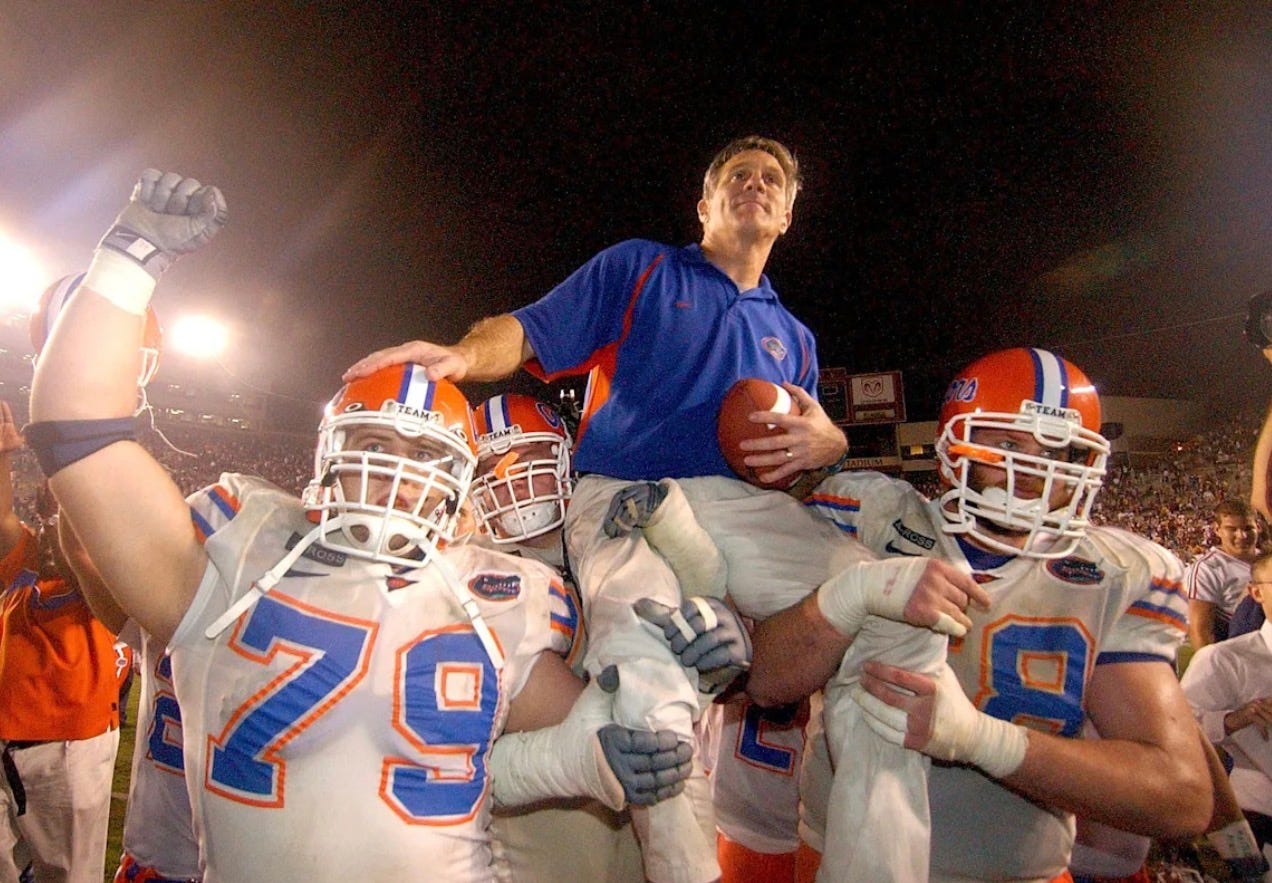
Ron Zook never got to hold the crystal football, but if fate had waited one more season, he just might have.
When Steve Spurrier resigned in January 2002, I was co-hosting Conch Town Live on WKWF-AM 1600, serving as the show’s Gator Insider.
At Chili’s that afternoon, before the national networks had even gone live with Spurrier’s announcement, I told listeners that Florida athletic director Jeremy Foley wouldn’t chase a celebrity coach — he’d stay inside the family. I said it straight into the mic: “The next head coach of the Florida Gators is going to be Ron Zook.”
“Follow the airplane.”
Weeks later, Foley made it official.
Hired to replace Spurrier’s Fun-and-Gun dynasty, Zook lasted only three seasons before being fired midway through 2004 with a 23-14 record. His exit followed an upset loss at Mississippi State and a chorus of fan frustration over inconsistency and sideline chaos.
Yet the players he recruited and molded would become the nucleus of Urban Meyer’s 2006 national-championship team — the same group that shocked college football by dismantling No. 1 Ohio State 41-14 in Glendale.
If Zook’s Gators were erratic, they were also fearless.
On the night Florida State dedicated Bobby Bowden Field in 2004, Zook’s soon-to-be-dismissed team stormed into Doak Campbell Stadium and beat the 11th-ranked Seminoles 20-13 — one of the most dramatic rivalry wins in Florida history.
It was his final game, and it came on the field of his fiercest rival’s coronation.
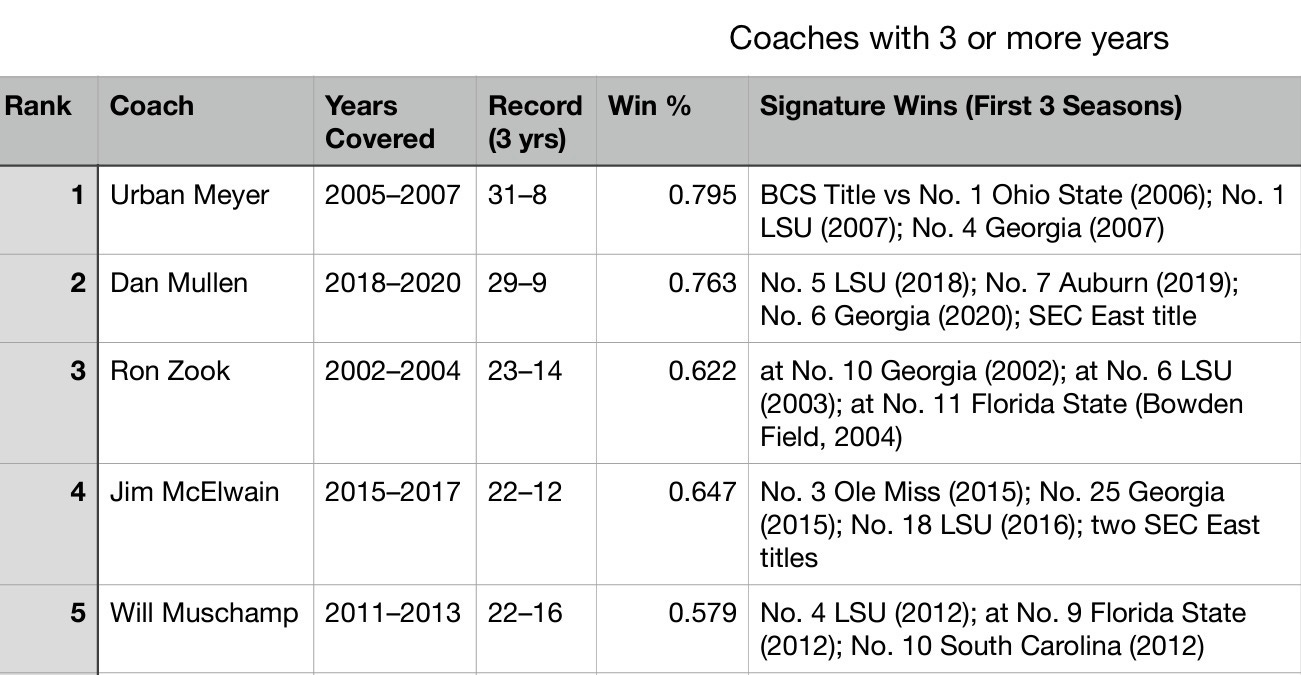
Zook’s résumé over just three seasons reads better than many remember:
A road upset of No. 10 Georgia (2002);
A 19-7 win over No. 6 LSU in Baton Rouge (2003) — one of Nick Saban’s only home losses;
And that FSU win (2004), amid the noise of his firing and Bowden’s banner night.
But it wasn’t the scoreboard that finally doomed him — it was Frat Row.
In October 2004, just weeks before that Florida State game, Zook confronted members of a fraternity after an off-campus fight involving players.
Witnesses said the coach showed up angry and refused to back down. Though he claimed he was protecting his players from harassment, the optics were disastrous.
Administrators saw a coach losing control; boosters saw a program losing polish.
Within days, Foley made the decision to move on.
Still, viewed through the long lens of time, Zook’s three seasons in Gainesville look more like an unappreciated foundation than a failure.
And another bad Jeremy Foley decision.
His 23-14 record equates to a .622 winning percentage, compared to Billy Napier’s roughly .440 over the same three-year span.
Zook beat three Top-10 teams on the road and went 2-1 against Florida State — while Napier, in three seasons, has yet to win a single true road game against a ranked opponent and has not beaten either Georgia or FSU.
Where Zook was shown the door after Year Three, Napier has been given time — and millions more in salary and support staff — to rebuild a program now fighting simply to stay bowl-eligible.
When Urban Meyer arrived in 2005, he inherited Zook’s recruits — quarterback Chris Leak, linebackers Brandon Siler and Earl Everett, defensive end Jarvis Moss, safety Reggie Nelson, and receiver Dallas Baker — the backbone of the 2006 national championship team.
Within two years, those players were raising a crystal trophy that Zook had helped shape.
“Ron Zook built that team,” former athletic director Jeremy Foley said. “He recruited those kids and gave them the belief they could win here again.”
Zook’s fiery sideline demeanor often overshadowed his results, but his relentless recruiting restored Florida’s depth at a moment the program could have slipped backward.
His .622 winning percentage remains higher than several of his successors, including Will Muschamp and Napier.
Eighteen months after his ouster, the roster he assembled was celebrating atop the BCS podium.
Meyer’s spread-option offense and Tim Tebow’s Heisman heroics became legend, but Zook’s fingerprints were still on the trophy — in the locker-room culture, the defensive backbone, and the seniors who learned to take a punch and keep swinging.
In hindsight, Zook’s tenure reads less like failure and more like foundation.
He didn’t win it all — but the Liar that followed did, with Zook’s players.
And yet again, I was right.