


“We take our living seriously,” one local guide says,
“but we take our dying lightly.”
The Key West City Cemetery was born from disaster.
In October 1846, a hurricane locals still call the Havana Storm tore through the island, leveling homes and churches — and unearthing nearly every coffin in the original seaside graveyard near Whitehead Point.
When the tide receded, residents found caskets lodged in trees and bones scattered across the shoreline.
So the town did what Key West always does after catastrophe: it adapted.
A new cemetery opened the following year on higher ground near Solares Hill, the island’s highest natural point — a mere 18 feet above sea level. Because the water table sits only a few feet below the surface, vaults and mausoleums rise instead of sink.
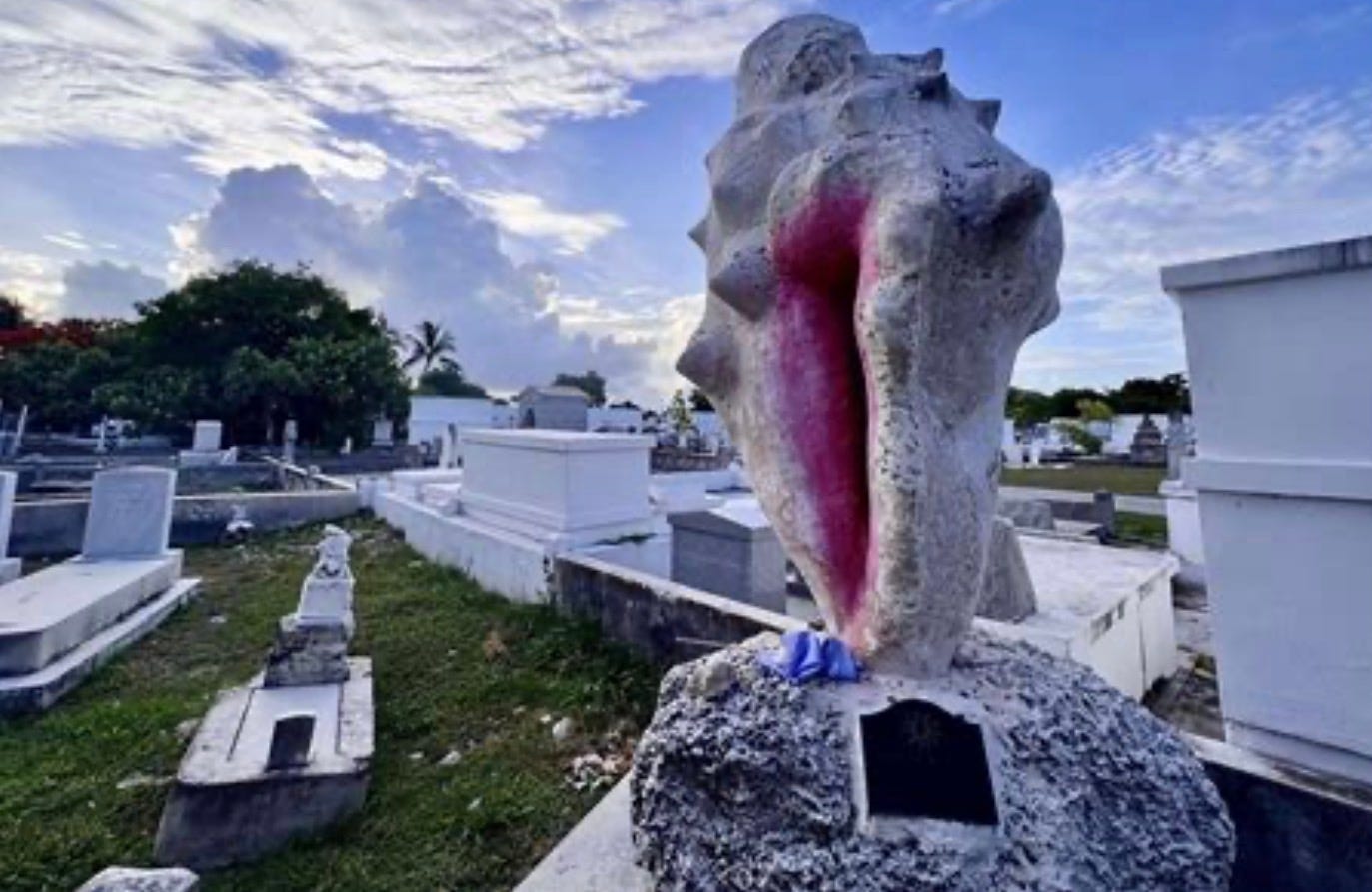
The result is a city of the dead that feels eerily alive: pastel crypts, wrought-iron fences, carved angels, and faded seashell offerings.
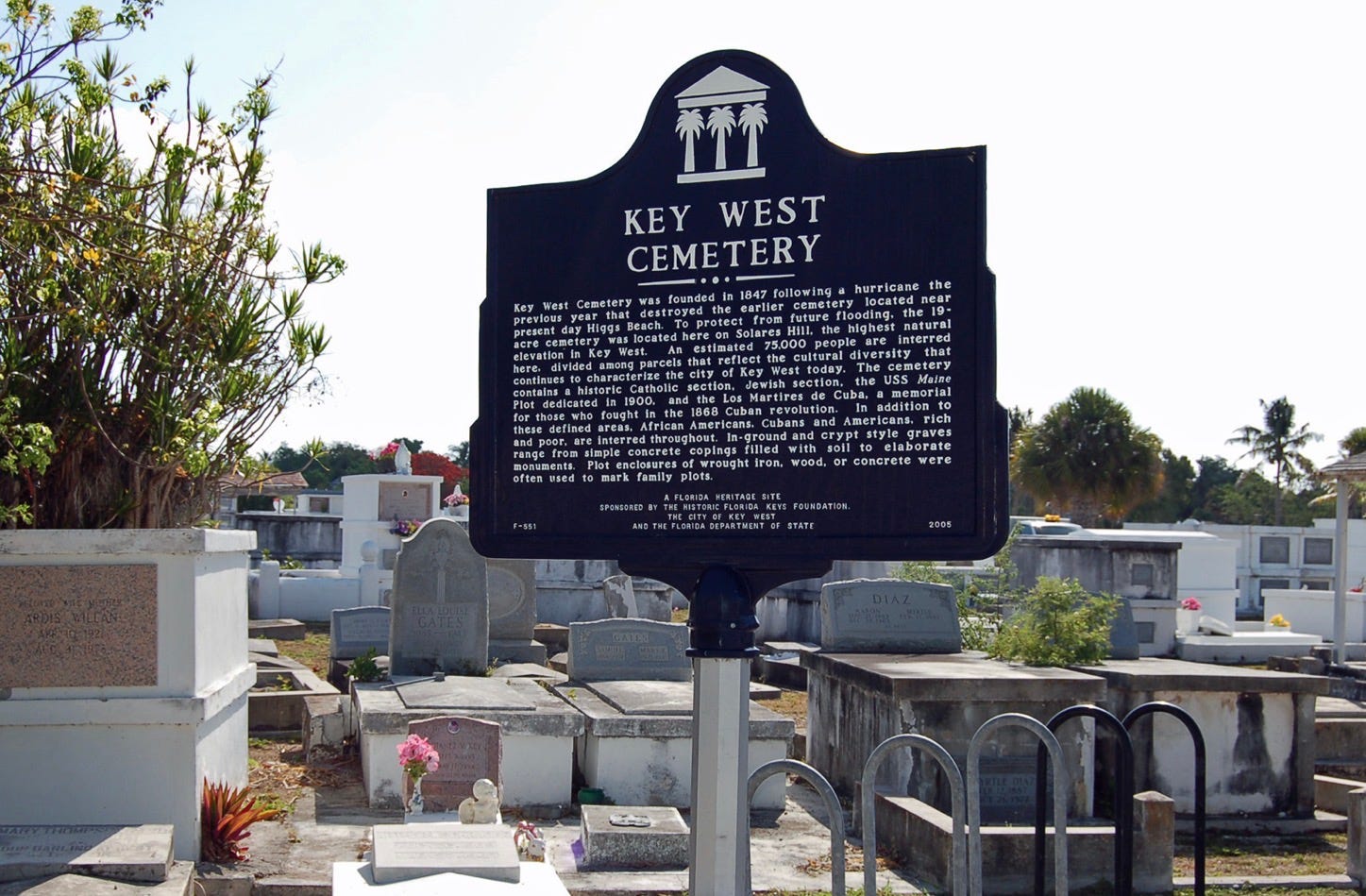
Mosaic of an Island
Enter through the gates at Margaret and Angela Streets, and you step into a microcosm of Key West itself.
The Catholic section dates to 1868. The Jewish cemetery came in the 1890s. There’s a memorial to Cuban freedom fighters — Los Mártires de Cuba — and the USS Maine Plot, where 19 sailors killed in the 1898 Havana harbor explosion rest beneath a rust-stained marble angel.
Everywhere you look, the island’s past overlaps: Bahamian settlers, cigar workers, ship captains, Civil War veterans, and rum-runners all share the same coral ridge.
“It’s the most honest neighborhood in Key West,” one historian says. “Nobody here’s pretending to be anything they’re not.”
The Characters Who Won’t Quit
No island cemetery would be complete without its legends — and in Key West, they’re legion.
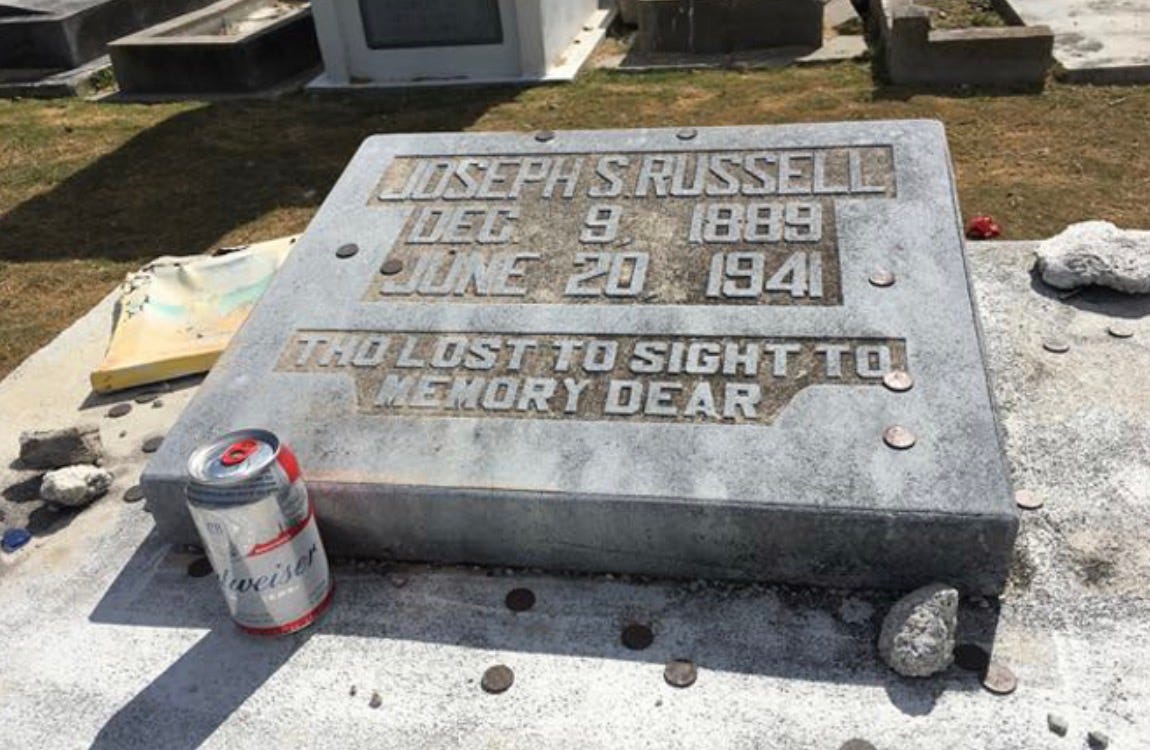
Joseph “Sloppy Joe” Russell, the garrulous bartender and fishing guide immortalized by Hemingway, rests under a gumbo-limbo tree. Visitors leave cigars, beer cans, and lures as offerings to the patron saint of happy hour.
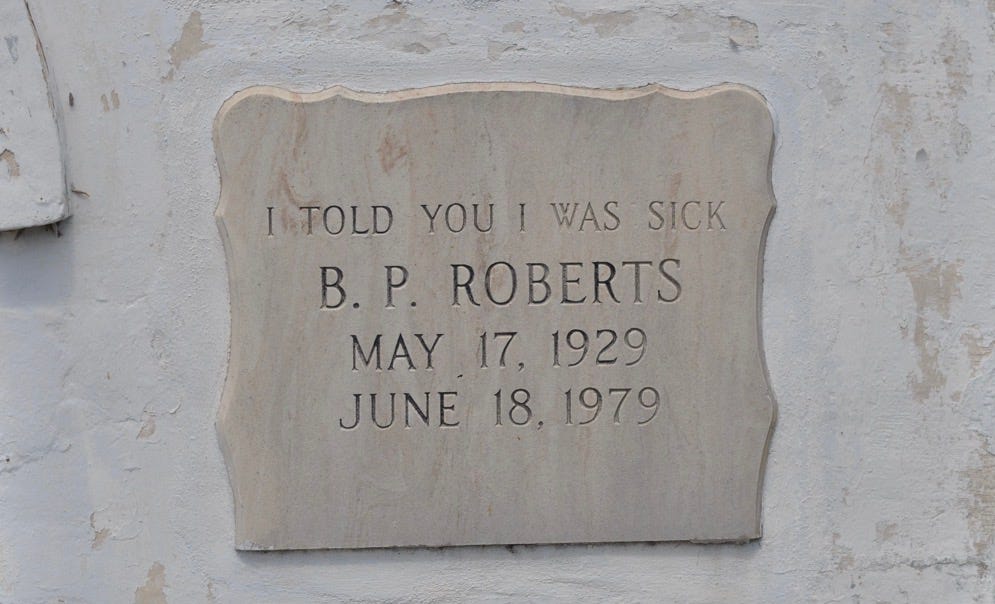
Nearby lies B.P. “Pearl” Roberts, whose headstone reads: “I told you I was sick.” It’s the most photographed epitaph in the Keys — equal parts humor and defiance.
The Harvey family plot marks the resting place of former Mayor C.B. Harvey and his wife Wilhelmina, Monroe County’s first female juror and self-styled “Admiral of the Conch Republic Navy.”
And then there’s Elena Milagro Hoyos, the young Cuban-American woman whose body was stolen by a lovesick hospital technician — Count von Cosel — who lived with her corpse for years. Her grave is unmarked, hidden among the older family plots.
Each of these figures — comic, noble, tragic — reveals something about an island that refuses to die quietly.
Stone Testaments
Because so many graves are built above ground, walking through the cemetery feels like touring a Mediterranean village of the dead. Vaults sit shoulder to shoulder, cracked stucco revealing coral beneath.
Some are adorned with conch shells or hand-painted tiles; others lean precariously after decades of hurricanes and sun.
Maintenance here is a Sisyphean act of love. Salt air corrodes, iguanas dig, and rising seas threaten the coral foundations. Yet city crews and volunteers persist, guided by the Historic Florida Keys Foundation and the City of Key West’s preservation program.
Self-guided maps are available at the Sexton’s office, and local historians now offer storytelling tours blending humor, history, and civic pride.
Laughter Among the Dead
Unlike grand northern cemeteries built on grief and grandeur, Key West’s wears flip-flops.
One marker shows a carving of a cocktail glass; another proclaims a lifelong “Devoted fan of Julio Iglesias.”
Locals insist the humor isn’t irreverent — it’s cultural. The living in Key West embrace death with a wink, a toast, and a shrug.
And that’s what makes this cemetery so unmistakably itself: a place where history is sun-bleached and salt-stained, where laughter mingles with loss, and where the living visit not to mourn but to remember how bright and brief the island’s light really is.
If You Go
Key West City Cemetery
701 Passover Lane at Margaret & Angela Streets
Open daily 7 a.m.–7 p.m.
Admission free
Self-guided maps available at the Sexton’s Office or online at cityofkeywest-fl.gov