


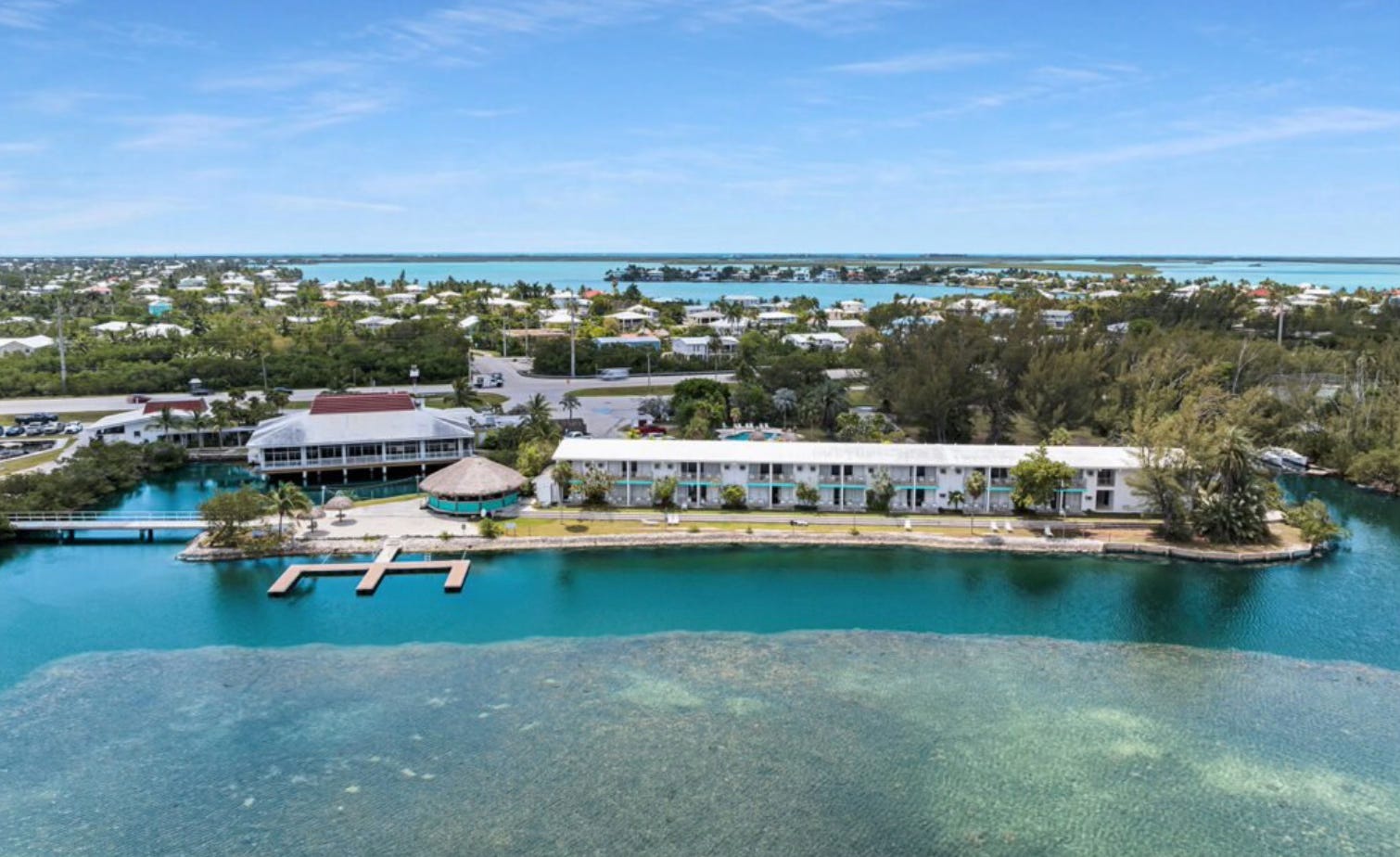
SUGARLOAF KEY, Fla. — A landmark Lower Florida Keys property shaped by family ownership, literary lore and roadside tourism is back on the market, as Sugarloaf Lodge has been listed for $45 million, offering one of the region’s most significant redevelopment opportunities.
The 10.6 acre offering includes a 31-room waterfront hotel, restaurant and bar, tiki bar, a 5COP liquor license, commercial retail space and a three-bedroom residential unit. The property also carries 24 vested hotel development rights, allowing expansion to a total of 55 rooms — a rare entitlement in Monroe County, where growth is tightly regulated.
Positioned along U.S. 1 between Key West and Marathon, the lodge has long attracted both drive-to visitors and boaters seeking access to nearby backcountry and reef fisheries.
The listing reflects not only the property’s current value, but its layered history — one that traces back to a family that helped define the character of the Lower Keys during a pivotal era of transition.
The lodge’s modern identity dates to 1973, when Lloyd Goode and his wife, Miriam, relocated from Philadelphia after purchasing the property. The couple raised their family on-site and operated the lodge as a hands-on business during a time when the Lower Keys remained a patchwork of fishing camps, small motels and emerging roadside attractions.
Under the Goode family, Sugarloaf Lodge evolved into a hybrid of marina, motel and gathering place — a model of old-Keys hospitality where ownership was personal and daily operations were intertwined with family life.
Like many properties in the Keys during the 1970s and 1980s, the lodge also intersected with a broader cultural current that drew writers, artists and public figures to South Florida’s fringes.
Journalist Hunter S. Thomspon was a frequent guest in residence, often terrorizing the housekeepers and Lloyd Goode by flushing lit M-80 firecrackers down the toilet — leaving behind the kind of disorder that became part of his larger-than-life reputation. One such incident, involving a dead pig head, a toilet and an angry Goode made it into the pages of Thompsons Songs of the Doomed.
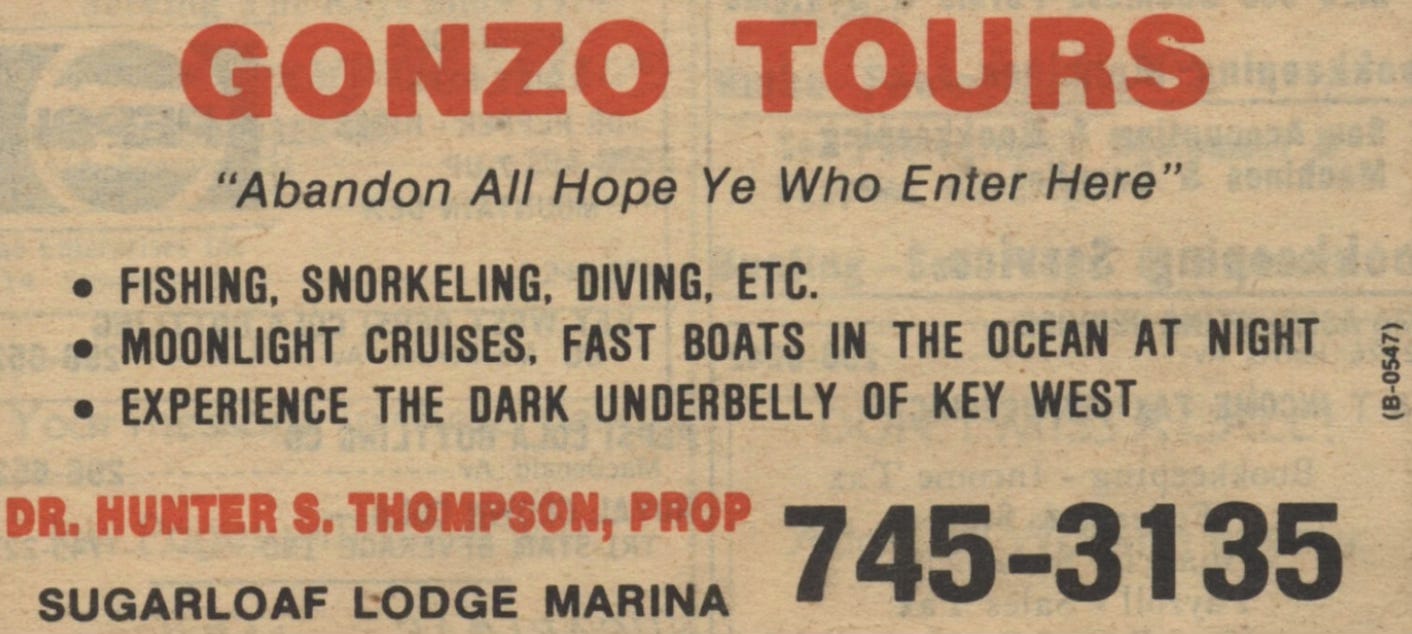
Thompson even ran his “Gonzo Tours” into the Sugarloaf Backcountry from the property before migrating to Boog Powell’s Marina on Stock Island.
For decades, the lodge’s most recognizable feature was Sugar, an Atlantic bottlenose dolphin housed in a lagoon on the property. The dolphin performed daily for visitors, helping transform the lodge into a roadside destination and embedding it in the memories of generations of Keys residents and tourists. Sugar remained at the property until 1997.
Sugar is said to be the inspiration for one of Carl Hiaasen’s first novel’s, 1991’s Native Tongue, in which his iconic character Skink — a former Governor who preferred to live in the mangroves and fight for Wild Florida — was born.
The lodge and its adjacent airstrip were also featured in the 1989 James Bond movie License to Kill. Other noteable visitors included World Wide Sportsman host Curt Gowdy, comedians Jonathan Winters and Phil Harris, baseball great Ted Williams, actor Paul Newman and notorius Key West celebs like Mel Fisher, Jimmy Buffett and Nicky Manetti.
The latter hob-knobbed with most of them.
Sugarloaf Lodge was built in the late 1950s by the Pennsylvania strip mining company that dredged and developed much of Sugarloaf Key, and the property mirrors the broader trajectory of the Florida Keys — from postwar development to family-run tourism operations and, increasingly, to high-value real estate driven by limited entitlements.
The lodge also reflects the vulnerabilities of waterfront development in the Keys.
Following Hurricane Wilma in 2005, which pushed a devastating storm surge across the Lower Keys, the property sustained significant impacts including losing its swimming pool and 24 rooms. In the years that followed, the lodge never fully regained its earlier footing, gradually slipping into disrepair even as its underlying land value and entitlements grew more attractive.
With few remaining opportunities for new hotel development in Monroe County, properties with existing density rights, waterfront access and highway visibility have become especially attractive to investors and developers.
Brokers say Sugarloaf Lodge offers multiple paths forward, including renovation of the existing structures, expansion using the vested room allocations or full repositioning as a boutique waterfront resort.
For longtime residents, the listing represents another inflection point in the evolution of the Lower Keys, where legacy properties once defined by families like the Goodes are increasingly viewed through the lens of redevelopment potential and long-term asset value.
Whether the next owner preserves elements of that history or reimagines the site entirely, Sugarloaf Lodge remains rooted in a distinct chapter of the Keys — one shaped as much by personality and place as by profit.
For more information, contact the brokers at The Agency in Key West.