
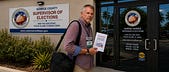


Campaign finance reports filed by Sarah Compton show a District IV City Commission campaign largely fueled by small-dollar, local contributions as the field begins to form ahead of the city’s next election.
Compton is preparing for a potential challenge against incumbent Lissette Carey, who has not yet indicated whether she intends to seek reelection. A third candidate, Juan Llera, has officially filed for the seat but reported no campaign contributions during the fourth quarter.
According to fourth-quarter filings, Compton raised approximately $7,600 from more than 45 individual donors, the vast majority of whom contributed well under $200.
The bulk of Compton’s fundraising came from small contributions, many clustered at recurring amounts such as $25.81, $51.63 and $103.25 — figures commonly associated with preset online or campaign-suggested donation tiers. More than half of contributors listed their occupation as retired, with others identifying as self-employed professionals, hospitality workers, healthcare employees, attorneys, architects, engineers, artists and small business owners. Campaign finance records show no contributions from political action committees, corporations, unions or registered lobbying firms during the reporting period.
The donation pattern closely resembles fundraising disclosures filed by Sam Kaufman and Chris Massicotte, whose campaigns have also reported high donor counts paired with relatively low average contribution sizes. Political observers say the similarity suggests a shared voter mood rather than coordinated fundraising, with residents spreading modest donations across candidates they view as alternatives to current leadership.
Compton’s campaign did receive several $1,000 contributions, the maximum allowed per election cycle, including donations from Sam Brown, Mathew Smith and George Cooper of Key West, as well as Douglas Hamilton of Atlanta and Bowman Cutter of Middlebrook, Virginia. Those maximum donations account for a meaningful portion of funds raised but represent a small minority of total contributors.
Most donors listed Key West addresses, including many within or near District IV. A smaller number came from outside Florida — including Missouri, Virginia, South Carolina, Massachusetts, New Jersey, Washington state and Georgia — suggesting personal connections rather than organized outside influence.
Reported expenditures during the quarter were limited and operational, including credit-card processing and donation platform fees, printed campaign materials such as palm cards, signs and business cards, promotional items including T-shirts, and routine bank account fees. There were no reported expenditures for polling, mass mailers, paid advertising or political consulting.
Taken together, the filings reflect a grassroots-driven fundraising environment emerging across multiple Key West races, one that appears to track with growing dissatisfaction at City Hall, 1300 White Street. That dissatisfaction has been fueled in recent years by high-profile firings, felony indictments tied to city operations, repeated transparency complaints, and criticism over what opponents describe as sweetheart deals benefiting select power players in the Southernmost City.
While campaign finance data does not capture voter motivation directly, the high number of donors combined with low average contribution sizes suggests broad engagement from residents seeking change rather than reliance on entrenched political or business interests. Future filings will show whether Compton continues to rely on grassroots support, whether Carey enters the race, and whether Llera begins active fundraising as the District IV contest develops.
The public can search for campaign filings, donors and expenditures at the Supervisor of Elections website.