

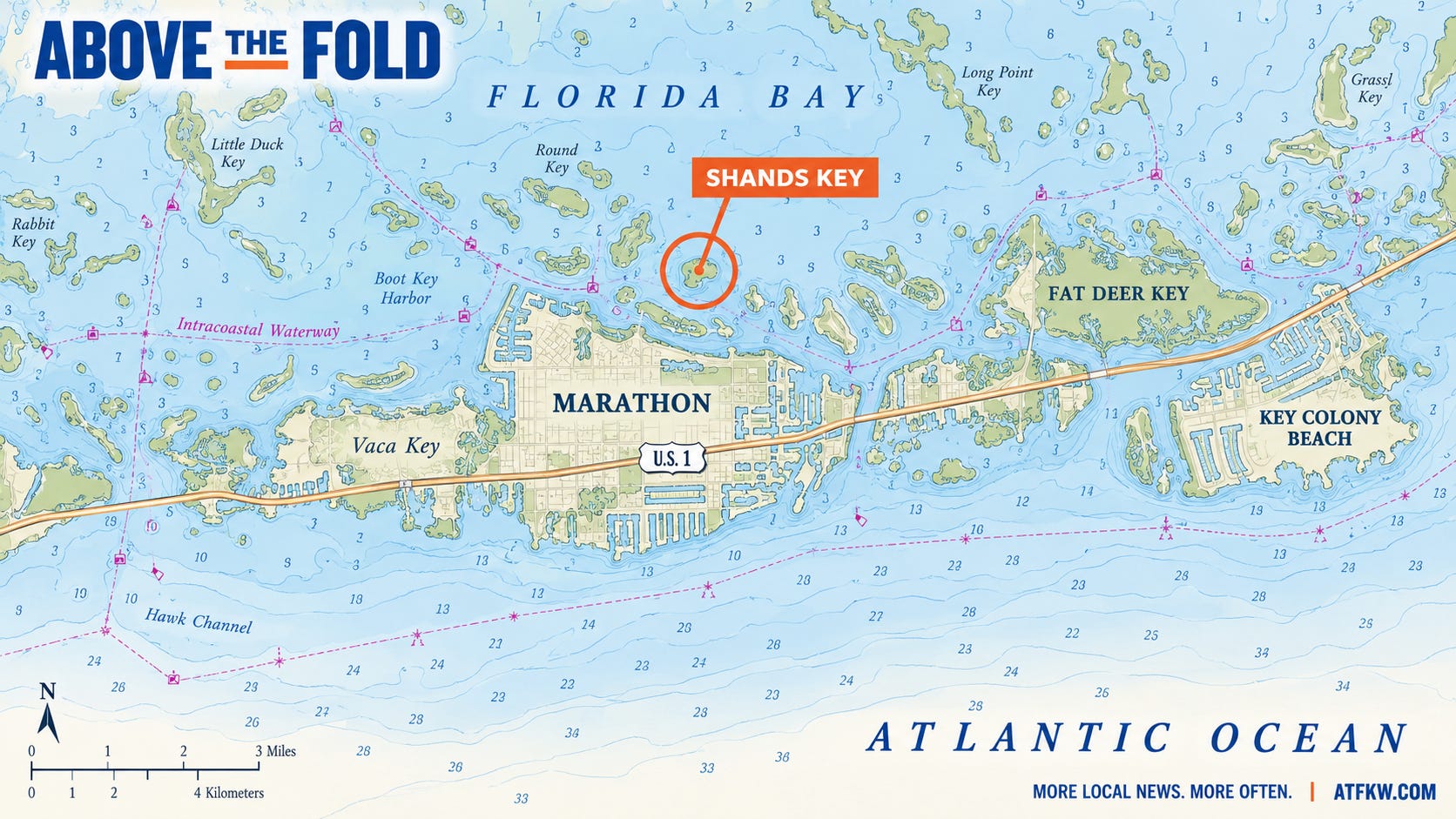
MARATHON, Fla. — A 7.9-acre island in the Middle Keys purchased from the federal government nearly 70 years ago has become the center of a long-running legal fight over how far government can restrict private property without paying for it.
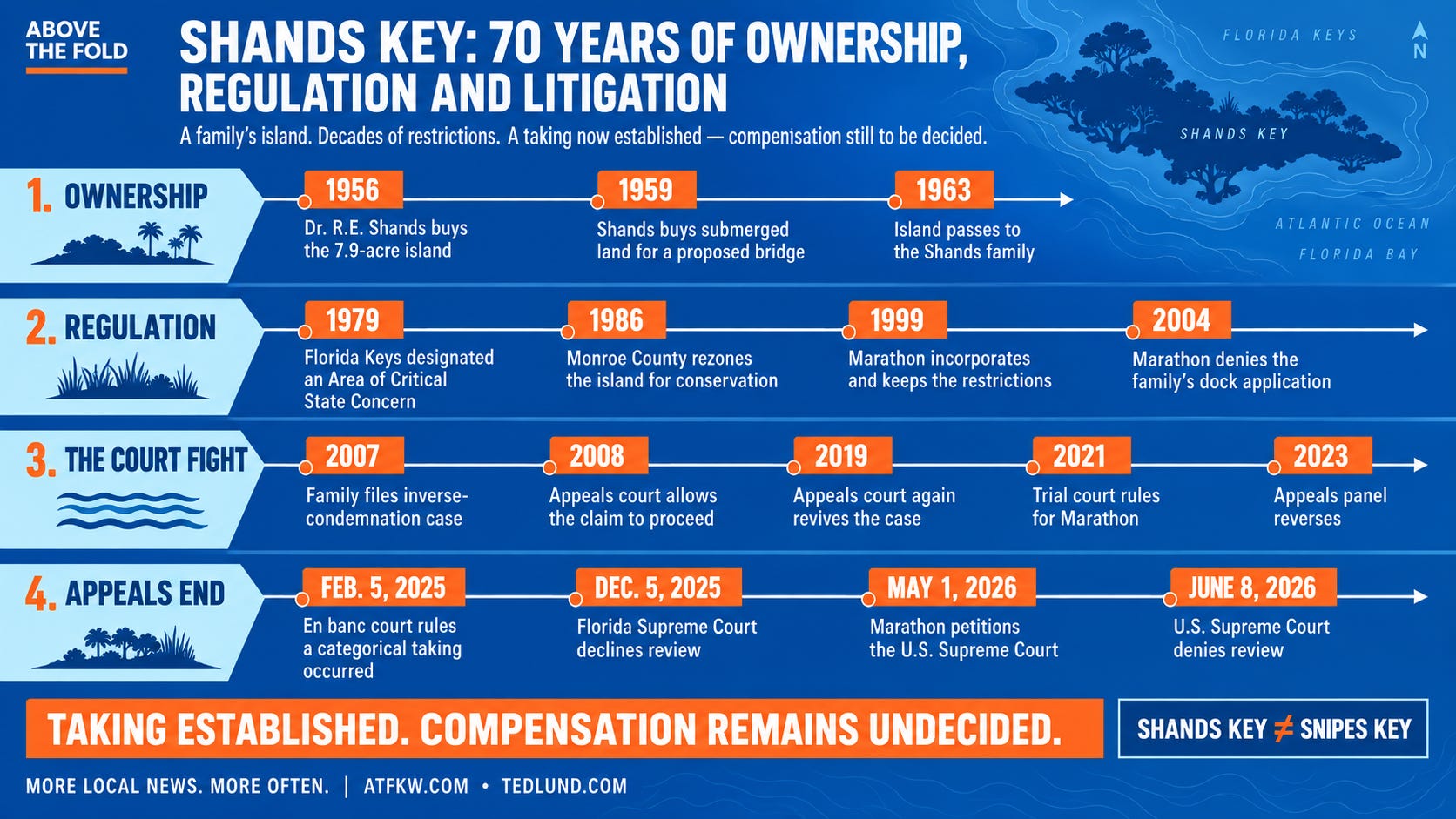
The island now known as Shands Key was purchased by Dr. R.E. Shands at a federal public auction in 1956. At the time, the property — then known as Little Fat Deer Key — was zoned by Monroe County for general use, allowing residential development at a density of one dwelling per acre.
Shands received a federal land patent giving him fee-simple ownership of the island. He later purchased about seven acres of submerged land from the state with plans to build a bridge connecting the property to the mainland.
Neither the bridge nor the homes were built before Shands died in 1963. The property passed to his wife and was later conveyed to their four children: Rodney Shands, Robert Shands, Thomas Shands and Kathryn Edwards.
Over the decades that followed, land-use rules in the Florida Keys changed dramatically.
Florida designated the Keys an Area of Critical State Concern in 1979 as state and local governments moved to limit development, protect environmentally sensitive land and address hurricane evacuation concerns.
In 1986, Monroe County rezoned Shands Key from General Use to Conservation Offshore Island.
When Marathon incorporated in 1999, the new city adopted Monroe County’s existing land-use regulations. Shands Key remained designated for conservation rather than residential development.
The Dock That Helped Trigger the Case
The dispute sharpened in 2004 when the Shands family sought permission to build a dock providing access to the island.
Marathon denied the application, citing what it described as high-quality tropical hardwood hammock surrounded by mangroves and habitat suitable for the state-listed threatened white-crowned pigeon.
The city’s development restrictions effectively limited use of the island to activities such as personal camping and beekeeping.
Marathon also expressed interest in acquiring six acres of the property. Instead of permitting development, the city proposed that the family dedicate land for conservation in exchange for transferable development rights, or TDRs, that could potentially be used or sold elsewhere.
The family declined and sought a Beneficial Use Determination.
A city special master concluded that the regulations prohibited development of the property and left the owners without reasonable economic use. The special master recommended that Marathon either purchase the property or allow construction of a home.
The City Council rejected those recommendations.
The Shands family sued for inverse condemnation, arguing that Marathon’s restrictions had effectively taken their property without paying just compensation.
A Case That Kept Coming Back
The litigation has moved through Florida courts repeatedly.
In 2008, Florida’s Third District Court of Appeal reversed a trial court decision dismissing the case. The appeals court ruled that the Shands family’s claim was an as-applied takings challenge and could proceed.
The case returned to the Third District a second time in 2019 after Marathon won summary judgment. The appellate court again reversed, finding the city had not established the value of the transferable development rights it relied upon to argue that the property retained economic value.
After another remand, the owners sought partial summary judgment under the U.S. Supreme Court’s 1992 decision in Lucas v. South Carolina Coastal Council.
Under Lucas, government regulation that eliminates all economically beneficial use of property can constitute a categorical taking unless the prohibited uses were already barred by longstanding principles of property or nuisance law.
A Monroe County circuit judge rejected the Shands family’s argument and the case proceeded to a nonjury trial.
The city presented evidence that Shands Key could have a market value of about $60,000 for recreational purposes or approximately $147,000 based on transferable development rights.
The trial court ultimately ruled that no taking had occurred.
Appeals Court Reverses Course
The Third District Court of Appeal initially reversed that ruling in 2023.
The full court then reconsidered the case en banc and issued a replacement decision on Feb. 5, 2025.
The majority ruled that transferable development rights and the possibility of selling the undeveloped island did not constitute an economically beneficial use sufficient to defeat the family’s categorical Lucas claim.
The court concluded that the regulations, as applied to Shands Key, deprived the owners of all economically beneficial use of the island.
It reversed the trial court and directed the judge to enter partial summary judgment for the Shands family on the categorical, as-applied takings claim.
That distinction is important.
The appellate court did not order Marathon to issue a building permit. It did not invalidate all of the city’s environmental or growth-management regulations. And it did not set a dollar amount for compensation.
It decided liability on the family’s Lucas claim and sent the case back to the trial court for the proceedings necessary to determine the consequences of that taking, including compensation.
Appeals Are Over
Marathon continued trying to overturn the ruling.
The Florida Supreme Court declined to review the case on Dec. 5, 2025.
The city then asked the U.S. Supreme Court to hear the dispute, arguing that the island’s market value for recreational use and transferable development rights should prevent a finding that all economically beneficial use had been lost.
Marathon filed its petition May 1, 2026.
The U.S. Supreme Court denied the petition on June 8, 2026. The court gave no explanation, as is customary when denying certiorari.
That denial left the Third District’s ruling intact.
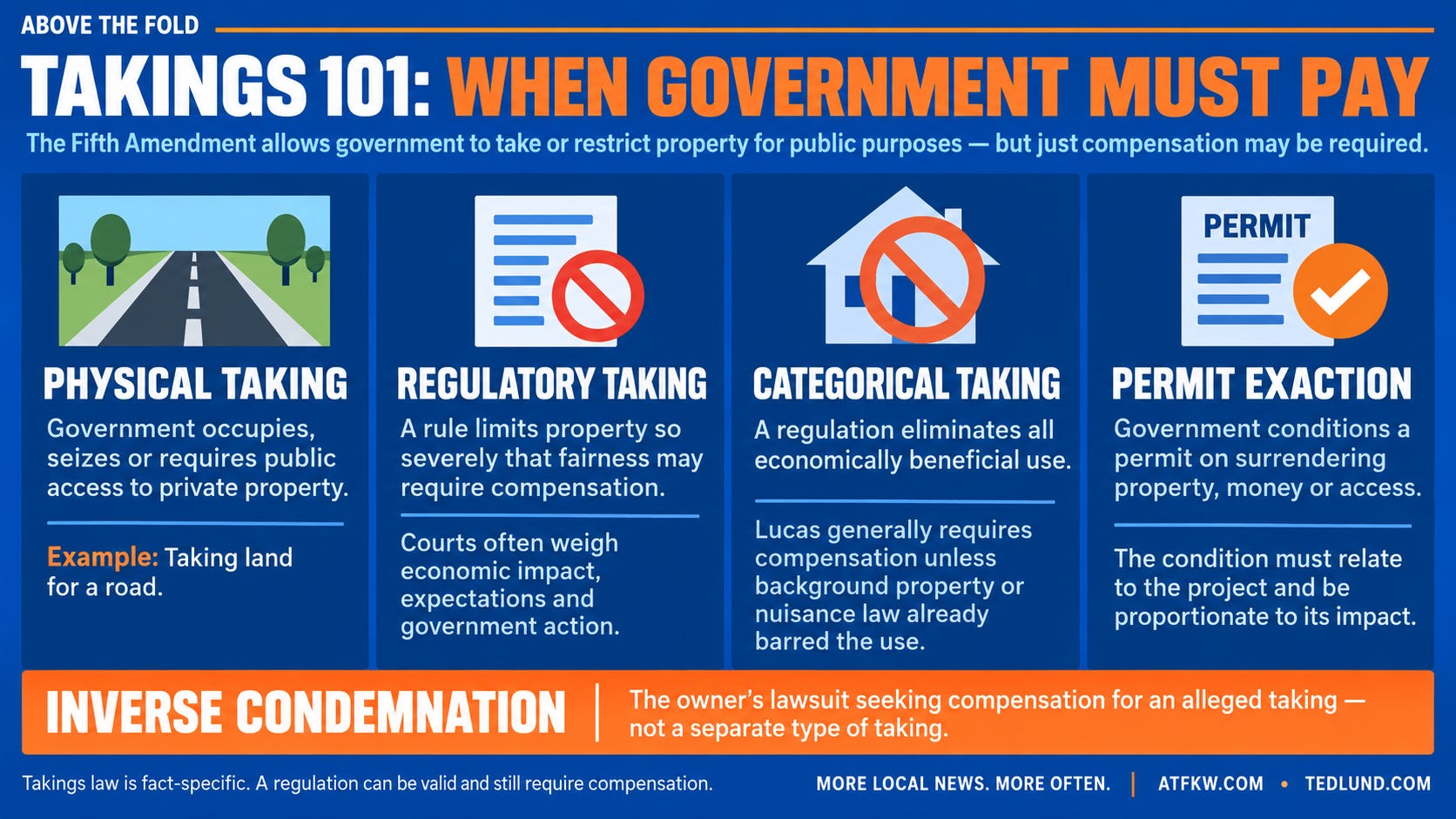
The major appellate question — whether Marathon’s regulations produced a categorical taking under Lucas — has therefore been resolved in favor of the Shands family.
What remains is not another appeal over whether a taking occurred. The case returns to the trial court for proceedings flowing from that determination, principally the amount of compensation owed and the treatment of any transferable development rights in calculating that compensation.
There has been no reported appellate order awarding a specific dollar figure, granting a building permit or eliminating generally applicable permitting requirements.
Case Timeline
Correction: Shands Key Is Not Snipes Key
A separate point requires clarification because of erroneous reporting elsewhere.
A Times of India account previously identified the property involved in the Shands litigation as Snipes Key.
It is not.
The property in the court case is Shands Key, the 7.9-acre island formerly known as Little Fat Deer Key in the Middle Keys and now within Marathon’s jurisdiction.
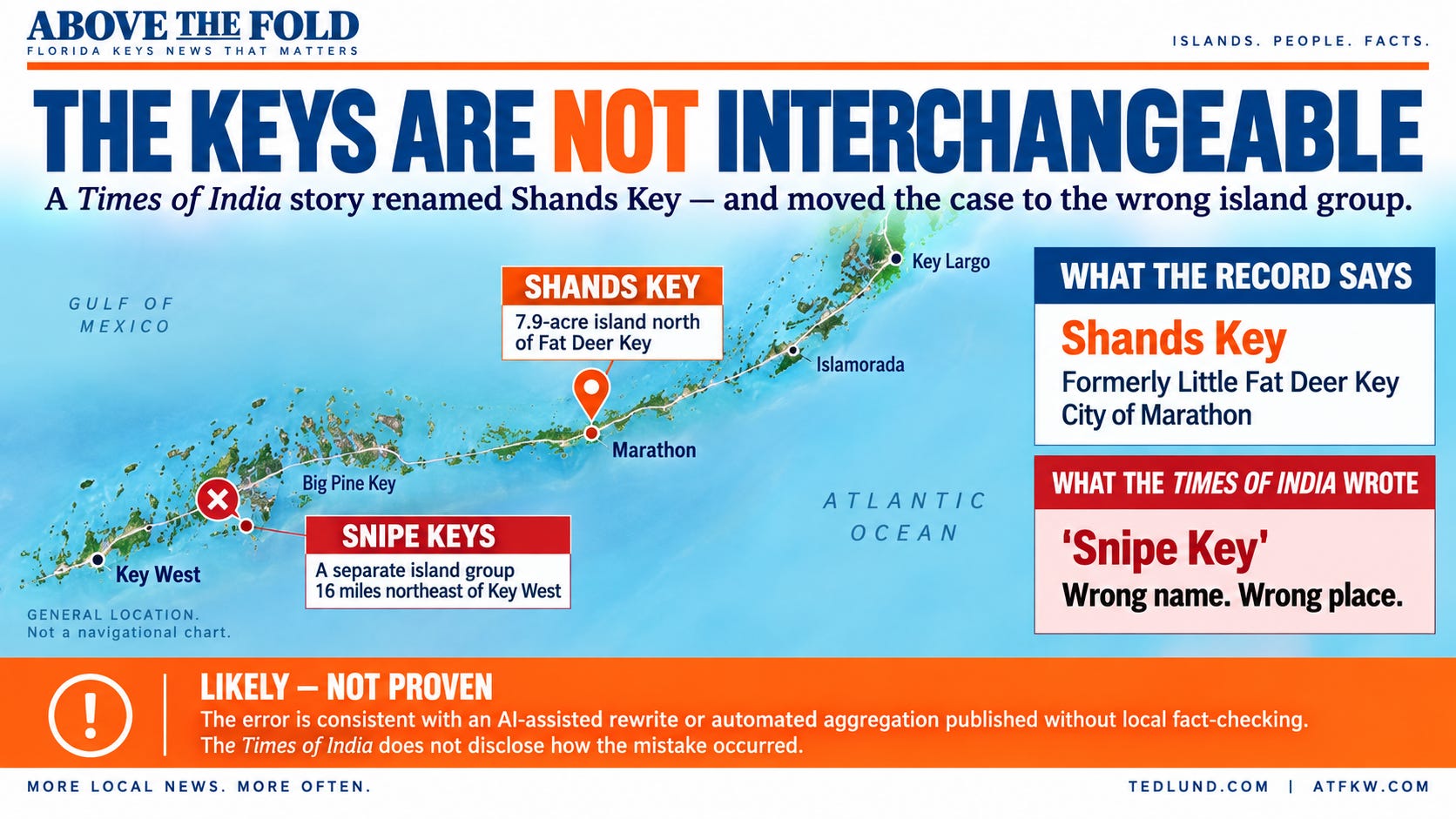
Snipes Key is a different island in a different part of the Florida Keys. It is not the property owned by the Shands family and is not the island at issue in Shands v. City of Marathon.
The two properties are not geographically interchangeable or connected to the litigation.
What the Decision Means
The significance of Shands extends beyond one small offshore island.
The Third District held that a government cannot necessarily defeat a categorical takings claim simply by pointing to transferable development rights or a potential market for land that regulations require an owner to keep essentially undeveloped.
The ruling does not mean environmental zoning itself is unconstitutional. Governments remain able to regulate land for conservation, hurricane evacuation, growth management and other legitimate public purposes.
The constitutional issue arises when those restrictions go so far, as the Third District concluded they did in this case, that they eliminate all economically beneficial use of a particular property.
At that point, the court held, government may regulate the land — but it cannot necessarily require the individual property owner to bear the economic cost without compensation.
For the Shands family, the dispute that began with a piece of Florida Keys real estate purchased in 1956 has now survived nearly two decades of litigation and appeals reaching all the way to the U.S. Supreme Court.
The question of whether a taking occurred is settled.
The question now is what that taking is worth.