

Robot Boats Take on Drug War in Navy Experiment Off Key West
Fleet Experimentation 2026 runs through April 30, pairing artificial intelligence, unmanned vessels and traditional Navy platforms in a test of how autonomous systems could patrol vast waters.

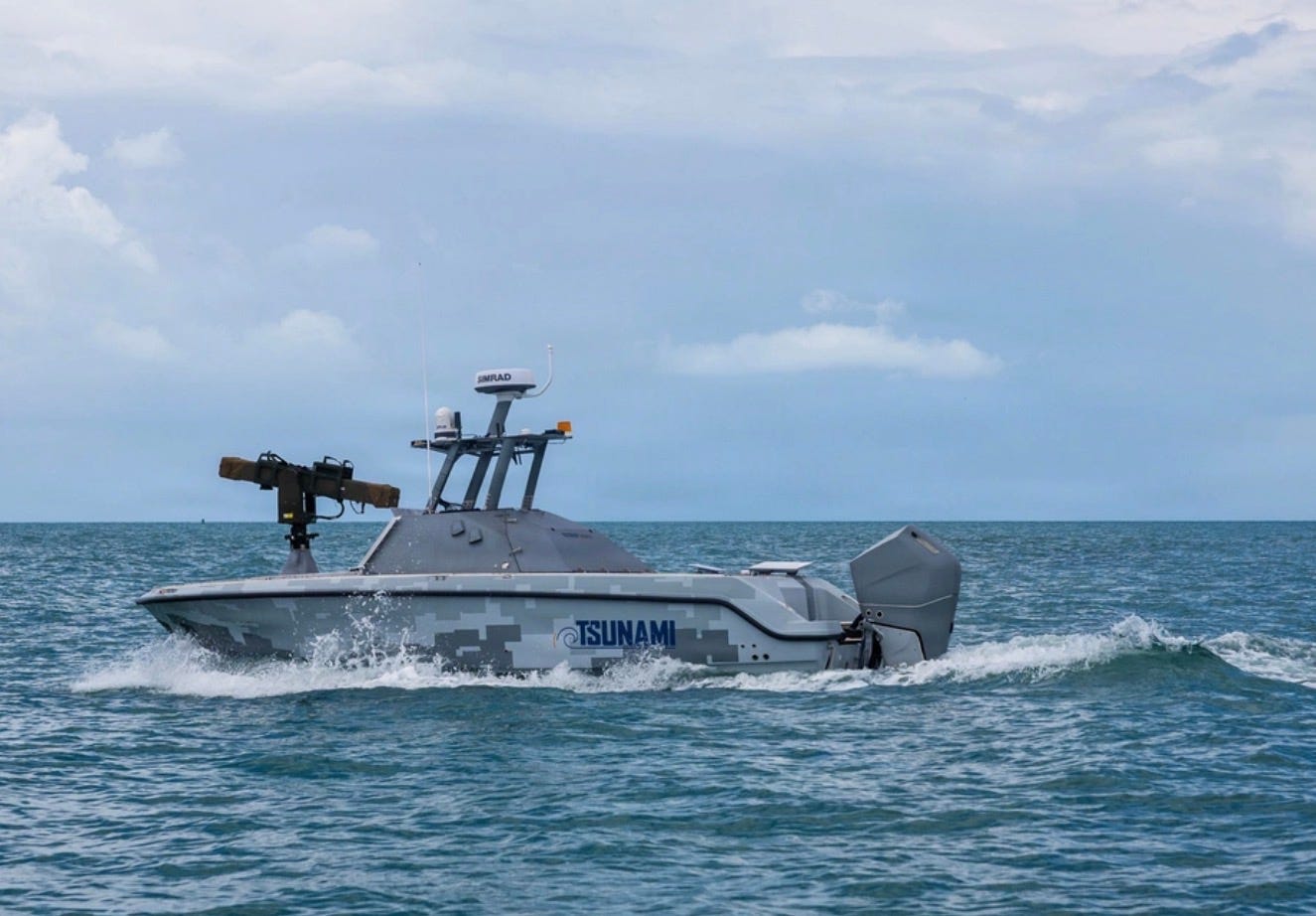
KEY WEST, Fla. — The boat left the Key West waterfront without a sailor at the helm.
A Tsunami unmanned surface vehicle went underway Sunday during Fleet Experimentation 2026, a weeklong Navy exercise off Key West that is testing how robotic vessels, artificial intelligence and traditional manned platforms can work together against drug trafficking networks.
The exercise, known as FLEX 2026, began April 24 and runs through April 30. It is hosted by U.S. Naval Forces Southern Command/U.S. 4th Fleet and integrates commercially developed unmanned systems and artificial intelligence with traditional manned naval platforms.
The offshore maneuver space includes Navy exercise areas south and southeast of Key West that the Coast Guard lists as hazardous to surface vessels until further notice, according to the Coast Guard District 7 Local Notice to Mariners.
The Navy says FLEX 2026 brings together the Department of War and industry to demonstrate a “kill chain” that can find, track and engage captured drug boats.
In military terms, a kill chain is the sequence of steps used to detect, identify, track and act against a target.
For Key West, the experiment puts the island at the edge of a larger Navy push to turn robotic and autonomous systems into working tools for maritime security, rather than one-off demonstrations. The campaign focuses on operationalizing advanced robotic and autonomous systems to combat transnational organized crime and patrol vast maritime regions.
The result is a glimpse of a future counterdrug patrol in which small unmanned surface vessels could extend the eyes and reach of crews aboard larger ships, while artificial intelligence helps sort what the machines see.
Fourth Fleet has used Key West as a test bed before. U.S. Naval Forces Southern Command/U.S. 4th Fleet has described FLEX as an annual venue where technology developers work with operational forces, evaluate systems in the maritime environment, validate assumptions and receive feedback from sailors and Marines, according to U.S. Southern Command.
The Navy’s goal is to move promising technology out of the lab and into the fleet faster. A 2022 Navy account of FLEX said the program was designed to test, evaluate and showcase unmanned vehicles that could strengthen warfighter capabilities, according to U.S. Naval Forces Southern Command/U.S. 4th Fleet.
“The purpose of this event is to bring new technology to address operational problems in the fleet,” Christopher Heagney, the Naval Air Fleet and Force adviser to U.S. Naval Forces Southern Command/U.S. 4th Fleet and the Office of Naval Research, said in a previous FLEX release, according to U.S. Naval Forces Southern Command/U.S. 4th Fleet. “Manned systems have an operational penalty of having people. The operational commander is assuming a high risk when there is a person who can be captured or killed. By having an unmanned system we are able to eliminate that.”
In the waters off the Keys, that concept is being applied to a familiar mission: watching huge stretches of ocean for boats that do not want to be found.
The U.S. Southern Command region includes the Caribbean, Central America and South America, where 4th Fleet supports joint and combined maritime security operations intended to maintain access, improve interoperability and build partnerships, according to U.S. Southern Command. Those waters are also central to U.S. counterdrug and trafficking missions.
Previous Key West FLEX events used commercially developed unmanned aerial systems and unmanned surface vehicles for drug interdiction-related tasks, including tracking and identifying targets, logistics and resupply, and forward-deployed repair, according to U.S. Naval Forces Southern Command/U.S. 4th Fleet.
FLEX 2026 appears to push that work further, emphasizing the full chain from detection to engagement in a scenario involving captured drug boats
The Navy’s interest is not just in the vessel, but in the network behind it. Unmanned boats can carry sensors. Artificial intelligence can help process data. Manned ships and command centers can make decisions. Together, the systems are meant to give commanders a wider maritime picture without requiring a crewed ship to be everywhere at once.
That matters in a region where distance is its own obstacle. The waters assigned to Southern Command are vast, and drug trafficking routes shift as law enforcement and military pressure changes.
The Navy has framed 4th Fleet as a place where unmanned systems can move from short tests to regular operations. During an earlier Key West experimentation event, Rear Adm. Doug Sasse, then reserve vice commander of U.S. 4th Fleet, said the experiments put technology experts in close contact with fleet operators and helped both sides understand operational problems and available tools, according to U.S. Southern Command.
For industry, FLEX offers a chance to prove commercial systems in military conditions. For the Navy, it offers a way to compare what works, what fails and what can be trusted at sea.


The Tsunami USV is part of that broader shift. The Tsunami family of autonomous maritime surface vessels was introduced in 2025 by Textron Systems in collaboration with Brunswick Corp. and is designed for missions that include surveillance, logistics and force protection, according to Naval Technology.
The vessels are built around Brunswick hulls and use Textron’s Common Unmanned Surface Vehicle autonomy control system, according to Naval Technology. Textron delivered the first 24-foot Tsunami craft to the Naval Surface Warfare Center Dahlgren Division in 2025, according to Naval Technology.
In Key West, the technology is being tested against a practical question: Can a hybrid fleet of sailors, ships, contractors, software and unmanned craft help the Navy and its partners see more of the ocean, faster?
The answer will matter beyond the exercise range. If the systems work, future patrols in the Caribbean and eastern Pacific could rely more heavily on unmanned vessels to watch routes used by traffickers, cue manned ships and aircraft, and reduce the strain on crews.
For now, the experiment is still underway in familiar waters off Key West, where an unmanned boat heading out to sea is less a novelty than a sign of where the Navy wants maritime security to go next.