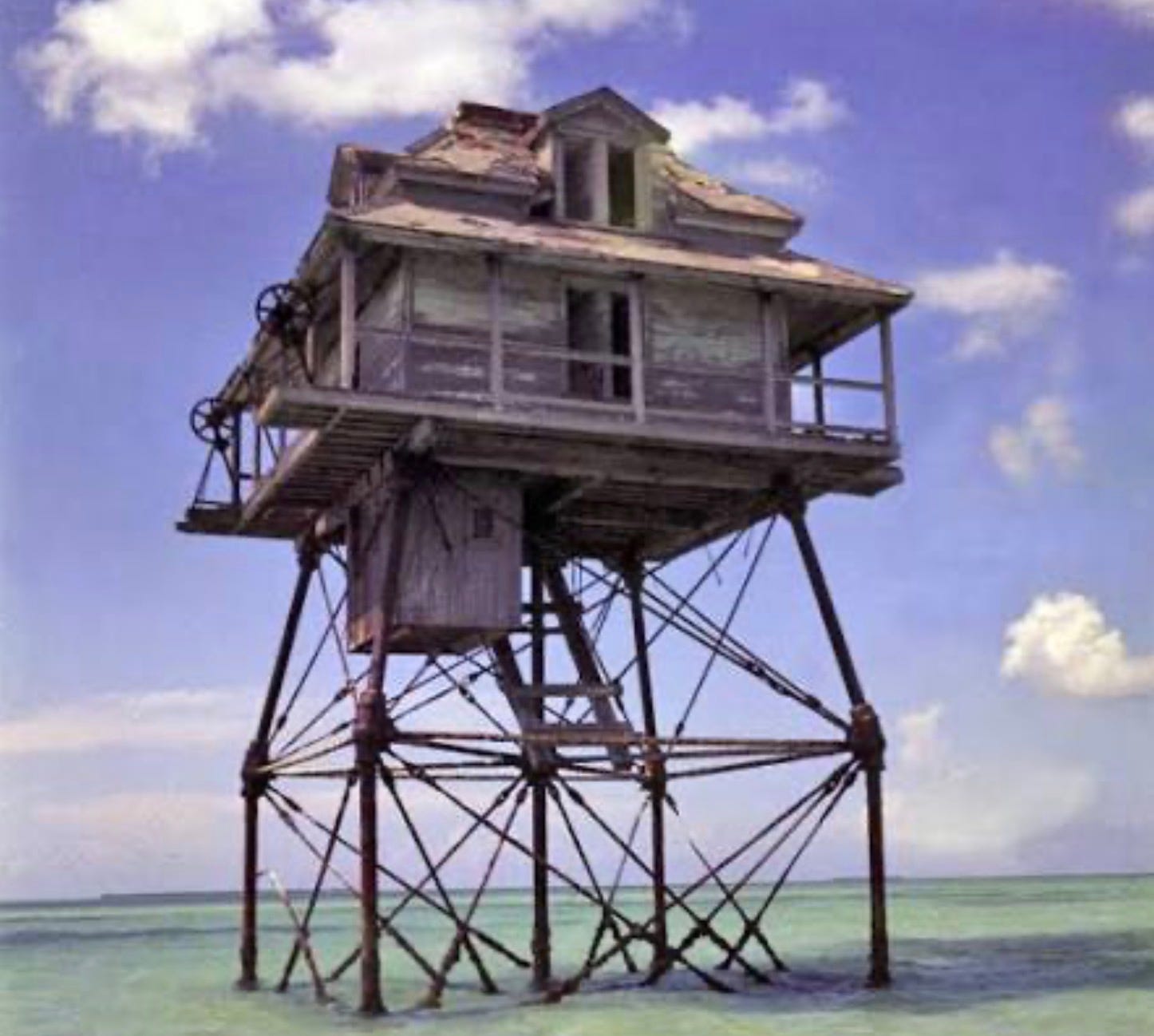
Ernest Hemingway often sought refuge at the Northwest Channel Light off Key West, writing in the morning and drinking well into the night. The structure was destroyed by partying high school kids in the late 1960s. / CONTRIBUTED
As Key West weighs whether to award or eliminate funding for the community’s bid to join the UNESCO Creative Cities Network, the debate has sharpened into a choice between mass tourism and cultural identity — cruise ships and cash registers on one side, history, arts and literature on the other.
Proponents argue cultural tourism visitors — drawn by history, arts and literature — stay longer and spend more.
They see it as a deliberate pivot from the churn of mass tourism.
On the other side stand backers of the mega-cruise economy, who for decades have argued the giant ships keep cash registers ringing for shops and bars.
Many who support pursuing cultural recognition argue that mass tourism puts too much stress on the city’s infrastructure and residents’ quality of life.
Shel Silverstein’s Key West
Poet, author and songwriter Shel Silverstein, left, chose Key West as one of his last creative havens.
The poet, songwriter, cartoonist and author — whose books The Giving Tree and Where the Sidewalk Ends are still bedtime staples worldwide — found both solitude and camaraderie in Key West.
Silverstein bought a home on William Street, a rambling Old Town property where he worked, hosted friends and quietly slipped into the island’s rhythm. Neighbors recall him as both reclusive and convivial, vanishing into days of writing but surfacing at night to share drinks and songs.
One of his haunts was Sloppy Joe’s, where he became a fixture of the Breakfast Club — an informal gathering of writers, artists and musicians who met in the off-hours to swap stories, talk shop and revel in Key West’s eccentric charms. It was a mix of local characters and visiting names, and Silverstein, already a household figure, fit right in.
His time in Key West extended beyond mere residence. He composed songs here — some later recorded by friends like Dr. Hook and Bobby Bare — and continued his lifelong practice of sketching, scribbling and trading barbs over beers.
Following his passing in 1999, fans remembered not just the global author, but the man who had chosen Key West as one of his last creative harbors.
What it Costs — and What Others Spend
For UNESCO supporters, Silverstein’s name adds another galley to an already expansive book filled with Key West literary legends — proof, they say, that the Southernmost City has never been just another tourist town.
It is — and always has been — in the words of singer/songwriter and frequent visitor Steve Goodman, where the elite retreat to greet.
UNESCO does not charge a flat fee to join its Creative Cities Network.
Instead, cities commit to sustained programming, staffing and events.
In practice, that means budgets vary widely.
San Antonio provides a clear example: as a UNESCO Creative City of Gastronomy, it set aside about $250,000 annually in public and private support to fund programs.
Iowa City and Seattle, both U.S. Cities of Literature, rely more on nonprofit partnerships and in-kind contributions such as staffing and cultural programming, typically budgeting in the low hundreds of thousands of dollars.
No Florida city currently holds a Creative City designation in any category.
For Key West, the comparison is stark: in a $286 million budget, even the original $150,000 UNESCO line item was a fraction of what the city spends on subsidizing tourism services or cruise-ship infrastructure.
Although the Monroe County Tourism Development Council is expected to help with funding, UNESCO makes it clear in its materials that cities interested in participating must provide a robust plan for implementing and promoting the Creative City designation.
It is important, supporters argue, that the city of Key West do its part and financially support what could be an important boost to the economy through marketing the island’s cultural assets on the world stage.
“Old Island Restoration Foundation stopped the wrecking ball in our historic district 65 years ago,” Frank said. “We have fought for the intangible heritage ever since.
“UNESCO recognizes cities. They are important to humanity, and Key West culture certainly is that. The return on investment for our businesses and for our community is clear because the actions taken 65 years ago were vital for our economy. A UNESCO designation will bring sustainability and resilience to our economy and a much better life for us all.”
In fiscal 2024 alone, the TDC spent more than $4.4 million on event funding and another $11.1 million on cultural capital projects across the Keys. For fiscal 2025–26, the “Cultural Umbrella” program allocates $1.5 million, with nearly $1 million earmarked for cultural event funding.
By the Numbers — UNESCO & Cultural Funding
$250,000 — Approximate annual budget San Antonio devotes to its UNESCO Creative City of Gastronomy programs
$150,000 → $75,000 — Key West’s funding for its UNESCO Creative City of Literature bid, cut in half by commissioners
$286.6 million — Total Key West city budget
.052 percent — share full funding would represent in overall FY 25-26 budget
$4.4 million — TDC funding for Keys cultural and tourism events in FY 2024
$11.1 million — TDC funding for cultural capital projects in FY 2024
$1.5 million — TDC “Cultural Umbrella” allocation for FY 2025–26, including $975,000 for cultural event funding
0 — Number of Florida cities currently holding a UNESCO Creative City designation
9 — U.S. cities with UNESCO Creative City status: • Iowa City, Iowa (Literature) • Seattle, Washington (Literature) • San Antonio, Texas (Gastronomy) • Tucson, Arizona (Gastronomy) • Santa Fe, New Mexico (Crafts & Folk Art) • Paducah, Kentucky (Crafts & Folk Art) • Detroit, Michigan (Design) • Austin, Texas (Media Arts) • Kansas City, Missouri (Music)
Global peers in Literature — Dublin, Edinburgh, Reykjavik, Melbourne, Norwich, Granada, Prague, and others
No disrespect to Kentucky.
But if Paducah can do it, Key West can, too.
A Tool for Preservation
UNESCO status could strengthen the city’s hand in preserving literary landmarks, archives and libraries, while opening doors to international exchanges and partnerships for local nonprofits and schools.
“We talk about affordable housing and keeping the island livable,” Commissioner Sam Kaufman said at a recent meeting. “But keeping culture alive is part of livability. If we don’t invest in it, it disappears.”
A Matter of Identity
To many, the symbolism matters as much as dollars.
As the late Monroe County historian Tom Hambright often observed in the early days of the cruise-ship controversy:
“Key West is at a crossroads — do we define ourselves by how many cruise ships we can bring in, or by the fact that some of America’s greatest literature was written here?”
UNESCO recognition is a way of planting that flag.
But the mega-cruise ship and cultural divide has deep roots.
In the 1990s, while working at Solares Hill under editor David Etheridge, I uncovered how the city of Key West was quietly subsidizing cruise lines — by selling them freshwater for less than the city paid the Florida Keys Aqueduct Authority.
The city’s commitment to UNESCO for $150,000 pales in comparison to what it spent on the water subsidy. It was cheaper for the floating behemoths to take on discounted water than run onboard desalination plants.
A Not-so-Traditional Poet
Jimmy Buffett’s arc underscores the choice.
His Key West storytelling helped launch a global Margaritaville brand — proof that culture can drive serious economic value.
To UNESCO supporters, that’s the model: profit from the island’s arts and letters.
To the volume-first camp counting passengers and souvenir sales, Buffett is just another hook to sell frozen drinks.
Looking ahead
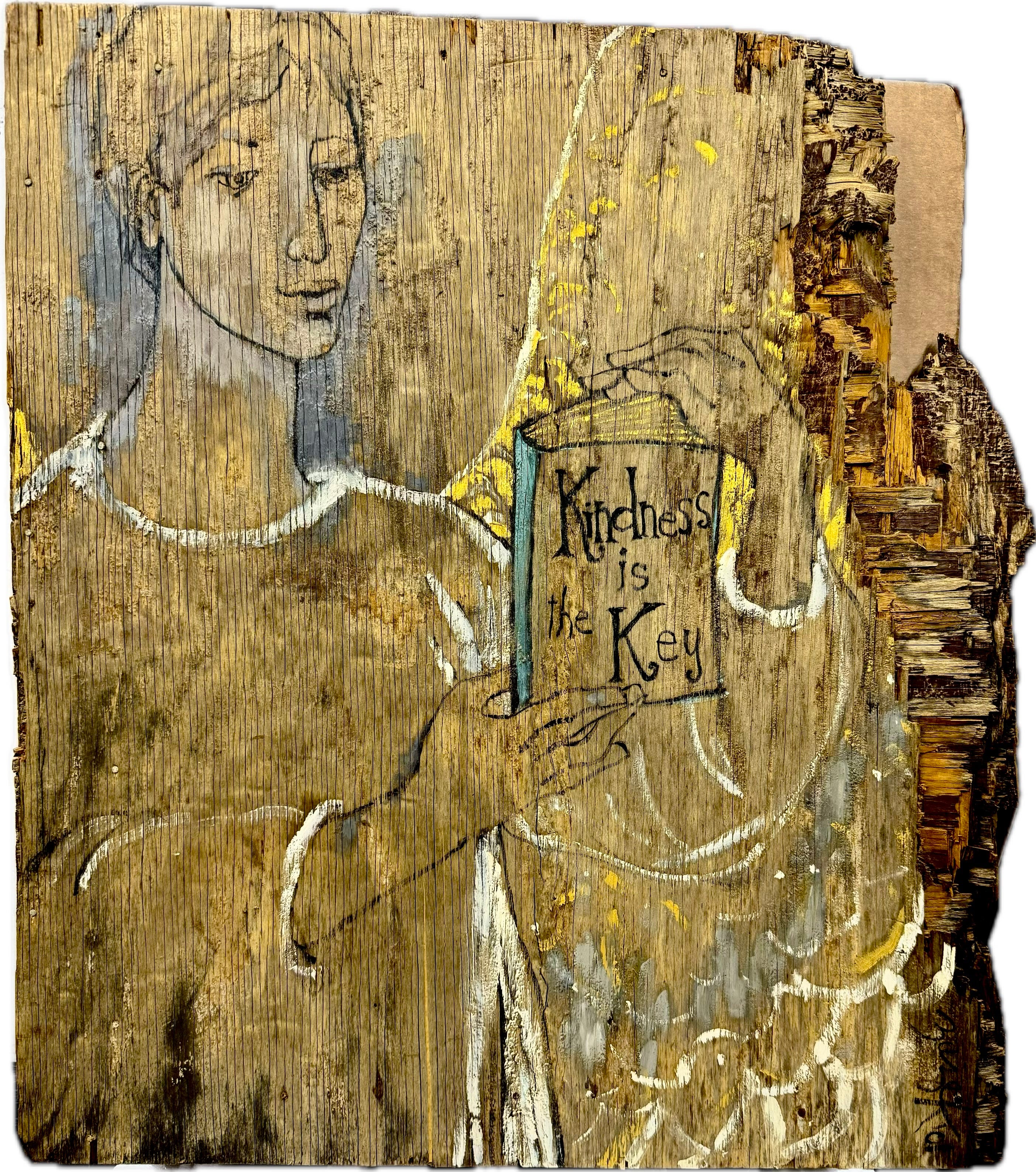
Suzie dePoo Zuzek / NYC METROPOLITAN MUSEUM OF ART PERMANENT COLLECTION
Frank said she is looking forward to the upcoming year and Key West, along with its community partners, earning the UNESCO recognition.
She said she believes “UNESCO is one thing we can all agree upon because it benefits all of us. Kindness is the key.”
If successful, Key West would be Florida’s first Creative City — and one of only a handful of U.S. Cities of Literature — telling its story to the world while giving young writers a sense of belonging to a living, global tradition.
The City Commission is expected to revisit the question on Oct. 9, when commissioners will decide whether to continue pursuing the designation and its commitment to helping fund it.
It could go one of two ways. Either they contribute the pared funds or they rescind support altogether.
For a city forever balancing commerce and culture, the vote may test how Key West wants to be seen.
Not just by itself.
But by the world.
Thanks for reading! This post is public so feel free to share it.