


Somewhere north of San Juan, the ocean turned that electric, impossible blue that only comes with deep water and hot currents. Captain Daryl Wiley throttled back the twin outboards of Caribbean Fishing Academy, and the crew—tagging specialist Wess Merten and a team from the Dolphinfish Research Program—went to work.
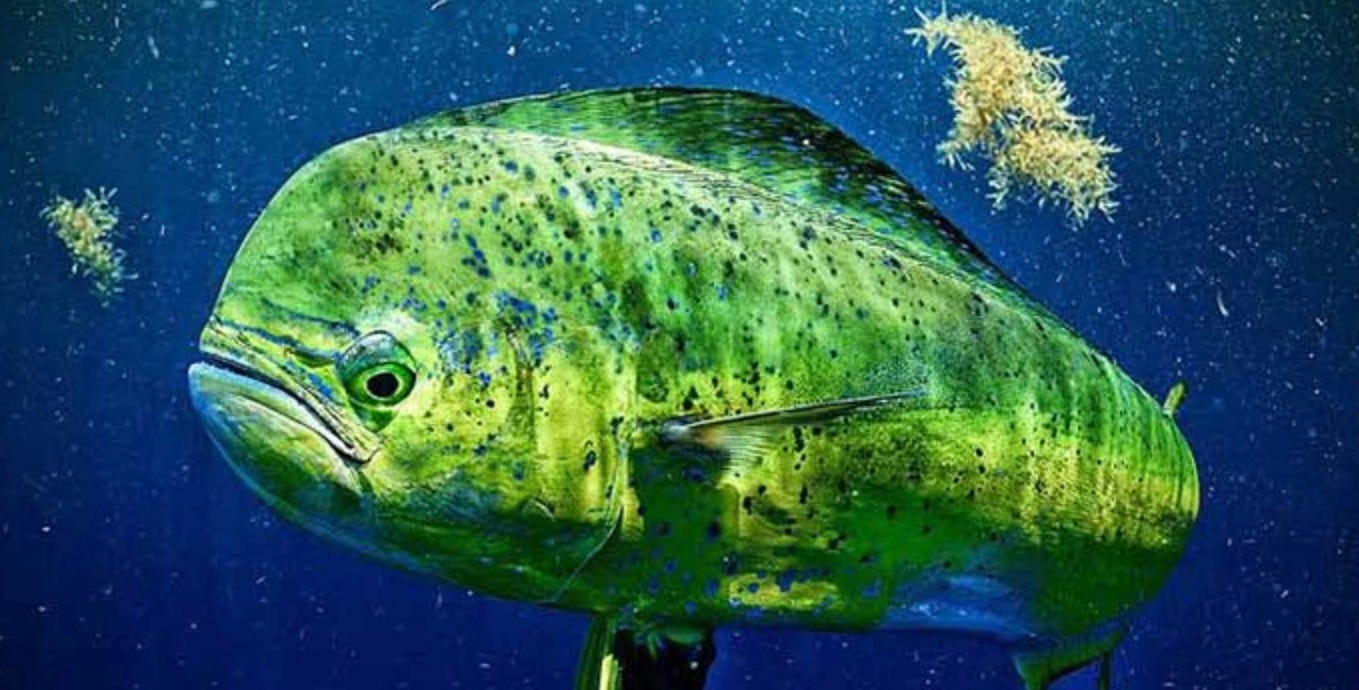
On the first pass, a green-and-gold flash broke the surface, tailwalking through spray. “Bull dolphin!” someone shouted. Minutes later, a sleek 48-inch fish lay across the transom, thrashing against the gaff’s grip. In the measured rhythm of fieldwork, Merten pressed a stainless tag into the fish’s shoulder, clipped a satellite tracker, and then—with one last look—slid it back into the indigo.
It was one of 17 dolphinfish tagged and released over two days off Puerto Rico in October, part of an expanding network of research meant to understand how the species—better known to anglers as mahi-mahi—moves across the Atlantic and Caribbean.
And this time, the team didn’t just tag dolphin. They also let a 125-pound blue marlin go, bearing a satellite tag of its own.
Predator and Prey in the Blue
The marlin had crashed a bait at the same spot where the bull dolphin was tagged earlier that day—pure coincidence, or maybe not.
“Marlin and dolphin occupy the same pelagic highways,” said Merten, who manages the Beyond Our Shores Foundation and directs the Dolphinfish Research Program. “To deploy tags on both, in the same place, gives us a rare chance to look at predator-prey overlap in real time.”
The satellite tags—part of an ongoing partnership with the Caribbean Fishery Management Council—will record location, depth, and temperature for up to six months before detaching and relaying their data via satellite. It’s the kind of work that requires equal parts angling skill, luck, and scientific precision.
“The dolphin are fast movers,” Wiley said. “You can tag one off San Juan in October, and by December it might be off North Carolina—or even the Azores.”
The Long Swim
The Puerto Rico trip marked the 15th tagging outing in 13 months under the current CFMC grant. To date, the program has tagged 295 dolphinfish, deployed 13 satellite tags, and documented 17 confirmed long-range movements between the Mid-Atlantic Bight, Puerto Rico, and the U.S. Virgin Islands.
Since its founding 25 years ago, the Dolphinfish Research Program has logged nearly 40,000 tags and 900 recaptures across the Western Central Atlantic and Eastern Tropical Pacific. What began as a grassroots partnership with anglers has evolved into one of the most successful citizen-science fisheries programs in the hemisphere.
“We’ve built this one fish, one tag at a time,” said Merten. “Every angler who takes the time to tag a dolphin becomes part of the science.”
Ocean Highways and Human Hands
Dolphinfish migrate along invisible rivers of warm water, riding the gyres and eddies that define the Atlantic. Scientists have long suspected that changing sea temperatures, fishing pressure, and regional currents affect their abundance. The DRP’s data are helping fisheries managers anticipate shifts that might otherwise take decades to understand.
In an era when recreational catches often outpace scientific sampling, the partnership between captains, anglers, and researchers is filling critical gaps.
“Anglers see the ocean changing before anyone else,” said Merten. “Our job is to turn those observations into something measurable—something that can protect the fish for future generations.”
A Quarter Century at Sea
As the Dolphinfish Research Program approaches its 25th anniversary in 2026, the team plans a commemorative magazine and new AFTCO apparel line to fund future tagging kits. The Beyond Our Shores Foundation, which has overseen the DRP since 2017, continues to expand into studies on wahoo, billfish, and tuna migration patterns throughout the Caribbean Basin.
The math behind all this effort is staggering: 410 donors, 134 satellite tags, 17 scientific papers—and a growing fleet of 104 participating vessels across the Atlantic and Pacific.
But for Wiley and Merten, the real proof of success isn’t in the numbers. It’s in the image of that bull dolphin fading back into the cobalt depths, a tiny silver tag glinting in the sun—an invisible thread connecting science, sport, and the sea itself.
Substack Tags: #GuyHarveyFoundation #DolphinfishResearchProgram #PuertoRico #BlueMarlin #FisheriesScience #Conservation #MahiMahi #CaribbeanSea #BeyondOurShores #CharlesFWatermanStyle
Would you like me to format this as a downloadable DOCX feature ready for Substack upload, with space for photos and captions?