

Ed. Note: If you are going to do one thing right now, stop reading this and read this here.
AGAIN… PLEASE READ THIS ARTICLE.
In Key Weird, the humidity blurs your vision and the real business happens before the microphones click on.
So, when City Hall needed a lawyer to carry out a very public killing, it didn’t sharpen its own knife. It hired one.
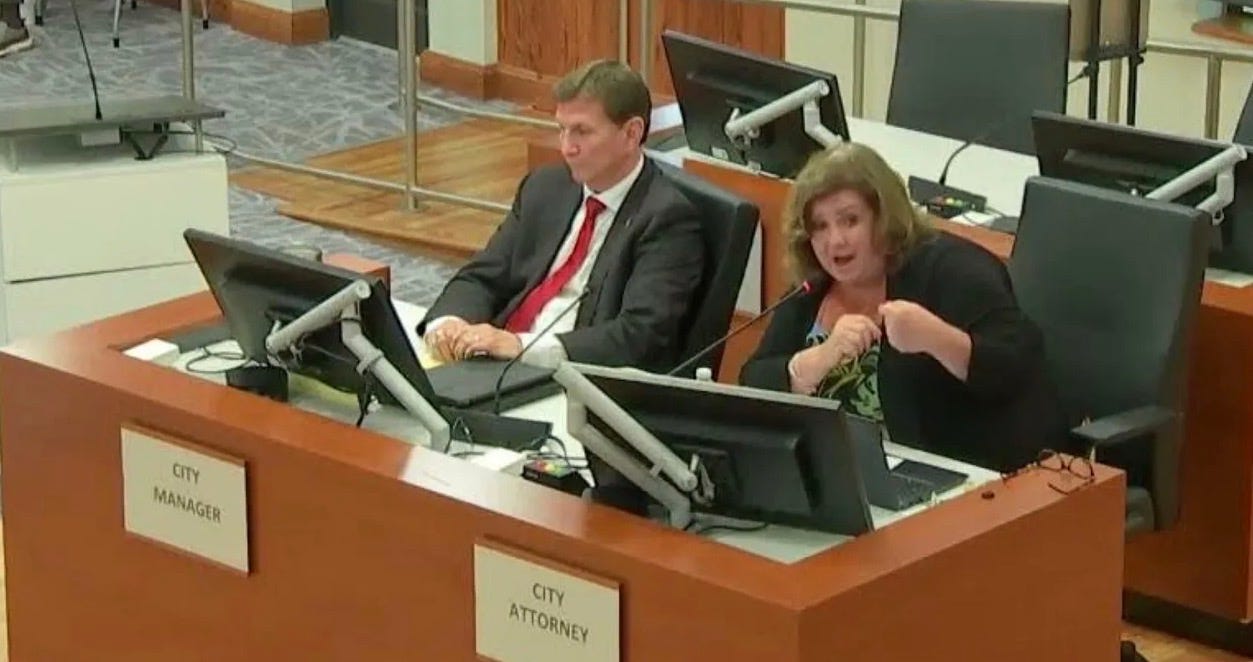
Enter Mayanne Downs — private counsel, Orlando-based, billing $500 an hour, parachuted in by then–City Attorney Ron Ramsingh to oversee the removal of City Manager Al Childress.
Ramsingh, now felony-indicted, needed someone clinical. Someone who could make the mess look procedural. Someone who knew how to turn a firing into a spectacle without ever calling it one.
Because he helped orchestrate the plot to take Childress down as we now know from discovery released in conjunction with the scathing grand jury report leading to indictments for Ramsingh, his brother Ron and Jim Young.
Downs delivered.
The execution was clean. The dais stayed dry. The talking points stuck. And when it was over — because this is how things work here — the city didn’t say thank you and show her the door.
They rewarded her.
They handed her the keys to the legal office.
What started as a one-off assignment became a governing model: a private attorney embedded deep inside City Hall, shaping risk, strategy, and silence — all without standing for election, all without answering to voters.
Downs now oversees legal affairs for the City of Key West while holding a strikingly similar role for the City of Orlando. Her firm also represents the Greater Orlando Aviation Authority, which oversees one of the busiest airports on earth — in the Happiest Place on Earth.
Two cities. One lawyer. Same playbook.
And then there’s the ideology.
Downs is affiliated with the Federalist Society, a national legal network that doesn’t just debate theory — it places people. Judges. City attorneys. Advisers. The quiet architects of policy who never appear on a ballot but decide how power is exercised once the election is over.
The Federalist Society doesn’t run cities. It runs the rules cities use to protect themselves.
If that sounds abstract, ask Orlando.
After the Pulse Nightclub shooting, survivors, families, and LGBTQ+ advocates began asking questions no one in power wanted answered:
Why were renovations unpermitted?
Why were exits compromised?
Why did city lawyers quietly assemble code-violation lists for potential litigation — then bury them?
A grassroots collective formed. Records were pulled. Thousands of dollars were spent. Police body-cam footage surfaced. The sanitized narrative cracked. And eventually, under pressure, the OnePULSE Foundation dissolved.
What those families describe is not chaos. It’s containment — legal containment, narrative containment, institutional self-protection.
Sound familiar?
Back in Key West, the model hums along nicely. A $500-an-hour lawyer handles the hard parts. Elected officials keep their hands clean. The public gets reassured. And when something goes wrong, the answer is always the same:
Trust us. Our lawyer says it’s fine
This isn’t about one attorney. It’s about a system that prefers hired conscience to accountability — one where governance is outsourced, consequences are managed, and democracy is reduced to agenda time limits and legal memos stamped privileged and confidential.
Downs is expected to be at the Key West City Commission’s next meeting on Jan. 6 beginning at 9 a.m. Stop by and let the record know what you think about all this. Or better yet, put your two cents in on eComment and let your commissioners know what you think.
In Key West, the weird don’t just turn pro.
They bill by the hour.
Why it matters
The Federalist Society operates as a professional network and pipeline — not a political party, but a clearinghouse for legal ideology, judicial recruitment, clerkship paths, and conservative legal strategy. Many members or affiliates:
clerked for federal judges,
participated in Society events as law students or faculty,
were vetted by Society-affiliated networks during judicial nomination processes, or
have been publicly recognized by the organization.
The list above reflects leaders most frequently cited in news reporting, legal analysis, judicial histories and Federalist Society materials. Their prominence underscores how a private legal association can shape the broader judiciary and government legal culture.
Here’s a list of high-profile Federalist Society members, across government and the judiciary, highlighting the organization’s influence in shaping U.S. legal leadership. These are widely reported affiliations — not membership “rosters” (which organizations don’t publicly publish), but individuals consistently identified in credible sources as associated with, invited by, or shaped by Federalist Society networks.
U.S. Supreme Court
These justices have been connected with the Federalist Society through membership, speaking engagements, leadership roles, or professional networks.
Clarence Thomas – Associate Justice
Samuel Alito – Associate Justice
Neil Gorsuch – Associate Justice
Brett Kavanaugh – Associate Justice
Amy Coney Barrett – Associate Justice
Federal Appellate Courts & Other Judiciary
A significant number of federal circuit judges with Federalist Society ties include:
James Ho – Fifth Circuit
Justin Walker – D.C. Circuit
Kathryn Kimball Mizelle – Middle District of Florida (appointed at a young age)
Patrick Wyrick – Tenth Circuit
Allison Jones Rushing – Fourth Circuit
Lawrence VanDyke – Ninth Circuit
(This is a sample; many more federal judges are often linked through past participation in Society events, panels, or leadership circles.)
Executive & Legal Officials
Jeff Sessions – Former U.S. Attorney General (long-time Society affiliate)
Ted Cruz – U.S. Senator (former Federalist Society student leader)
Josh Hawley – U.S. Senator
Ken Cuccinelli – Former acting Director, U.S. Citizenship and Immigration Services
Russell Vought – Director of the Office of Management and Budget and key architect of Project 2025.
Key Legal Strategists & Influencers
Leonard Leo – Longtime Federalist Society leader and strategic architect of judicial appointments; Executive Vice President Emeritus and board co-chair (architect of many judicial vetting processes)
Steven Calabresi – Co-founder of the Federalist Society
William F. Lee – Former President of the American Bar Association and Federalist Society council member
Academics & Thought Leaders
Federalist Society networks intersect with conservative legal scholarship; notable figures include:
Harold Hongju Koh (debated within, not a Society member but often engaged in Society forums)
Gary Lawson – Professor, influential in Federalist Society circles
Steven G. Calabresi – Law professor and co-founder
If you are not pissed off by now, you clearly are not paying attention.
🤬 another brick in the wall…oh grand jury I await