


Baseball legend Yogi Berra once famously quipped, “It’s like déjà vu, all over again.”
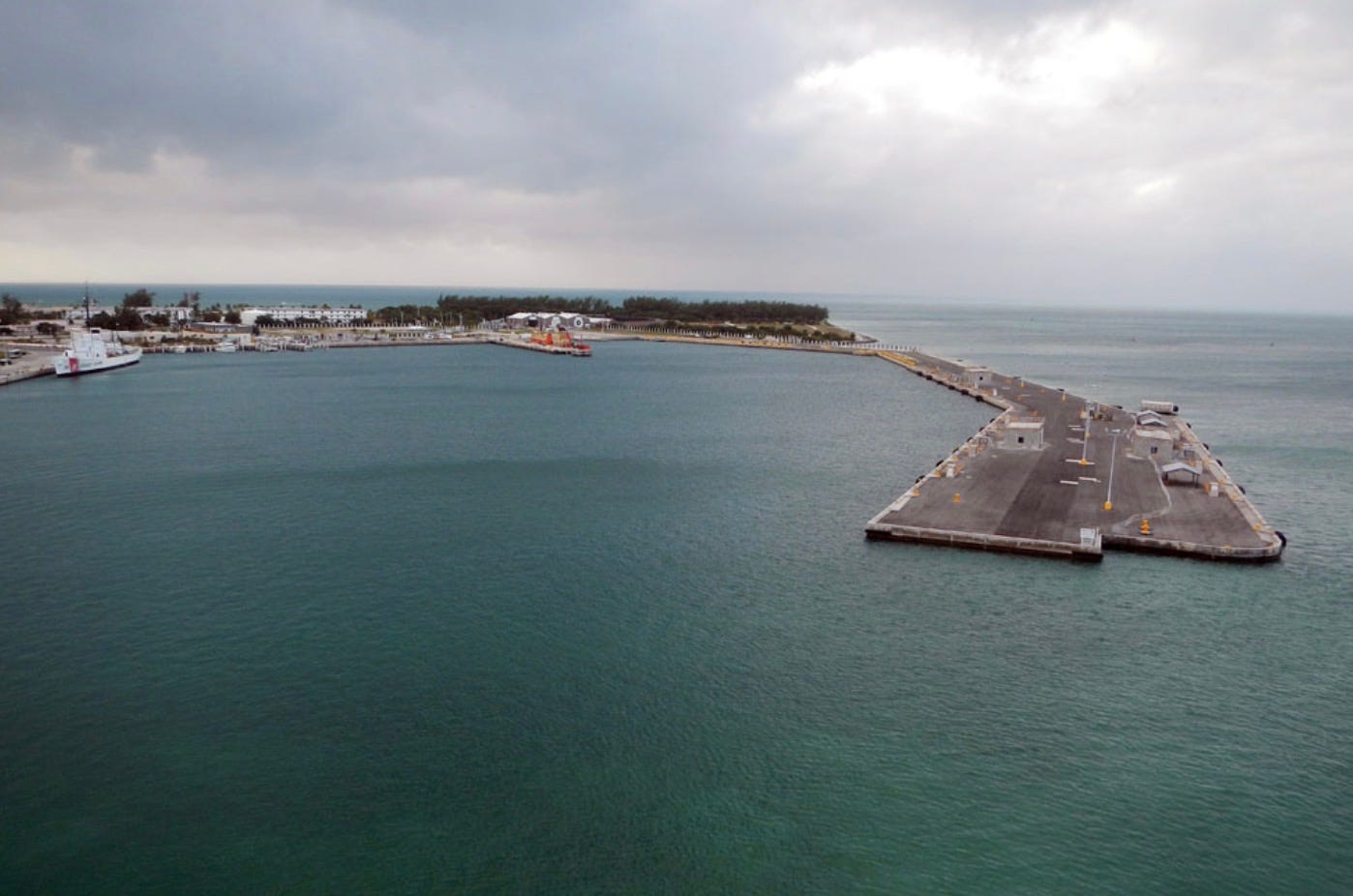
In Key West, the phrase may as well apply to the Outer Mole.
The U.S. Navy’s decision last week to terminate the City of Key West’s lease for the Navy-controlled pier has reopened a familiar chapter in the island’s long-running waterfront wars, reviving fears of expanded cruise ship operations, private redevelopment ambitions and a political battle many residents thought had already been fought.
Federal property.
Cruise ships.
Developers. Navy negotiations. Environmental concerns. Questions over who really controls the harbor. Is this about Cuba?
The current dispute centers around approximately 800 linear feet of waterfront at Naval Air Station Key West commonly known as the Outer Mole, one of the most strategically valuable cruise berths in Florida — a jumping off point for the Carribean.

The Navy’s sudden move has already triggered speculation in political and maritime circles about whether rising geopolitical tensions involving Cuba and the Caribbean may have influenced the decision.
Although they offered certain caveats, that of course has led to rampant speculation that certain cruise industry players like Pier B operator Mark Walsh, Historic Tours of America and others might be interested.
The Navy also intends to host a site visit on May 20 for interested parties that express interest.

To be clear, although the city began looking at terminating the lease because Brian Barroso thought it was a good idea, the Navy move came as a surprise to city staff and commissioners.
But the popular suggestion that the Navy terminated its lease because pending War Department action against our island neighbors 90 miles to the South appears unlikely.
Unlike WWII or Cold War-era staging concepts, today’s Navy surface fleet is largely self-contained and capable of rapid deployment without relying heavily on the cruise-terminal-style civilian infrastructure at the Outer Mole.
Yes, the Navy has priority, and they use the Outer Mole. That is why plans — which we’ll get to in a moment — were scrapped at a time that the US Government was trying to sell off just about everything it owned in Key West.

And if the Navy were genuinely concerned about preserving the property for potential military contingencies involving Cuba or broader foreign hostilities, officials could have simply suspended or paused the city’s lease indefinitely rather than fully terminating it.
Such a move would have allowed the Navy to revisit the agreement once tensions eased or allow the current lease term to naturally expire in roughly three years.
If the Navy wanted the Outer Mole for military reasons, why would it be concerned about the annual power boat races?
If the issue truly involved escalating military concerns surrounding Cuba or broader Caribbean instability, the implications for tourism and real estate in the Florida Keys and Key West would likely extend far beyond the future of one pier lease.
Tourism officials and business owners privately acknowledge that any serious regional security event involving military installations in the Lower Keys could ripple through the entire Florida Keys economy — and possibly South Florida as a whole.
Recent drone warfare seen in parts of the Middle East, including attacks and interception events involving energy and military infrastructure as well as popular tourism areas in Dubai, the United Arab Emirates and Saudi Arabia, has underscored how modern asymmetric conflict can quickly disrupt tourism markets and public perception even far from traditional battlefields.
Defense analysts have also warned for years about expanding Chinese strategic and intelligence interests in Cuba, including repeated reports of Beijing seeking expanded surveillance and communications footholds there.
If you don’t think that the Chinese could send some of their drones — or the North Koreans, or the Russians — to Cuba, think again.
Questions that once sounded hypothetical now carry heavier weight in an era of drone warfare and global instability: What would a security incident involving the Joint Interagency Task Force South headquarters, NAS Key West or other strategic facilities mean for the short- and long-term health of tourism in Key West and the Florida Keys?
But still, no public evidence has emerged linking the Navy’s lease termination directly to any imminent military threat involving Cuba or the Florida Straits.
That could all change if the Trump administration is successful in indicting Raul Castro.
If anything, the larger concern is what even the perception of instability could do to the Keys’ tourism-dependent economy.
For now, though, the formal termination notice appears more closely tied to the increasingly strained economics and operational structure surrounding the city’s use of the property.
Long before the “Safer, Cleaner Ships” referendum movement dominated local elections, the Outer Mole was already at the center of redevelopment fights tied to the future of Key West tourism and the island’s increasingly valuable waterfront.
In the late 1990s and early 2000s, developers, city officials and tourism interests explored a variety of marina and harbor redevelopment concepts connected to former Navy property around the Truman Annex and Outer Mole corridor.
Among the major players during that era were business interests connected to Truman Annex mastermind Pritham Singh and the Spottswood family, both who had become deeply intertwined with large-scale hospitality and waterfront redevelopment projects throughout Key West.
At the time, concepts involving expanded marina infrastructure, large-vessel access and mixed-use waterfront redevelopment circulated as the city continued transforming former military property into tourism-oriented real estate.
The Outer Mole quickly emerged as one of the harbor’s crown jewels because of its deep-water access and ability to accommodate vessels too large for many city-controlled docks.
Critics at the time warned then that aggressive redevelopment of federally controlled waterfront property could permanently reshape the harbor and intensify pressure for larger cruise ships and expanded maritime traffic.
Those early tensions eventually exploded publicly during the 2013 referendum battle over widening Key West’s harbor channel to accommodate larger cruise vessels.
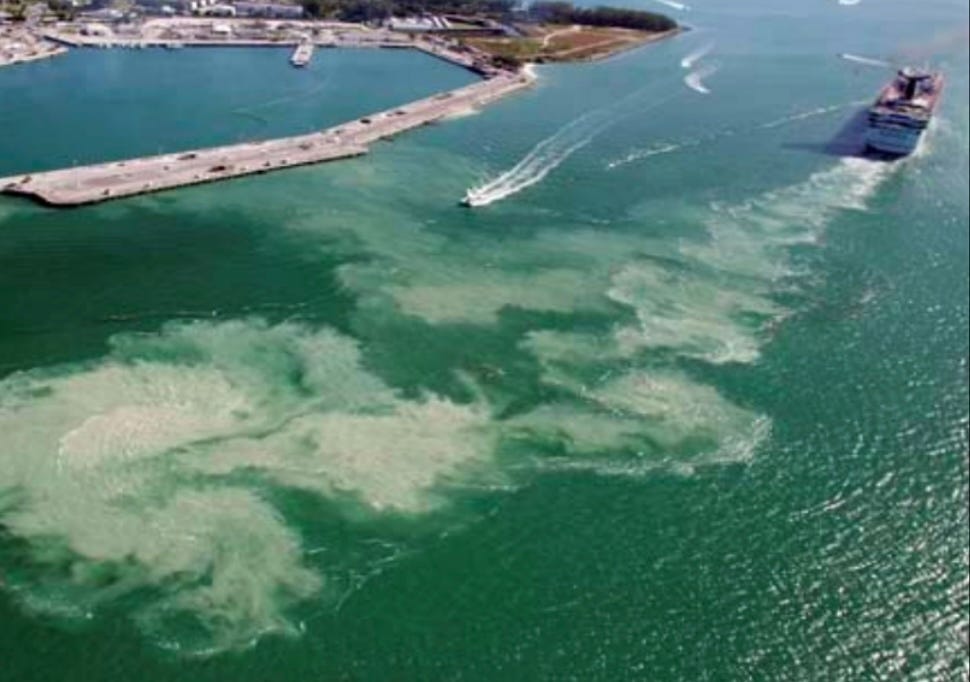
Voters overwhelmingly rejected the dredging proposal amid fears over damage to coral reefs, harbor ecology and the island’s quality of life.
At the time, I served on the Florida Keys National Marine Sanctuary. I know what the concerns were and are, and helped draft the first State of the Sanctuary address.
To say it painted an unflattering picture of water-quality in Key West Harbor would be an understatement.
The fight resurfaced again in 2020, when Key West voters overwhelmingly approved the “Safer, Cleaner Ships” referendums limiting cruise passenger numbers, prioritizing smaller ships and effectively banning the largest vessels from city-controlled docks.
But the victory proved short-lived.
In 2021, Gov. Ron DeSantis signed legislation overriding the local referendum measures after an intense lobbying campaign backed by cruise industry interests and maritime operators.
Cruise opponents later regrouped behind the city’s “One Ship Policy,” adopted unanimously by the Key West City Commission in 2022, limiting city-controlled docks to one cruise ship per day.
Supporters of the policy say it effectively pushed the largest ships away from city-managed waterfront facilities and reduced overall cruise traffic into Key West waters.
But the Outer Mole has always existed in a different category.
Unlike Mallory Square or other city-owned docks, the Outer Mole sits on federally controlled Navy property operating through lease agreements rather than direct municipal ownership.
That distinction is now fueling growing concern among critics who fear the Navy could eventually negotiate directly with a private operator if the city’s lease expires without replacement.
Some residents worry that such an arrangement could weaken the city’s practical leverage over cruise operations and potentially reopen the door to larger and more frequent cruise ship calls at the federally controlled pier.
The current lease dispute also carries major financial and infrastructure implications.
During an April City Commission meeting, City Manager Brian Barroso warned commissioners the city could no longer afford insurance and lease-related costs associated with the property without continued cruise ship revenue.
At the same time, internal Navy correspondence obtained and reviewed by Above the Fold showed concern from NAS Key West leadership about the possible collapse of the longstanding City-Navy partnership.
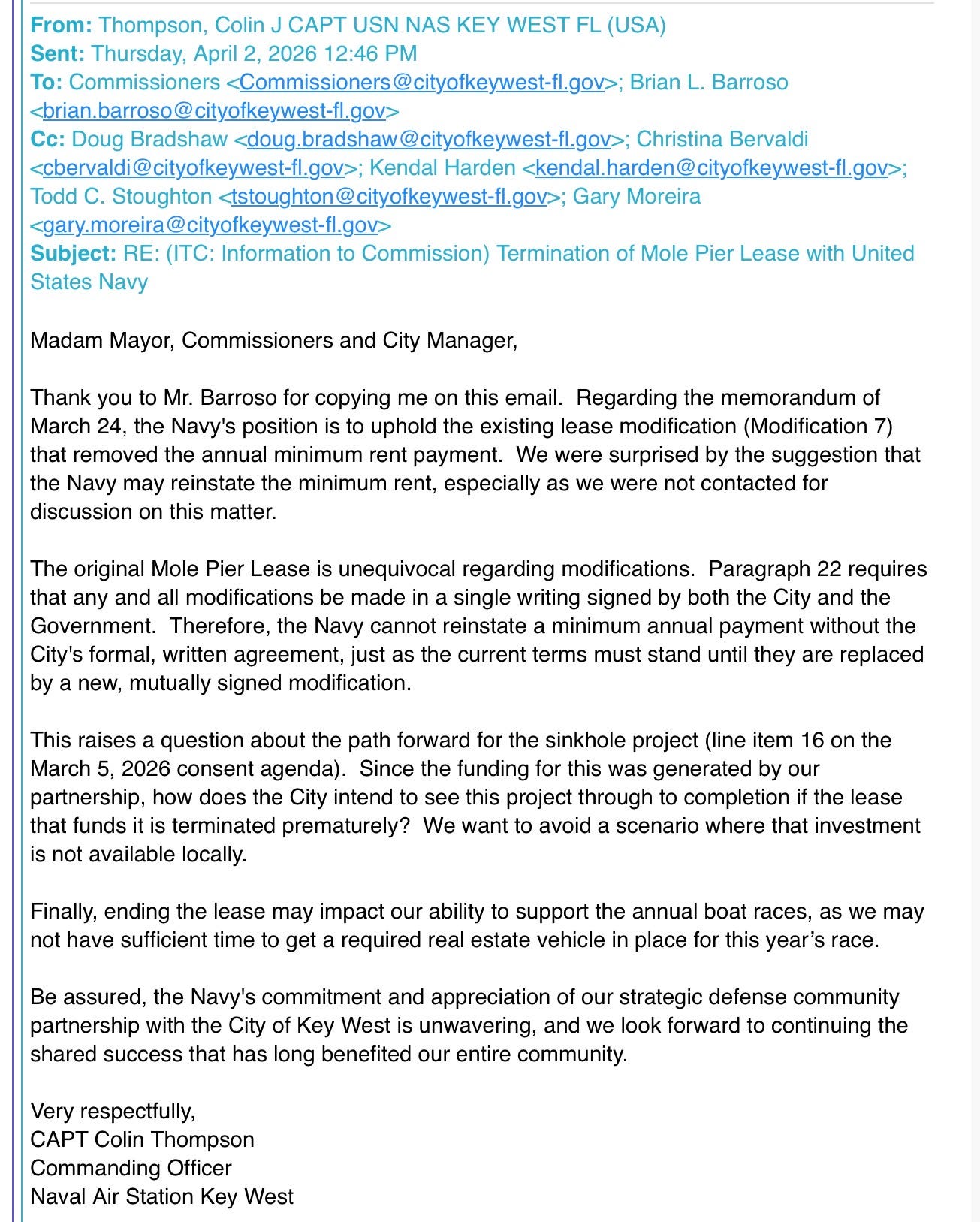
In an email to Mayor Danise Henriquez, commissioners and Barroso, NAS Key West Commanding Officer Capt. Colin Thompson warned termination of the lease could jeopardize ongoing sinkhole repair work funded through the partnership and complicate future Race World Offshore events traditionally associated with the Outer Mole.
“Be assured, the Navy’s commitment and appreciation of our strategic defense community partnership with the City of Key West is unwavering,” Thompson wrote.
The Navy’s formal termination notice states the city remains obligated to complete pending seawall repairs despite termination of the agreement.
For many in Key West, though, the larger concern is less about seawalls than the island’s future identity.
The Outer Mole has spent decades sitting at the intersection of military strategy, tourism economics and local politics, a concrete strip of federal waterfront that repeatedly becomes the center of the island’s biggest cultural and economic fights.
Very few current residents remember firsthand what life in Key West felt like during the Cuban Missile Crisis, when the island suddenly found itself on the front line of a global geopolitical standoff only 90 miles from Cuba.
But for some longtime observers, the latest uncertainty surrounding the Outer Mole carries echoes of that era.
Either way it goes, it could end up being like déjà vu. Alll over again.
Good explanations. Thank you.