


Ed. note: AI is expected to be a topic of public comment at next Thursday’s City Commission meeting. The morning session begins at 9 a.m. at 1300 White Street. The evening session begins at 5 p.m. For those unable to attend, the meeting will be streamed live on the city’s website.
KEY WEST, Fla. — A growing national backlash against artificial intelligence-powered police surveillance has reached Key West, where residents are urging city commissioners to set limits on emerging technology as Gov. Ron DeSantis warns that the proliferation of automated license-plate readers has gotten “out of control.”
The concerns come nearly 10 months after the Key West City Commission approved a $3.7 million, 10-year agreement with police technology company Axon Enterprise.
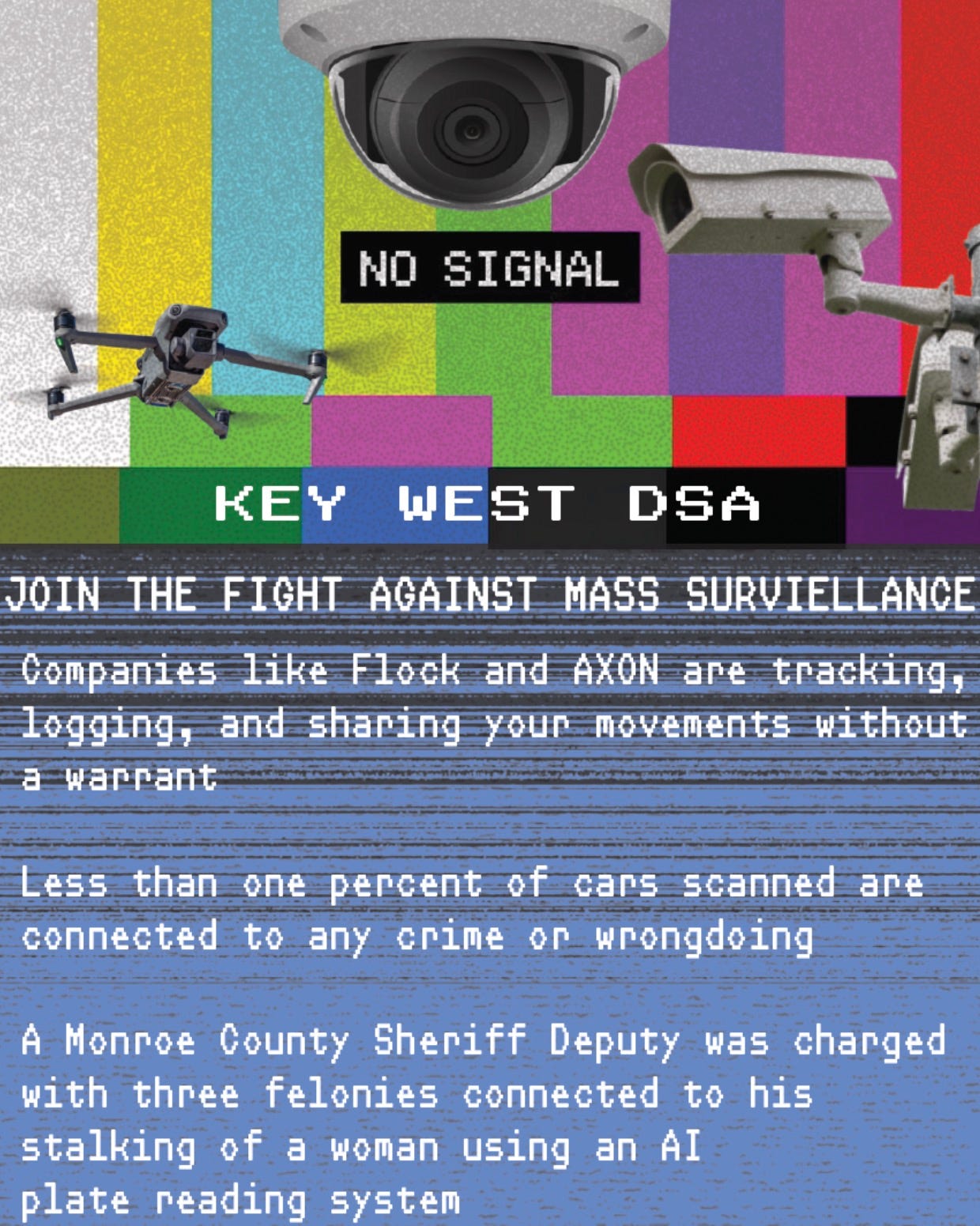
The campaign comes amid a rapidly expanding national debate over automated license-plate readers, interconnected camera networks, drones, facial recognition and artificial intelligence capable of searching and analyzing information collected by police.
That debate reached the highest levels of Florida government Wednesday.
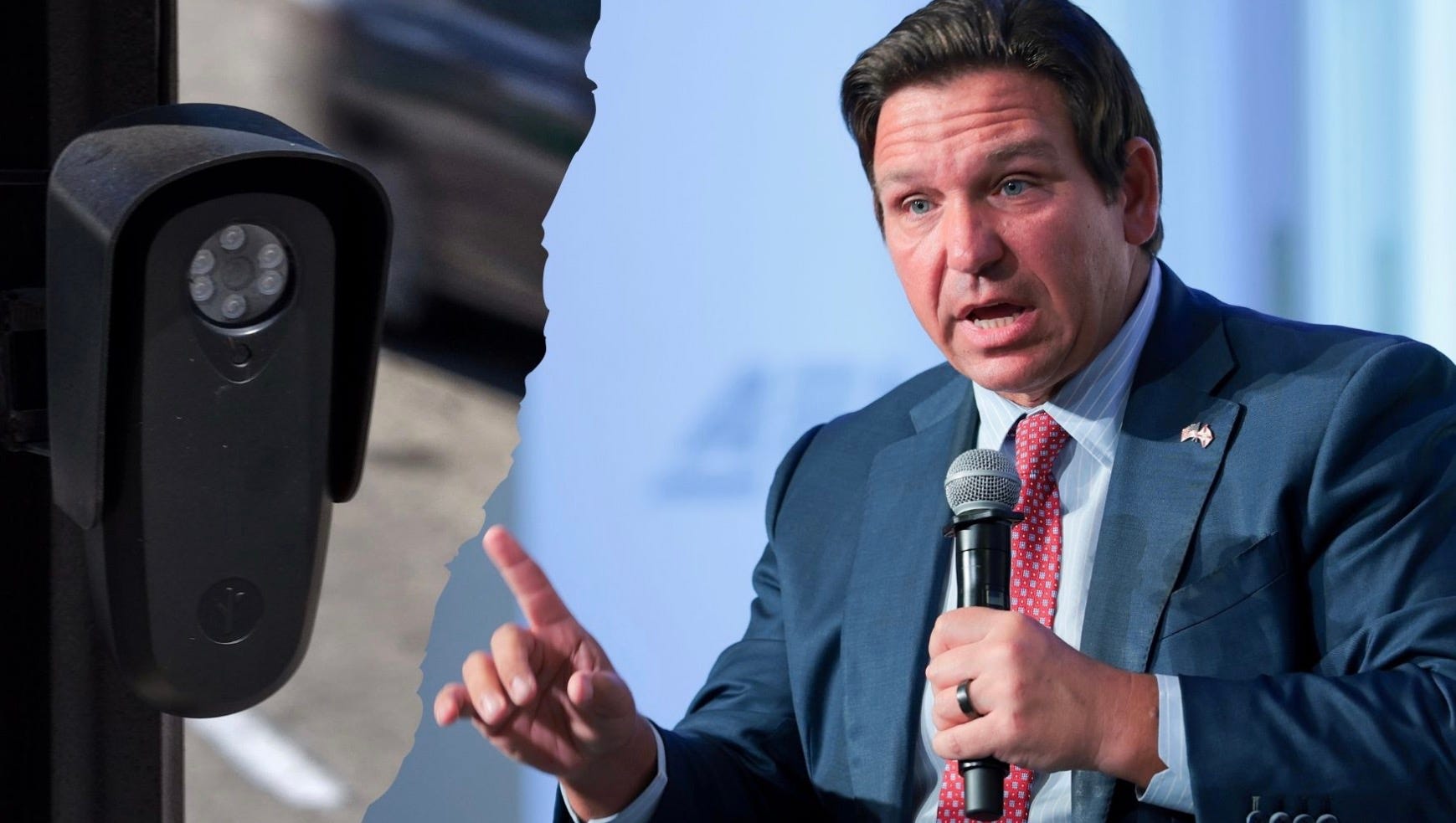
“I think these cameras, license plate readers, I think it’s out of control,” DeSantis said.
The Republican governor, who has made support for law enforcement a centerpiece of his administration, drew a distinction between using technology to investigate crimes and creating a system capable of tracking the movements of ordinary Floridians.
DeSantis said people are “right to be concerned” and warned against allowing the technology to create a “surveillance state.”
He said his administration is examining how Florida agencies use license-plate reader technology and looking at possible legislative restrictions, including policies adopted in New Hampshire.
The governor’s comments put Florida squarely into a surveillance debate already playing out in communities across the country.
Axon vs. Flock: Different Networks, Similar Questions
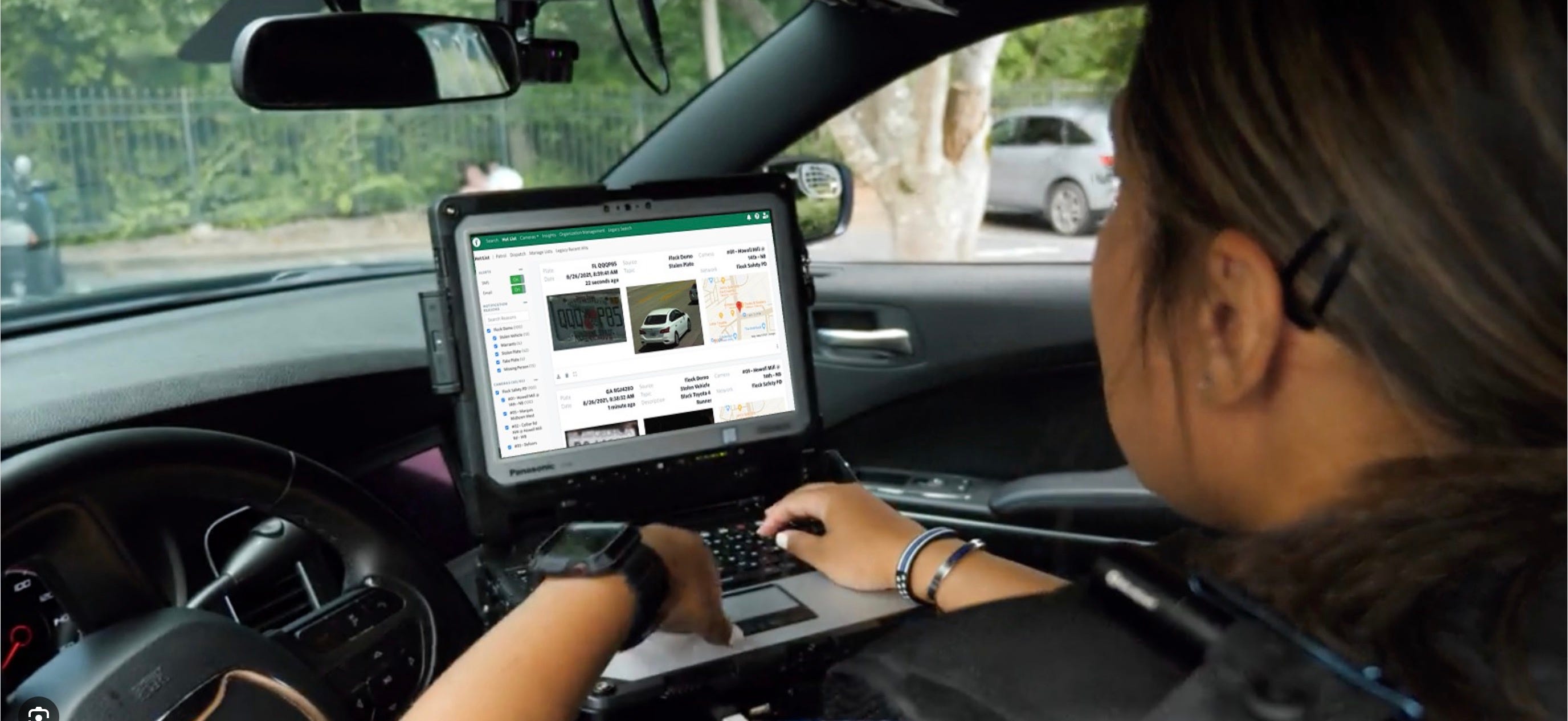
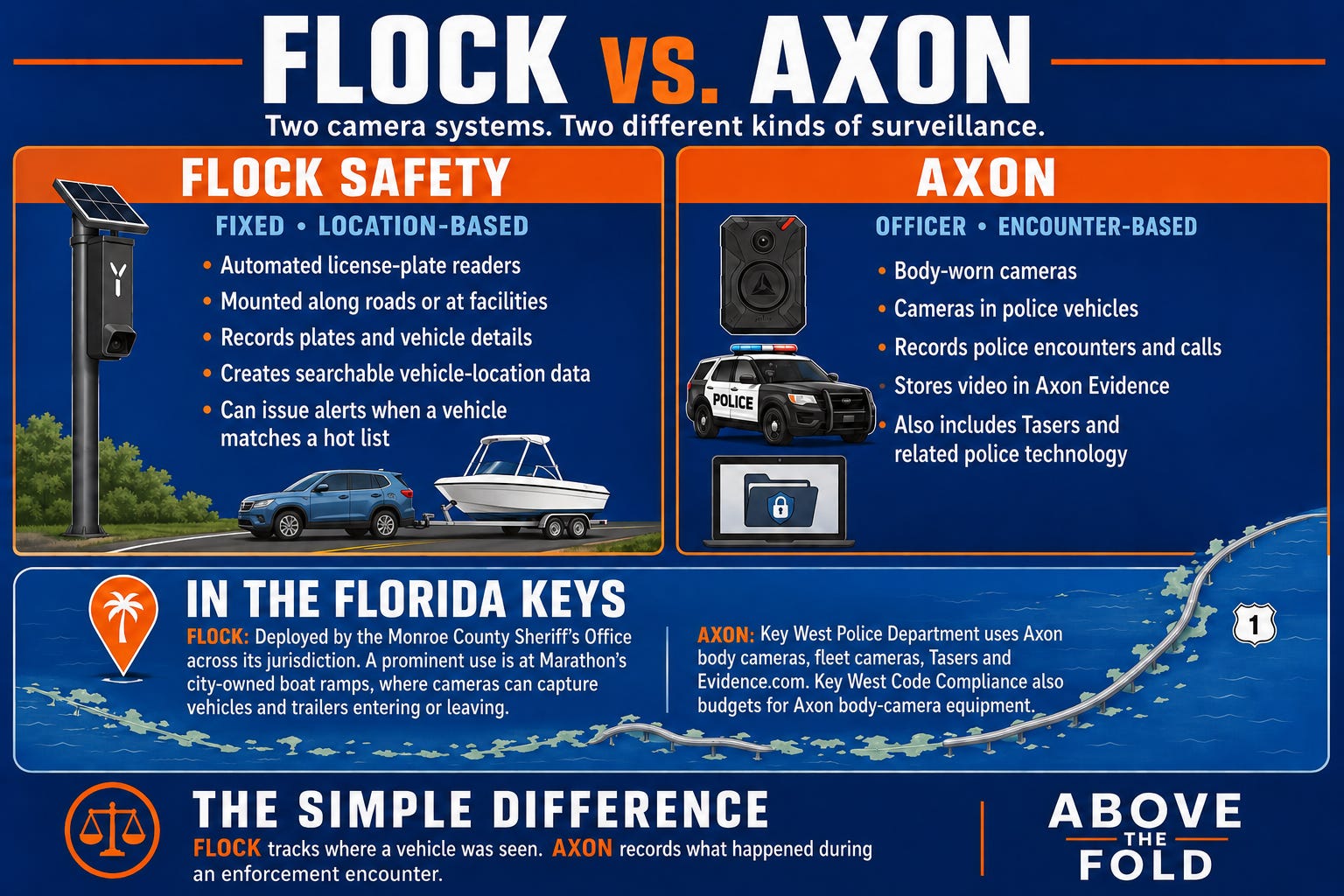
Axon and Flock both sell cameras that scan license plates and record when and where vehicles are seen. Flock specializes in roadside readers connected to a national data-sharing network. Axon incorporates plate readers into a larger police ecosystem that includes body and vehicle cameras, Tasers, drones, artificial intelligence, evidence storage and real-time surveillance.
Axon invested in Flock and partnered with the company in 2020 but ended their integration for new customers in 2025. The companies now compete directly.
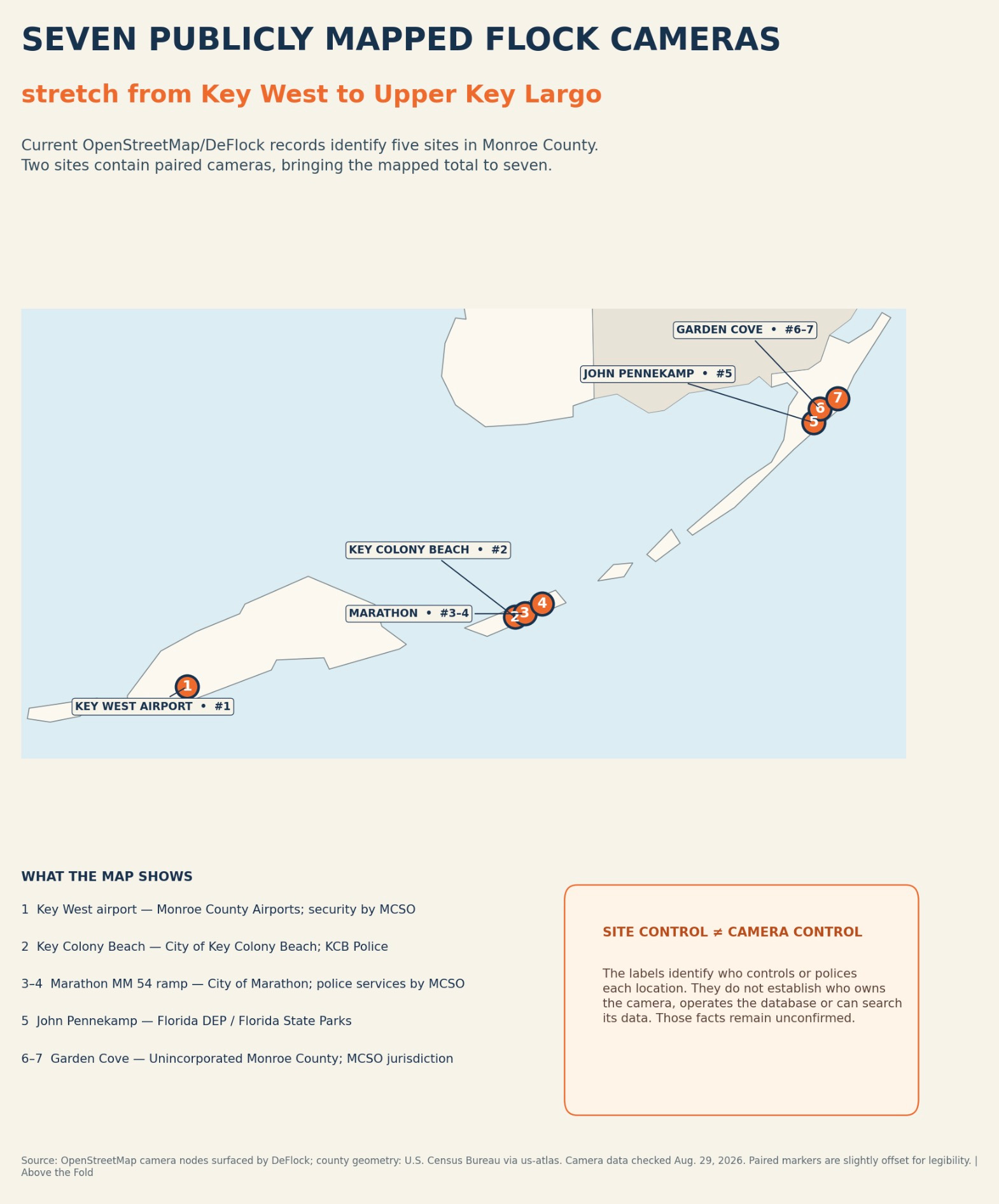
Key West approved a 10-year, $3.74 million Axon master agreement in November 2025. Available records do not confirm that the city has activated Axon’s plate-scanning capability. Flock readers have been publicly mapped in Marathon and Key Colony Beach.
The Guardian reported that Axon has replaced Flock in at least seven municipalities across five states, raising questions about whether communities are reducing surveillance or merely changing vendors.
Some governments have limited Axon:
Pima County, Arizona, rejected a proposed 10-year, $45 million Axon expansion involving cameras, Tasers and AI.
Nashville rejected a five-year contract for Axon’s Fusus camera-integration platform after pausing its use.
Apex, North Carolina, paused a proposed Axon drone and interview-camera agreement for additional review.
Denver approved only a one-year plate-reader contract with restrictions on retention and federal data sharing.
No municipality identified in the available reporting has canceled an entire Axon master agreement comparable to Key West’s contract.
Cities Begin Saying No
At least 56 U.S. cities have rejected or canceled contracts with Flock Safety in 2026 alone, according to an Aug. 20 report by The Guardian.
Flock operates automated license-plate readers that photograph passing vehicles and record information including license plates, locations and times. Law enforcement can then search the information during investigations.
But controversy has increasingly centered on how broadly those databases can be searched, how long information is retained and whether data collected in one community can be accessed by agencies elsewhere.
Some communities have responded by pulling the plug.
Mountain View, California, terminated its Flock program after an audit found outside law enforcement agencies had accessed the city’s license-plate information in violation of local policies.
Other communities, including Bend, Oregon; Salem, Massachusetts; Kaukauna, Wisconsin; and South Kingstown, Rhode Island, have declined to renew or terminated Flock agreements.
Another example emerged Tuesday in Pflugerville, Texas.
The City Council voted unanimously to end its relationship with Flock and deactivate its automated license-plate reader network after questions emerged over access by outside organizations.
Records showed 459 outside organizations conducted nearly 1.6 million searches that included Pflugerville’s camera network during a six-month period, according to published reports.
Those numbers do not mean that every search returned information collected by a Pflugerville camera or that every search was improper. But the extent of outside access prompted city officials to shut down the system and begin developing stronger data-governance rules.
The backlash has spread quickly.
The Guardian reported Aug. 20 that at least 56 cities had rejected or canceled Flock contracts this year alone.
But abandoning Flock does not necessarily mean abandoning surveillance technology.vSome communities have switched to competing vendors, including Axon, and that distinction is particularly relevant to Key West.
A Deal Made Last Year
The Key West City Commission approved its $3,739,205.05 Axon agreement Nov. 5, 2025.
The agreement replaced what city officials described as a series of piecemeal Axon purchasing contracts with an integrated, fixed-price program lasting 10 years.
The agreement predates the current local campaign over AI surveillance.
The Action Network effort is not a lawsuit or formal legal challenge seeking to invalidate the contract.
Instead, it encourages residents to ask commissioners to establish restrictions on artificial intelligence and surveillance technology.
That chronology is important.
Key West commissioners did not approve the Axon agreement this year in response to a proposal for AI surveillance. Instead, the city committed to a decade-long relationship with a police technology company whose products and capabilities continue to evolve while communities across the country are reconsidering how similar technologies should be regulated.
Axon Is No Longer Just Tasers And Body Cameras
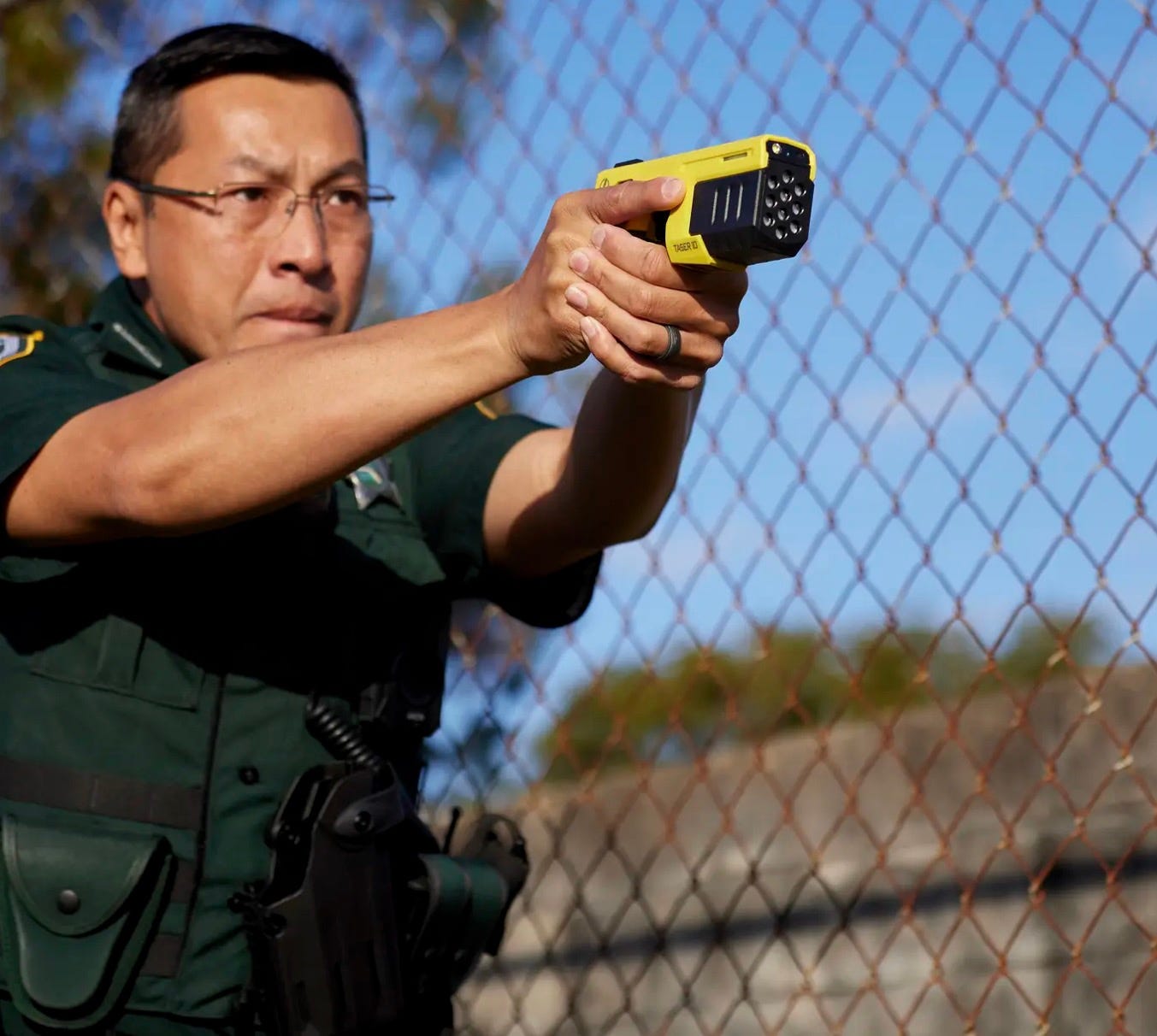
Axon built much of its business around Tasers and police body cameras, but now its product portfolio extends considerably further.
The company offers Fusus, a platform designed to combine information from government cameras, privately owned cameras, license-plate readers, sensors and other sources into a centralized interface.
Axon describes Fusus as offering AI-assisted search and detection capabilities.
The company also offers Draft One, a generative artificial intelligence product that uses transcripts from body-camera audio to produce draft police reports. Axon says officers must review and approve the reports before submitting them.
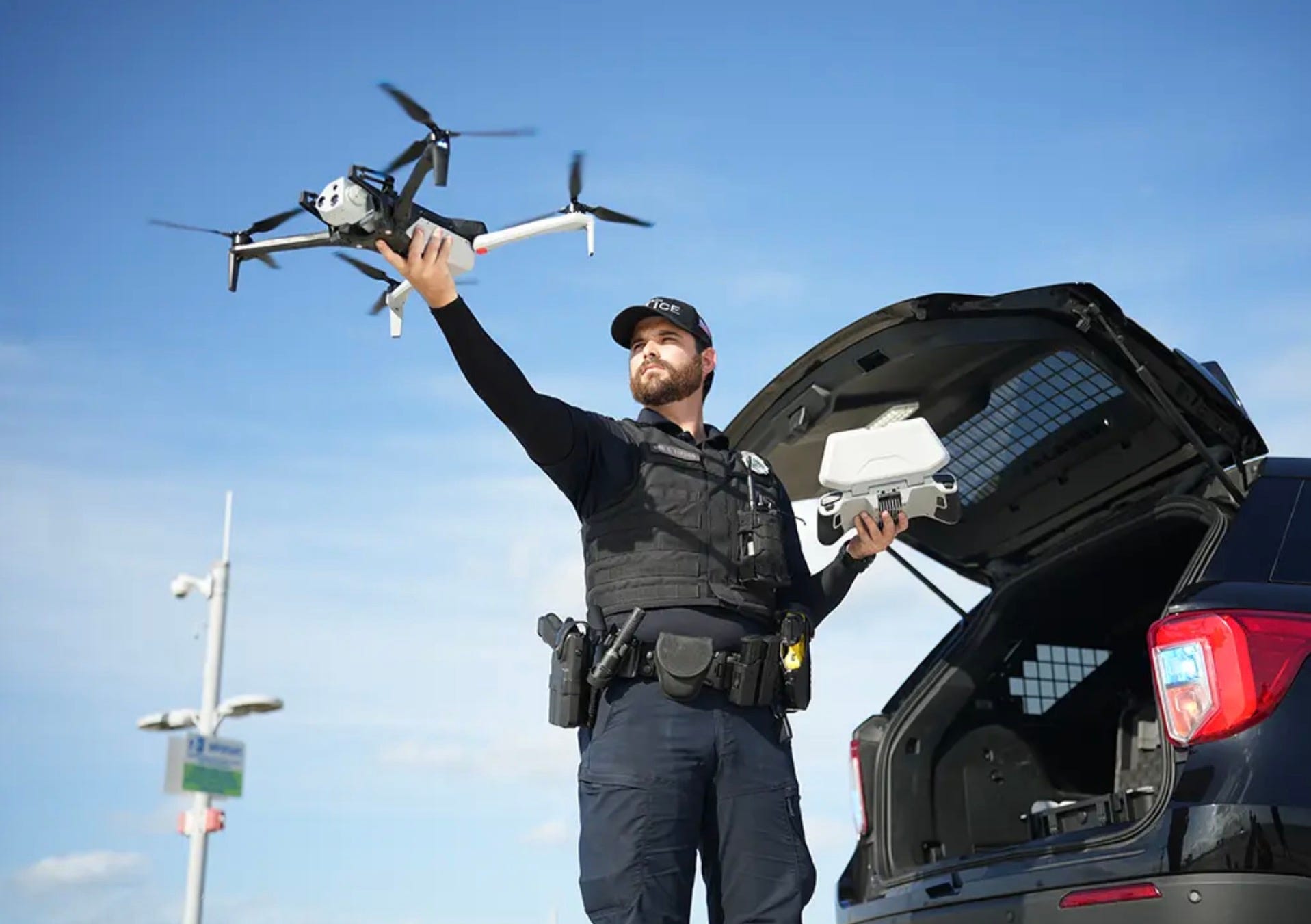
Axon’s technology ecosystem also extends into drones through its relationship with drone manufacturer Skydio.
An Axon representative has publicly described discussions with the Key West Police Department about expanding the department’s drone program using Skydio X10 aircraft.
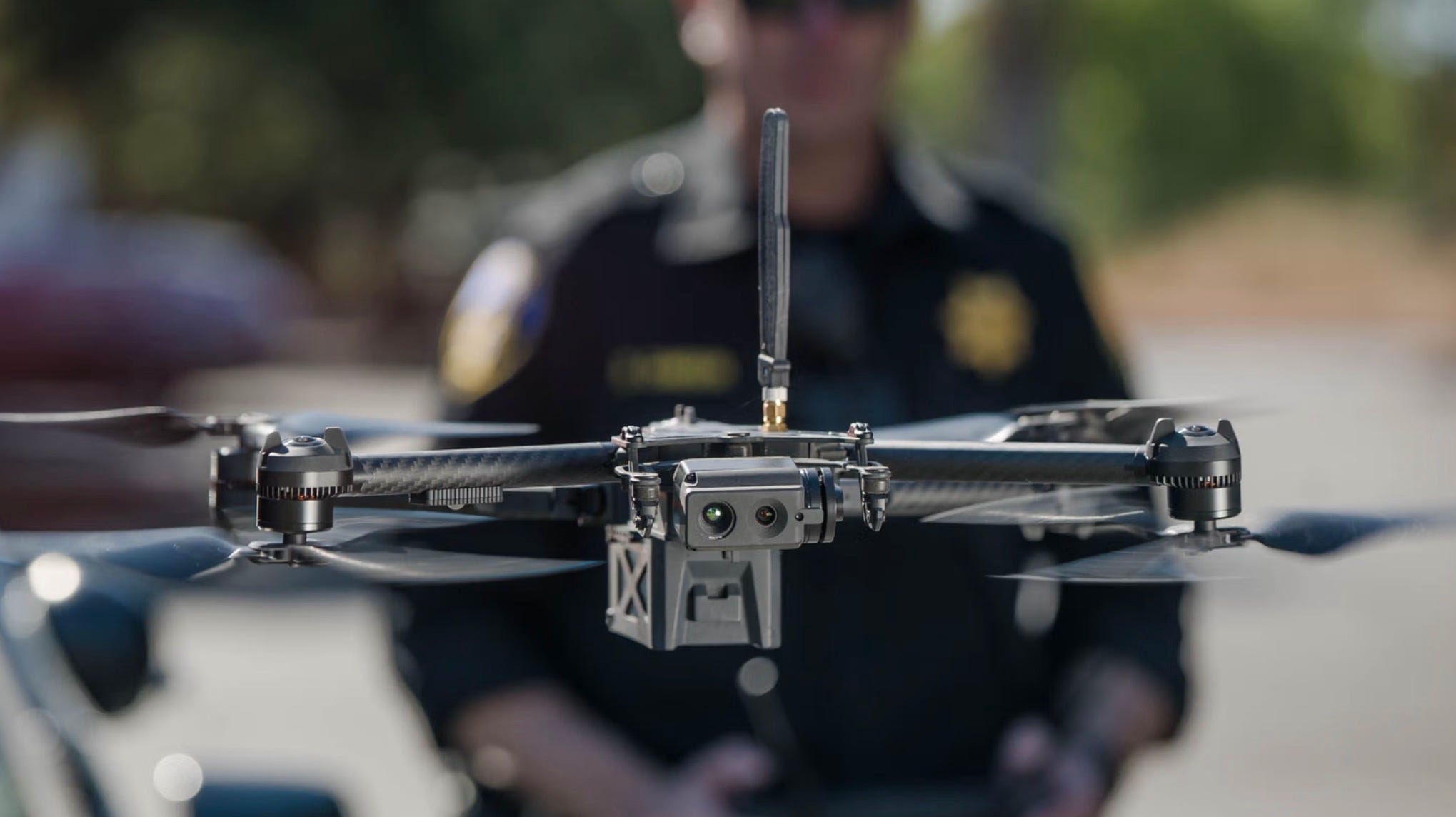
That does not establish that Key West purchased Skydio drones through its 2025 Axon agreement.
Nor has Above the Fold established that Key West currently uses Fusus, Draft One or other specific Axon AI products.
Available records reviewed by Above the Fold also do not establish that those products are included in the city’s $3.7 million agreement.
Those distinctions are significant, because the emerging debate is not simply about technology KWPD is known to be using today. It is also about what capabilities the city may choose to adopt as police technology evolves during a contract extending well into the next decade.
A Long Relationship With Axon
Key West’s relationship with Axon predates the 2025 agreement.
Commissioners approved approximately $250,000 in 2021 for 30 Axon Fleet 2 in-car camera systems.
In 2022, the city approved a roughly $1.53 million Axon package that included 103 Tasers, 103 body-worn cameras, 20 in-car camera systems, two interview-room camera systems and related software.
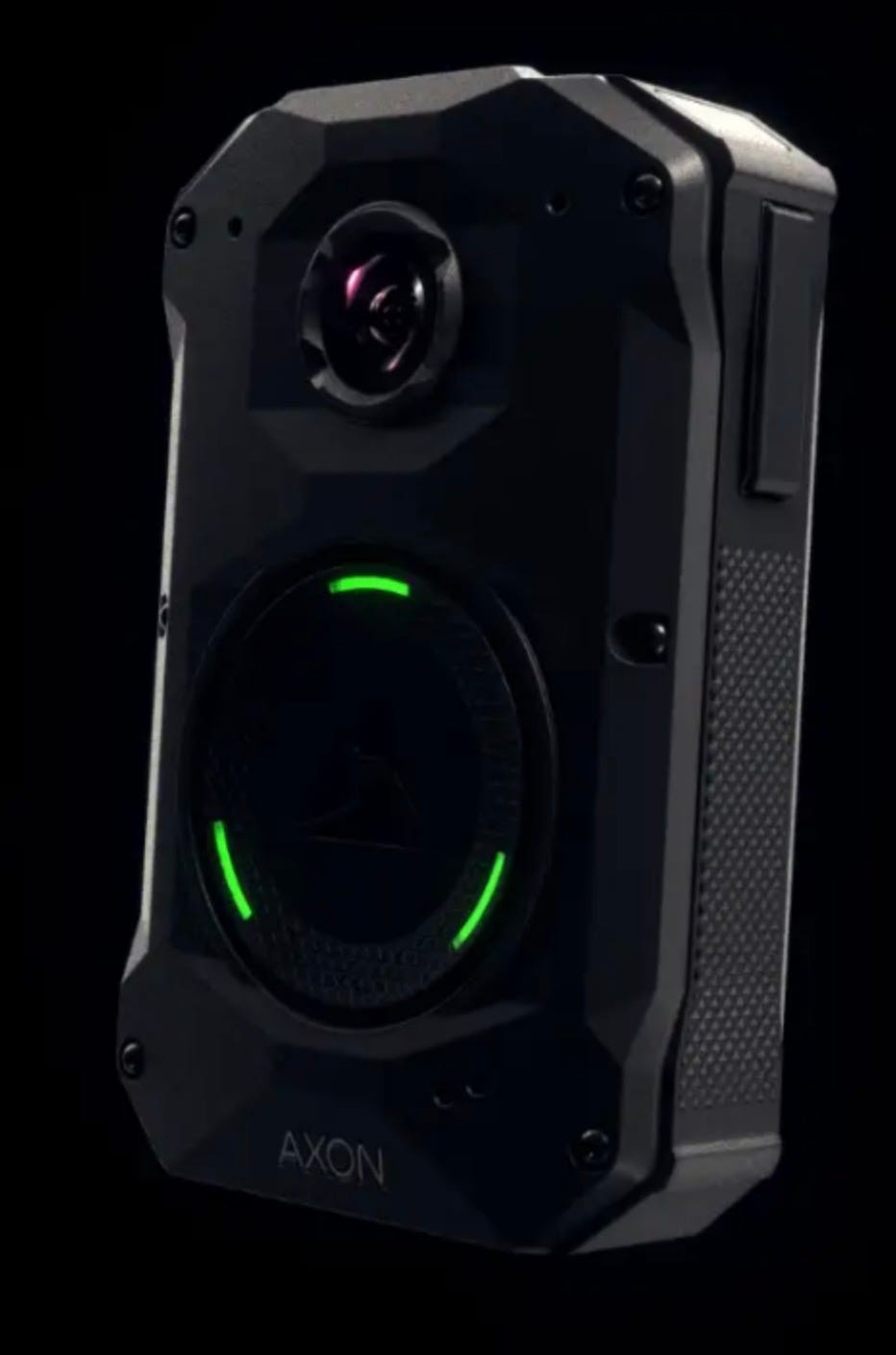
Another $92,412.80 body-camera purchase followed in 2024.
The November 2025 agreement consolidated the city’s Axon purchases into a 10-year integrated program.
Commissioners approved the agreement using provisions of the Key West Code governing brand-name purchasing, sole-source procurement and purchases considered to be in the city’s best interests.
The expanding capabilities of Axon’s product line make the details of that agreement increasingly significant.
It remains unclear whether additional Axon products can be added during the agreement’s 10-year term and which additions, if any, would require separate approval by the City Commission.
Surveillance Beyond Key West
Questions about surveillance technology also extend beyond the Key West Police Department.
The Monroe County Sheriff’s Office, headed by Sheriff Rick Ramsay, provides law enforcement services throughout much of the Florida Keys and has long used body-worn cameras.
The technological relationship between MCSO and Key West police dates back more than a decade.
In 2015, the sheriff’s office purchased 100 body cameras for KWPD using federal High Intensity Drug Trafficking Area funding, helping launch Key West’s body-camera program.
There is also documented evidence that Monroe County sheriff’s investigators have used facial-recognition technology.
During a 2018 Marathon homicide investigation, MCSO said detectives used facial-recognition software and law enforcement databases while attempting to identify a woman whose body had been found by a fisherman.
The potential sharing of information among agencies raises another issue increasingly central to the national surveillance debate.
Modern systems can allow information gathered by one law enforcement agency to be accessed by another.
A Key West policy restricting KWPD from operating a particular surveillance technology would therefore not necessarily answer whether city officers could access information collected through another agency’s cameras, license-plate readers, drones or other systems.
The same question applies to privately owned cameras connected to law enforcement networks.
ASIDE: Virtual Discussion Will Examine License-Plate Surveillance
A virtual community discussion titled “Flock Off: Surveillance Is NOT Safety” is scheduled for 5 to 6 p.m. Wednesday, Sept. 2, as scrutiny of automated license-plate readers grows across Florida and the country.
State Rep. Anna Eskamani and Rindala Alajaji, associate director of state affairs at the Electronic Frontier Foundation, will discuss how Flock cameras work, what information they collect, privacy and civil-liberties concerns, and possible policy safeguards. A question-and-answer session will be available through the Zoom chat.
Flock cameras photograph passing vehicles and create searchable records containing license-plate numbers, vehicle descriptions, locations and timestamps. Police credit the technology with helping locate stolen vehicles, suspects and missing people. Critics question warrantless searches, widespread data sharing, misuse by individual officers and the creation of databases containing the movements of people not suspected of crimes.
The statewide virtual event is separate from the Key West Action Network’s local campaign concerning license-plate surveillance in Key West.
Already In The Keys
The technology at the center of the national debate is not hypothetical in the Florida Keys.
Ocean Reef announced this year that it was adopting Axon Fusus to consolidate cameras and license-plate readers into a common interface and improve coordination with law enforcement partners.
Supporters of automated surveillance systems say the technology can help police identify suspects, recover stolen vehicles, locate missing people and respond more quickly to crimes and emergencies.
Privacy and civil liberties advocates argue that interconnected networks can also allow authorities to create detailed records of people’s movements, including people who are not suspected of crimes.
Recent controversies have increasingly centered on who can access the information.
Nationwide, their has been an uptick in using plate reading systems for personal gain, including stalking potential victims of unwanted affection.
BACKGROUND
Monkey Business In The Keys

It reads like something off the pages of a Carl Hiaasen novel. But a MCSO Deputy used his plate reader to stalk an extra on the Bad Monkey set and later pulled her over. It is a growing problem nationwide.
Mountain View’s experience involved outside law enforcement access that violated city policies.
Pflugerville acted after records revealed that hundreds of outside organizations had conducted searches that included its network.
Those cases illustrate why the debate is increasingly less about cameras themselves than the databases and computer systems behind them.
From Cameras To Artificial Intelligence
Artificial intelligence adds another layer.
A traditional police body camera records an encounter. Modern technology can potentially transcribe that encounter, search the recording, analyze video and use the information to help generate a police report. License-plate readers can record where vehicles are observed. Drones can provide live aerial video. Facial-recognition systems can attempt to identify people captured by cameras.
The integrated platforms can bring information from multiple sources into a common interface.
Artificial intelligence can make enormous quantities of that information searchable in ways that would have been impractical for investigators only a few years ago.
For Key West, the issue is particularly consequential because the city has already committed to a police technology provider for the next decade.
The Axon agreement was approved in November 2025. It was not a response to the current debate over AI surveillance.
But it commits Key West to a company whose police technology portfolio is expanding into many of the same areas now generating scrutiny across Florida and the country.
DeSantis’ comments Wednesday add a distinctly Florida dimension to that debate.
The governor said he supports giving police technology that helps them catch criminals but does not want private technology companies or government systems compiling sweeping records of where ordinary people go.
Some communities have responded by eliminating surveillance systems.
Others have kept the technology while imposing tighter rules governing how information can be collected, retained, searched and shared.
Still others have replaced one vendor with another.
The debate now reaching Key West leaves commissioners with a policy question they did not necessarily answer when they approved the Axon agreement last year:
Not simply what technology police should be allowed to buy, but what government should be allowed to do with the information that technology collects.
This is an evolving story. Watch this space.
Don’t want to become a paid subscriber?