
Mystery Survey Targeting Key West Mayoral Race Draws Complaint Over Disclosure Laws
Questions emerge over attribution, political ties, legality, ethicality and ties to dark money, statewide political operatives.


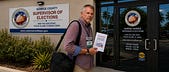
KEY WEST, Fla. — A political “survey” circulated to Key West voters is drawing scrutiny from a local political committee, which is asking elections officials to investigate whether the communication violates Florida campaign disclosure laws.
In a formal complaint submitted to the Monroe County Supervisor of Elections, Jeffrey Siegel, chairperson of A Clean Slate for Key West PAC, said the email-based survey appears to function as a campaign message rather than legitimate opinion research while lacking required attribution.
The communication, distributed by an entity identifying itself as “IH Strategies,” asks recipients a series of questions about the Key West mayoral race between Mayor Danise Henriquez and her Commissioner Sam Kaufman. The survey includes both standard voter sentiment questions and statements portraying Henriquez in a positive light while raising negative associations about Kaufman.
Siegel said the structure and content of the survey suggest it may be a “push poll,” a campaign tactic that mimics survey research while attempting to influence voters.
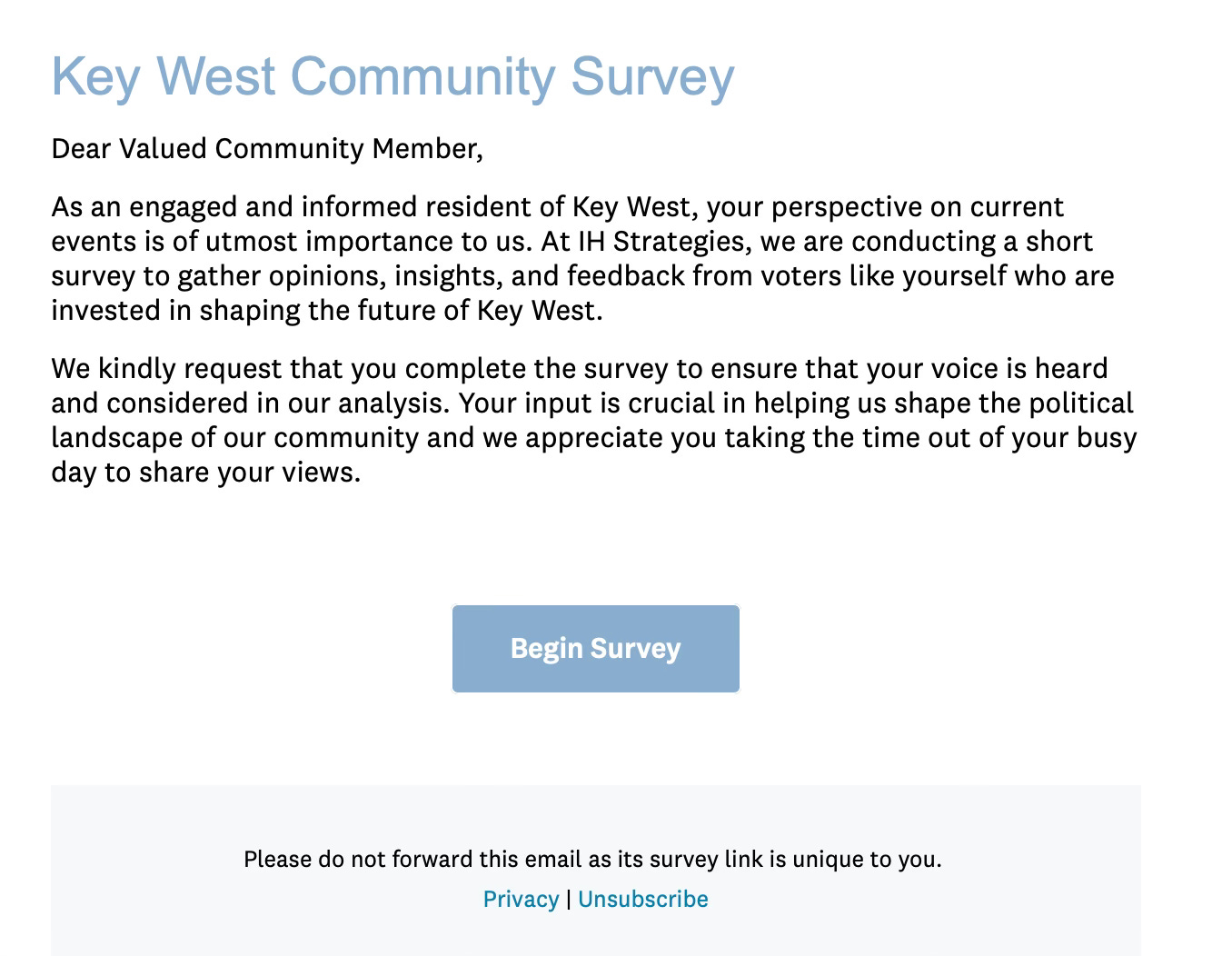
Push polls are not designed to measure public opinion but to shape it, typically by presenting respondents with leading or selective information about a candidate under the guise of a survey. Unlike traditional polling, which relies on neutral wording and controlled sampling, push polls often use persuasive or negative framing and may be widely distributed rather than scientifically conducted.
Among the questions, respondents are asked whether they are more or less likely to support Henriquez after being presented with statements about transparency efforts, community engagement and policy achievements. Another question references Kaufman’s tenure on the City Commission during a period of corruption investigations, asking whether that information affects voter support.
“This communication appears to function primarily as campaign messaging rather than objective data collection,” Siegel said, adding that the lack of a “paid for by” disclaimer deprives voters of transparency.
Kaufman echoed those concerns, saying the survey appears designed to shape voter perception rather than measure it.
“This appears to be less about gathering opinions and more about shaping them,” Kaufman said. “If a communication is designed to influence voters, people deserve to know who is behind it. That’s a basic expectation for maintaining trust in our elections.”
The complaint followed a series of communications between Siegel and local and state officials regarding jurisdiction and potential enforcement.
In a response copied to county and city officials, Assistant County Attorney Patricia Eables said the matter does not fall within the constitutional duties of the Monroe County Supervisor of Elections.
“Any alleged violation you suggest … [is] not within the constitutional duties of the Supervisor,” Eables said, adding that the office concurred that complaints should be directed to the Florida Elections Commission.
Contract City Attorney Mayanne Downs similarly advised that election-related complaints fall under the jurisdiction of the Florida Elections Commission and said she did not identify a clear violation based on the information presented.
“Nothing in your email appears to be a violation of Florida law,” Downs said, while directing Siegel to the state agency responsible for enforcement.
In a follow-up message, Siegel said he would pursue the matter with state authorities and seek further clarification on whether Florida Statute 106.143, which governs political advertisement disclaimers, may apply.
“I will follow your advice and submit a formal complaint to the Florida Elections Commission … what I lack in experience, I hope to make up for with persistence,” Siegel said.
Florida law generally requires political advertisements to include clear disclaimers identifying who paid for and approved the communication. Whether a message qualifies can depend on whether it is designed to influence voter behavior rather than collect neutral data.
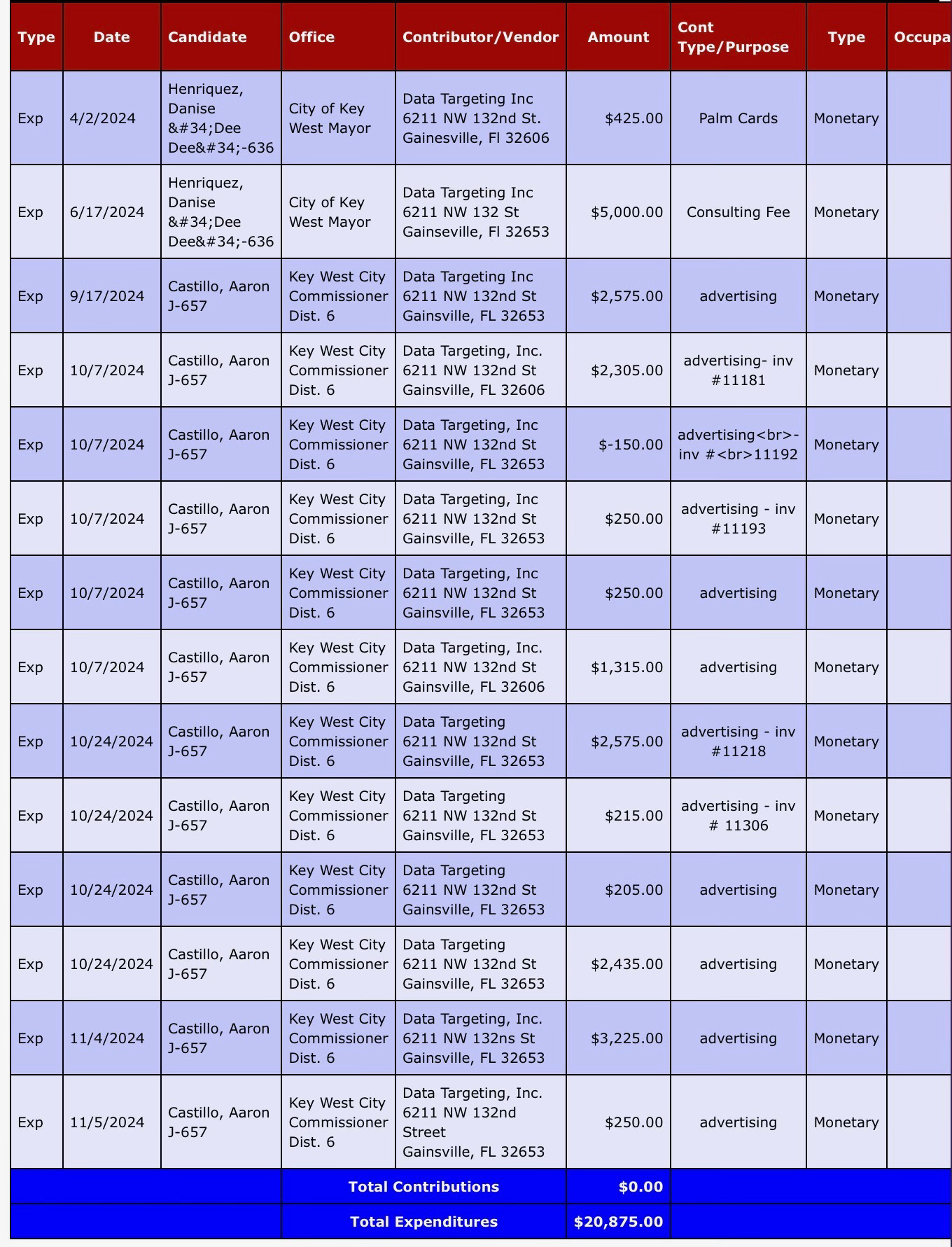
Siegel’s complaint also raises questions about the origins of the communication. He pointed to potential connections between IH Strategies and Gainesville-based political consulting firm Data Targeting Inc., which has previously received payments from Henriquez’s 2024 campaign, according to public campaign finance records.
IH Strategies has been associated with Republican political operative Lance Gardener, a senior figure tied to Data Targeting. Gardener was interviewed by prosecutors in a broader “parallel investigation” stemming from the 2020 ghost candidate scandal involving former state Sen. Frank Artiles, according to records released by the Miami-Dade State Attorney’s Office and first reported by The Orlando Sentinel.
That investigation examined a network of political consultants and nonprofit organizations accused of concealing the source of hundreds of thousands of dollars used to finance political mailers in multiple Florida Senate races. Prosecutors focused on how so-called “dark money” flowed through nonprofit entities that are not required to disclose donors, allowing contributors to “protect their identity,” according to testimony obtained in the case.
Gardener, who served as chief financial officer for Data Targeting, told investigators he oversaw payments to contractors and political entities but said he did not know the full scope or intent of certain consulting arrangements tied to the effort, according to transcripts of his interview.
Campaign finance records also show that Key West City Commissioner Aaron Castillo spent nearly $15,000 with the same firm during his 2024 election bid, further tying the vendor to local political activity.
Beyond legal questions, the spending has also raised concerns within the local business community. The use of out-of-market political consultants, rather than local media, advertising, and public relations firms, has drawn criticism from some who say campaign dollars are being directed away from Key West-based businesses.
That broader history, Siegel said, underscores concerns about whether the Key West communication may be part of a pattern of political messaging designed to obscure its origin.
It was not immediately clear how widely the survey was distributed or whether it targeted a representative sample of voters. Traditional public opinion surveys typically rely on controlled sampling methods and neutral question framing, while push polls are often disseminated broadly and incorporate persuasive language.
Efforts to reach IH Strategies, Data Targeting, Inc. and Gardener for clarification were unsuccessful.
The episode comes as political activity intensifies in Key West ahead of the 2026 election cycle, with the mayoral race expected to draw significant attention and spending.
Siegel said transparency in political communications is essential to maintaining voter trust.
“Messaging that disguises itself as research while concealing its source undermines that trust and misleads voters,” Siegel said.