


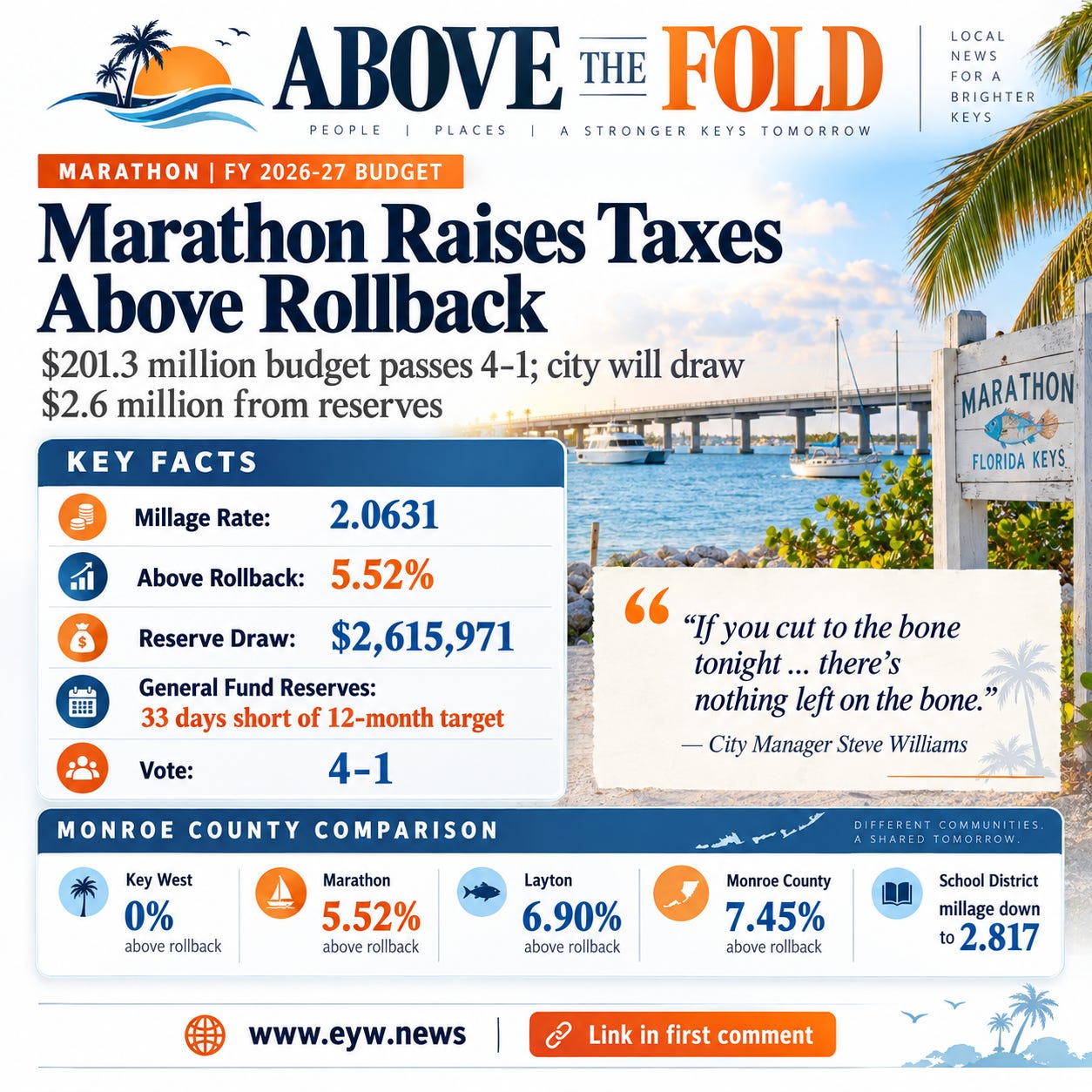
MARATHON, Fla. — Marathon property owners will pay a tax rate 5.52% above rollback next year even as the city plans to pull more than $2.6 million from its General Fund reserves to balance a $201.3 million fiscal 2026-27 budget.
The Marathon City Council voted 4-1 Tuesday after nearly 2½ hours of debate to approve a 2.0631 mill property tax rate and a $201,318,841 spending plan.
The millage rate is unchanged from last year, but because property values increased, it is 5.52% above the rolled-back rate of 1.9552 mills. The rolled-back rate is generally the rate that would generate the same property tax revenue as the previous year, excluding new construction.
Finance Director Jennifer Johnson said the General Fund budget at the adopted rate requires $2,615,971 from reserves, which city officials refer to as deficit spending.
Council member Lynn Landry cast the lone dissenting vote and repeatedly raised concerns about continuing to spend down reserves. Mayor Lynny Del Gaizo, Vice Mayor Debbie Struyf and council members Kenny Matlock and Robyn Still voted for the budget and tax rate.
The decision comes after Marathon adopted the rolled-back rate for three consecutive years, a distinction city officials have said placed it among only three of Florida’s 411 municipalities — and by far the largest — to do so during that period.
But holding taxes to rollback while expenses increased also contributed to the city’s growing reliance on reserves.
Johnson repeatedly reminded council members, who were attempting to reduce an initially proposed 18.82% increase discussed at the Sept. 16 first budget hearing, that anything below that level would require additional reserve spending.

“The reason we are increasing above the roll-back rate is that we were already budgeted to deficit spend about $2 million this year,” Johnson said early in the proceedings. “If that would have compounded and rolled into this year with no tax increase, you would looking closer to a $4 million spending deficit.”
Council members spent much of the evening searching for additional revenue and possible spending cuts.
“I would like to see some more changes,” Struyf said. “I’d like to try to get this down to 7%.”
Discussions included cost-of-living adjustments and merit raises for city employees, the cost of providing fire and emergency medical services to Key Colony Beach and other city services. Several discussions resulted in changes to the spending plan.
The final 5.52% figure places Marathon near the middle of the tax decisions being made by major taxing authorities across Monroe County this budget season.
Key West Went Lower
The City Commission adopted a final rate of 1.8848 mills, exactly equal to its rolled-back rate, meaning a 0% increase over rollback. Key West simultaneously approved a $333,263,334 budget.
Layton Went Higher
Its City Council adopted a final rate of 2.8337 mills, compared with a rolled-back rate of 2.6511 — 6.90% above rollback.
Monroe County Also Went Higher
County commissioners adopted an aggregate millage rate of 3.3975 mills, 7.45% above the aggregate rolled-back rate of 3.1618. The countywide portion alone is 2.6929 mills, 5.91% above its corresponding rollback rate. Commissioners approved a $690.2 million budget.
The county’s individual taxing districts vary substantially. The Lower and Middle Keys Fire and Ambulance District adopted a rate 19.05% above rollback, while the local road patrol district is 9.50% above rollback.
The Monroe County School District moved in the opposite direction, adopting a total rate of 2.817 mills, down 0.13 mills from last year and the district’s lowest millage rate in 12 years. Its fiscal 2026-27 budget increased about 3.8%, however, with rising taxable property values allowing the district to collect additional revenue despite the lower rate.
Key Colony Beach adopted its final fiscal 2026-27 millage and budget Sept. 17. The city’s official records confirm adoption of Resolution 2026-15 setting the final millage, although the searchable version of the resolution currently posted by the city does not expose the numerical rate in its indexed text.
Islamorada has not yet completed its process. The village initially set a maximum proposed rate of 2.8 mills against a rolled-back rate of 2.4756, but later directed staff to prepare a lower budget. Its first hearing produced a tentative plan described locally as roughly a 10% increase in property tax revenue. The final hearing was postponed and is now scheduled for Sept. 28, meaning Islamorada does not yet have a final adopted rate directly comparable with Marathon’s.
For Marathon, the broader comparison underscores the financial compromise council members ultimately made: its 5.52% increase over rollback is higher than Key West’s 0% but below Layton’s 6.90% and Monroe County’s 7.45% aggregate increase.
City Manager Steve Williams said the problem extends beyond this year’s budget, warning council members that the city’s finances could be further strained by changes to Florida property taxes.
“I don’t recall a time in recent years for any of our local governments, especially the city, where our financial future is so uncertain,” Williams told council. “It’s no reflection on Jen but it’s a reflection on what we have on the ballot in November.”
“We don’t know if Amendment 3 is going to pass or fail. If it passes, we still don’t know anything because then we’ll subject to the special legislative session in November or December who defines what are the exemptions from Amendment 3 — most importantly, our fire department and whatever else would get classified as our needs or our services provided.”
Williams cautioned council members that cutting spending too deeply now could leave little room for another round of reductions.
“My point is, if you cut something to the bone, which is what all taxpayers want — me included — if you cut to the bone tonight, and you get told again in March or April to cut to the bone again, there’s nothing left on the bone.”
Several residents who spoke during the hearing called for a lower tax rate.
The final budget leaves Marathon’s General Fund reserves 33 days short of the city’s 12-month reserve target — while still requiring the city to draw another $2.6 million from those reserves during the coming fiscal year.
