


KEY WEST, Fla. — Haitian workers across the Florida Keys lost their driving privileges Friday when TPS-linked licenses expired, even as federal protections remain technically in force through Monday — leaving anyone who gets behind the wheel in violation of Florida law.
The mismatch stems from a gap between federal court action and state licensing. The U.S. Court of Appeals for the D.C. Circuit ruled July 22 that Temporary Protected Status for Haitian nationals cannot be revoked before July 27, when the Supreme Court’s mandate in Mullin v. Doe formally returns to the lower court. U.S. Citizenship and Immigration Services updated work-authorization documents to reflect the new date.
But Florida driver’s licenses for TPS holders had been set to expire July 24, the previous federal deadline, and were not updated to match. The result: Haitian TPS holders can legally work through Monday but cannot legally drive to get there.
The gap hits the Keys’ gig economy first. Haitian drivers are a visible part of the Uber, Lyft and Uber Eats workforce on an island where transportation options are limited. Any TPS holder who drove for a ride-share or food-delivery service after Friday is operating a commercial vehicle without a valid license — a misdemeanor that carries citations, vehicle impoundment and potential contact with law enforcement at a time when federal immigration authorities have signaled aggressive enforcement.

“Haiti is not home for me anymore,” a Key West Uber driver identified only as Jean told the Keys Weekly this month. “I came to Key West in 2016 because Haiti was very dangerous, very poor. And now it’s worse. I don’t know what will happen.”
The expired licenses are the first concrete blow in a week expected to bring a second, larger one. TPS has not been extended. The program remains in effect only as a procedural hold while the Supreme Court’s June 25 ruling — a 6-3 decision allowing the Trump administration to terminate protections for approximately 350,000 Haitian nationals — works through the appellate system.
Volunteers with immigrant support groups have said they have seen an uptick in enforement actions in Key West as Customs and Border Patrol ramp up for impending enforcement actions; the heaviest activity over the past seven days has been in the vicinity of the Riviera Mall on Flagler Avenue and Stadium Trailer Park on Duck Ave.
The volunteers — who asked not to be identified for fear of retribution from authorities — said they believed that the Haitian community has look outs posted to warn of immigration activity.
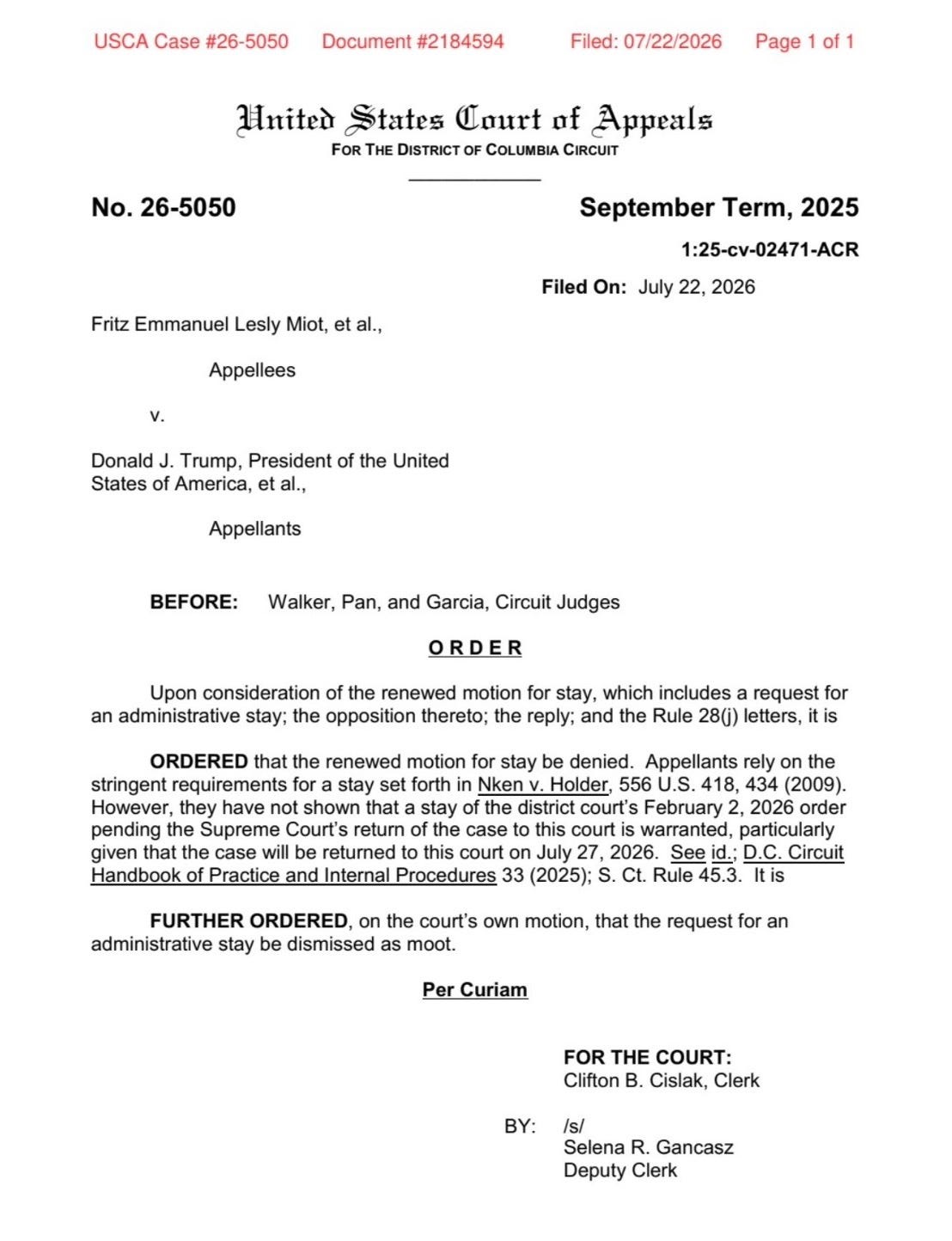
Once the mandate reaches the D.C. Circuit on Monday, the appeals court is expected to lift the district court injunction that has blocked termination since February. When that happens, the federal E-Verify employment verification system will automatically flag Haitian TPS holders as work-authorization noncompliant. Employers who entered July 27 as the expiration date in their I-9 and E-Verify records — as USCIS instructed July 24 — will see those authorizations lapse. Workers who cannot present alternative proof of eligibility must be terminated or the employer faces federal civil and criminal liability.
For Keys businesses, the fallout will be immediate. Haitian workers staff hotels, restaurants, Lower Keys Medical Center, nursing homes, construction crews and commericial fishing operations.
Some 5,000 Haitian nationals are believed to live and work in the Lower Florida Keys.
One of the hardest-hit businesses in Monroe County and elsewhere in Florida is expected to be Waste Management the solid waste removal conglomerate, which has yet to issue a corporate level statement on the matter.
“The Haitian community is an integral part of our island,” Key West Business Guild Executive Director Rob Dougherty told local media. “Many Haitian residents serve as essential workers, particularly within the service and hospitality industries. The loss of TPS would create significant staffing challenges for many of our member businesses.”
Statewide, an estimated 158,000 Haitians hold TPS, with 93,000 in the workforce. The Florida Restaurant and Lodging Association says they contribute $2.6 billion annually to the state economy. An estimated 36,350 work in health care, many caring for the state’s elderly.
The Archdiocese of Miami said Friday it will terminate at least 40 employees at Catholic Health Services because of the changes, with 10 more under review.
The City of Key West said at recent budget meetings that it expected a loss of four total positions across departments, although that doesn’t reflect the real numbers. A large part of the city’s Haitian employees were furloughed earlier this year after incumbent Mayor, Danise Henriquez, voted against a resolution positioning the City she runs to support an extension off TPS.
The mayor, who faces re-election, was the sole loan vote against the resolution, and also led the charge to re-enroll the City in a 287(g) agreement with the Department of Homeland Security that allowed the Key West Police Department to officially cooperate with immigration authorities.
A bill extending Haitian TPS through early 2029 passed the U.S. House in April but remains stalled in a Senate committee as Congress nears its summer recess. The Department of Homeland Security maintains Haiti is safe enough for nationals to return. The U.S. State Department and the United Nations disagree, citing pervasive gang violence, kidnappings and political collapse.
TPS was first granted to Haitian nationals after a 7.0-magnitude earthquake struck the country in 2010, killing more than 200,000. The designation has been renewed repeatedly as conditions deteriorated.
In Monroe County, teachers have reported empty seats and frightened families since the Supreme Court ruling, and the district could lose several thousand students which will negatively impact school funding in a precarious property tax environment in Tallahassee. Many TPS holders have U.S.-born children who are American citizens, raising the prospect of family separation if their parents lose legal status.
This is an evolving story. Watch this space.