

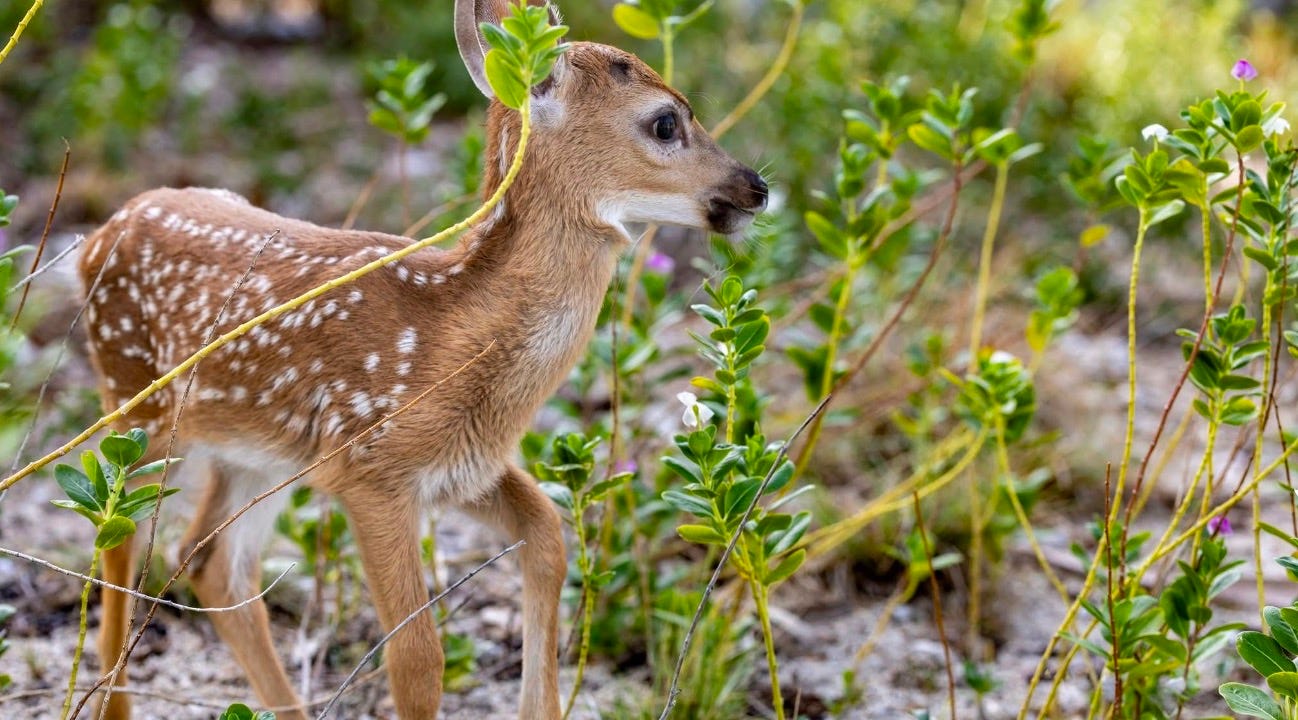
BIG PINE KEY, Fla. — Key deer believed to be the last remaining on a College of the Florida Keys (CFK) property have been safely relocated to nearby open habitat, the college announced this week, completing a monthslong collaborative effort with federal and state wildlife agencies. But at least one wildlife advocacy group is questioning the relocation method used.
The relocation involved the U.S. Fish and Wildlife Service (USFWS), the Florida Fish and Wildlife Conservation Commission (FWC) and cooperating veterinarians, according to CFK. The agencies will continue monitoring the property to confirm no additional deer remain on-site.
How the relocation worked
Wildlife professionals sedated the deer before moving them to a holding area, where veterinary staff monitored the animals until they were confirmed stable and alert. The deer were then released together at a nearby open habitat site.
CFK officials said sedation is a standard, widely accepted method used in wildlife capture and relocation efforts nationwide. The approach allowed crews to safely navigate the property’s hazards — including collapsed structures, exposed rebar, hidden barbed wire and dense vegetation containing poisonwood — while avoiding an alternative method: leaving a gate open, which the college said could have allowed more deer to wander onto the property rather than off it.
Advocacy group raises concerns
Not everyone agrees with that reasoning. Valerie Preziosi, president of Save Our Key Deer, Inc., said chemical immobilization carried more risk to the endangered deer than an alternative the group had proposed: a two-way, humane wildlife passage built into the fence.
“Chemical immobilization posed a greater risk to the Key deer than simply allowing the proposed two-way, humane wildlife passage in the fence,” Preziosi said. “Why weren’t the deer released in their original location?”
Preziosi said the deer’s limited range is central to their endangered status, and that human encroachment and overdevelopment have already shrunk their habitat significantly. She said the animals need access to as much of their historic range as possible, particularly areas with critical water sources.
“When they can’t access important habitat and water, they resort to alternative, less ideal options,” Preziosi said. “The photos clearly illustrate the difference between free access and habitat fragmentation caused by fences blocking access.”
Property history and zoning
The site previously housed the Big Pine Key Road Prison and is zoned Suburban Commercial. It sits outside the boundary of any wildlife refuge, including the National Key Deer Refuge, according to CFK.
As the property owner, CFK said it is responsible for securing the site for public safety. College officials described the former prison grounds as containing multiple deteriorating and dangerous structures, including collapsed buildings and hidden hazards.
Security measures underway
— CFK outlined several steps taken to secure the property:
— Repaired a vandalized gate and fence line
— Replaced locks across the site
— Installed security cameras
—Plans to install deer grates along gates to prevent future deer entry
What’s next
CFK said it remains grateful to its federal, state and local partners for their expertise throughout the relocation effort. The college directed the public to it’s website for updates on the property’s future development.