


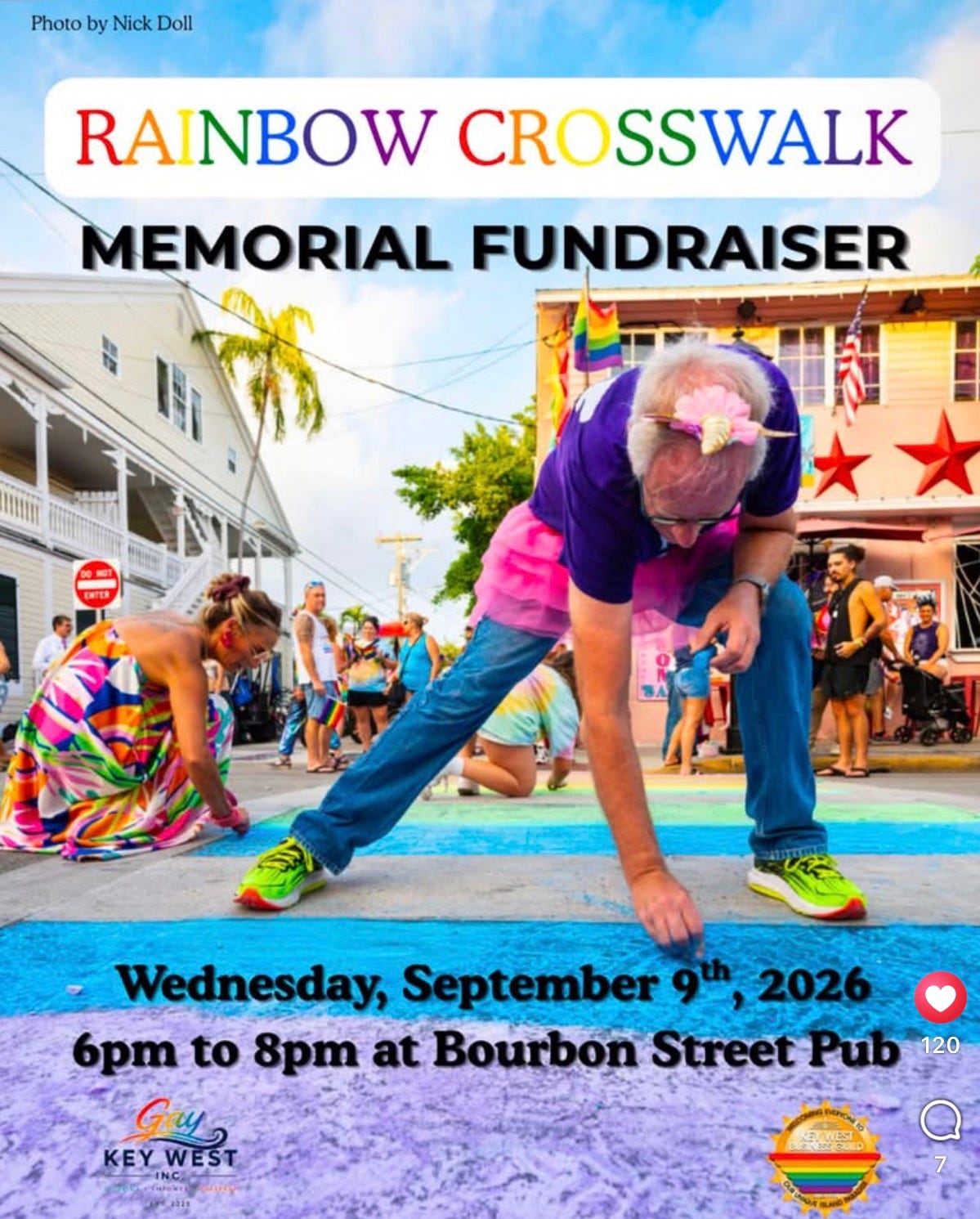
KEY WEST, Fla. — The Key West Business Guild will hold a fundraiser next month to support a proposed memorial to the rainbow crosswalks removed from Duval Street nearly one year ago.
The Rainbow Crosswalk Memorial Fundraiser is scheduled for 6 to 8 p.m. Wednesday, Sept. 9, at Bourbon Street Pub. The suggested donation is $10.
The event falls on the first anniversary of the removal of the four rainbow crosswalks at Duval and Petronia streets. State crews painted over the crosswalks during the early morning hours of Sept. 9, 2025, after the Florida Department of Transportation ordered Key West and other communities to remove street art it considered inconsistent with state standards.
Event details
What: Rainbow Crosswalk Memorial Fundraiser
When: 6-8 p.m. Wednesday, Sept. 9
Where: Bourbon Street Pub, Key West
Admission: $10 suggested donation
The Key West crosswalks were installed in 2015 as a symbol of the island’s LGBTQ+ community and were replaced with permanent colored markings in 2020.
BREAKING NEWS: Duval and Petronia crosswalks repainted

The battle over Key Wests rainbow-colored Pride crosswalks at the corner of Duval and Petronia streets entered a new chapter Thursday night, when fresh paint appeared on the pavement just days after the state removed the original designs under the cover of darkness.
The Business Guild said it has been working with the city on a multistep plan to create a Rainbow Crosswalk Memorial while recognizing the broader history of Key West’s LGBTQ+ community.
Renderings of several historical placards proposed for Duval Street will be unveiled during the fundraiser. The guild would own and manage the placards, which would document local LGBTQ+ history and explain the former crosswalks’ significance.
The proposal also includes an augmented-reality experience. Visitors could scan a QR code on the crosswalk placard and use a cellphone camera to see a virtual recreation of the rainbow crosswalks overlaid on the street.
Money raised will help pay for the augmented-reality technology and the larger memorial project. Donated items will also be auctioned during the event, and each attendee will receive a piece of chalk.
ACLU Sues Key West Over Enforcement Actions Tied To Rainbow Fence Protest

KEY WEST, Fla. — A Key West couple has filed a federal lawsuit against the City of Key West alleging officials selectively enforced historic district regulations after residents painted rainbow-colored fence pickets in protest of the city’s removal of the Duval Street rainbow crosswalks.
Gay Key West is helping collect donations through its nonprofit organization, according to organizers.
Four initial sponsorships will be available to businesses interested in supporting individual historical placards. Sponsors would receive recognition on a placard and on the website hosting the augmented-reality experience.
Those interested in donating money or an auction item, or sponsoring a placard, may contact Jordan Upchurch at itssocialtimesomewhere@gmail.com.
Donations may also be made at qrco.de/bgz3hD.
Thank you for reporting on the Key West Business Guild’s Rainbow Crosswalk Memorial Fundraiser and for keeping the community’s attention on the Duval and Petronia Street rainbow crosswalks that were removed last year. A chalk restoration, commemorative placards, and an augmented-reality experience are meaningful ways to mark the anniversary and recognize a symbol that mattered to many residents and visitors.
But I hope the fundraiser prompts a broader question rather than closing the book on the issue: **Is an annual memorial enough, or can Key West find a durable way to tell this part of its history?**
Chalk fades. A one-night AR activation and sidewalk placards may be thoughtful and effective, but they are temporary. They do not provide visitors with a lasting opportunity to understand why the rainbow crosswalks mattered or the larger history behind them.
If Key West wants something that lasts, I suggest thinking beyond a single memorial and toward a **content-neutral historic marker and public art program** that tells the broader story of Key West.
Such a program could recognize Conch heritage, the U.S. Navy’s presence on the island, Cuban migration, literary history, the cigar industry, maritime commerce, the AIDS epidemic, Fantasy Fest, and the LGBTQ community’s documented contributions to Key West’s tourism economy and cultural identity — along with the many other people, businesses, events, and industries that shaped modern Key West.
That approach has an important advantage: **it treats LGBTQ history as history.**
The question should not be whether a particular community is permitted to have a place in Key West’s public history. The question should be whether historically significant events, people, businesses, and contributions can be documented objectively and consistently alongside the rest of the island’s history.
A legally durable program could be structured around several straightforward principles:
* **Individual markers or installations could be privately funded, owned, and maintained** by nonprofit organizations, business associations, or other private entities, with the City performing only its ordinary regulatory functions — such as right-of-way, engineering, safety, HARC, Planning, and other content-neutral reviews.
* **Any City participation would be limited to what is legally permissible**, avoiding unnecessary ongoing financial, ownership, promotional, or programmatic obligations that could create additional legal questions under SB 1134.
* **Historical content would be factual and documented**, describing the cultural, economic, and historical significance of the people, businesses, communities, and events being recognized. LGBTQ history could therefore be presented as one important thread in the larger story of Key West, rather than as a stand-alone City diversity initiative.
This would not require the City to endorse a political position. It would require the City to recognize that **history does not become less historical because the people involved belong to a particular community.**
Key West’s tourism economy and cultural identity were shaped by many communities. The LGBTQ community is a **documented part of that story**, including the history of Fantasy Fest, LGBTQ-owned and LGBTQ-serving businesses, and the broader role the community has played in Key West’s visitor economy and cultural life.
That history deserves more than an annual chalk drawing.
Key West should be able to tell its history honestly, comprehensively, and in a form built to last — while respecting current state law and applying the same objective standards to every historical contribution.
The goal should not be to recreate one particular symbol at all costs. **The goal should be to ensure that legitimate chapters of Key West history remain available to residents and visitors, even as laws and political circumstances change.**
Respectfully,
**Loretta M. Di Tocco**
Key West, Florida