


Florida’s environmental regulators have ordered the Village of Islamorada to overhaul its wastewater collection system and pay more than $11,000 in fines after documenting repeated sewage spills that violated state clean-water rules — part of a broader pattern of enforcement across the Florida Keys.
The Florida Department of Environmental Protection’s Southeast District in Marathon announced the consent order (OGC File No. 25-0038) on October 15, 2025, citing at least six separate unauthorized discharges between 2021 and 2025, most from the 286 Gardenia Street Pump Station near Mile Marker 92.
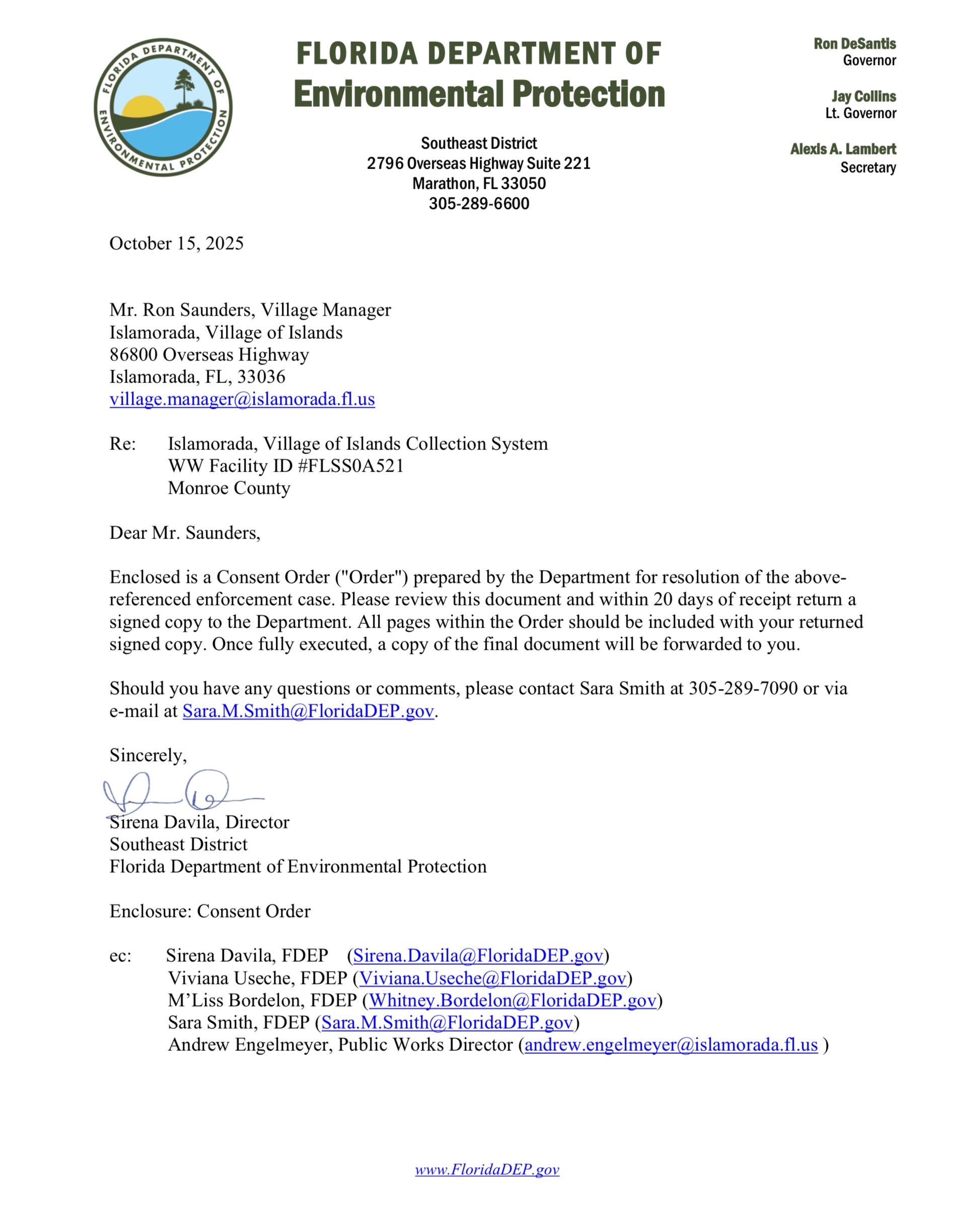
The consent order was detailed in an Oct. 15 letter to Village Manager Ron Saunders
.
The state found that Islamorada repeatedly discharged untreated wastewater into the environment, failed to maintain or update its operation and emergency manuals, and allowed aging infrastructure to rupture.
“These recurring discharges represent clear violations of the Florida Administrative Code,” the order states, “and require immediate corrective action to protect the waters of the Florida Keys.”
Aging Infrastructure and Spills
According to DEP records, Islamorada’s system released more than 430,000 gallons of untreated sewage since 2021, including a single 400,000-gallon overflow in July 2022. Smaller discharges occurred along U.S. 1 near Mile Marker 92.3 and at other North Village pump stations.
The village purchases wastewater treatment from the Key Largo Wastewater Treatment Plant, serving mile markers 90–72. Officials have told regulators that replacing the Gardenia Street pump station with an in-line booster system will help prevent future failures.
AT ISSUE — Sewage Spills and Consent Orders in the Florida Keys
Islamorada: Gardenia Street Pump Station (DEP OGC 25-0038)
May 3, 2021 — 10,000 gallons of untreated sewage overflowed from the Gardenia Street pump station.
July 23, 2022 — Major release of ≈400,000 gallons of untreated wastewater at the same site; no recovery reported.
June 18, 2023 — Pipeline rupture near Burton Drive spilled about 2,000 gallons.
May 13, 2024 — Another rupture at Mile Marker 92.3 released 4,000 gallons.
Sept 2, 2024 — Repeat overflow at the same MM 92.3 location, again ≈4,000 gallons.
Mar 27, 2025 — Pump failure at Gardenia Street sent ≈10,000 gallons of raw sewage into the ground.
Total (2021–25): ≈430,000 gallons discharged, all untreated and unrecovered.
State action: DEP consent order requires a compliance plan (due Dec 2025), an in-line booster-pump replacement by Dec 31, 2027, updated emergency plan within 90 days, and semiannual progress reports.
Penalty: $11,320 (civil + costs) with option for an in-kind environmental project worth at least $16,230.
Under the consent order, Islamorada must:
Submit a compliance plan within 60 days outlining repairs and replacement schedules.
Complete construction and commissioning of the booster pump by December 31, 2027.
Update its Emergency Response Plan within 90 days.
File semiannual status reports each January 30 and July 30 until the project is operational.
Penalties and Compliance Options
The DEP assessed $10,820 in civil penalties plus $500 in investigation costs. Islamorada may offset the fine with an “in-kind” environmental project valued at least $16,230, such as restoration or infrastructure upgrades beyond the required fixes.
Future spills could trigger stipulated penalties up to $15,000 per day, depending on the discharge volume. Continued non-compliance could expose the village to additional civil or even criminal penalties under Florida Statute 403.161.
The consent order was signed by Sirena Davila, director of DEP’s Southeast District.
Key West Faced Similar Action
Islamorada is not the first Keys municipality ordered to clean up its act. The City of Key West entered its own DEP consent decree (OGC File No. 21-0581) in 2021 over unreported discharges and system-maintenance lapses at the Richard A. Heyman Wastewater Treatment Plant. That agreement required quarterly reports, public-notice postings, and in-kind environmental mitigation.
Together, the two cases highlight the state’s escalating push to modernize wastewater systems across Monroe County — infrastructure that faces twin pressures from heavy tourism and rising seas.
“These consent orders underscore that water-quality compliance in the Keys is not optional,” a DEP source familiar with both cases said. “We’re dealing with coral-reef protection zones, nearshore ecosystems, and public-health issues.”
Broader Context
The enforcement effort comes amid renewed scrutiny of the Keys’ nearshore waters, where nutrient pollution and bacterial exceedances threaten both coral reefs and the region’s tourism economy.
Islamorada’s consent order requires final compliance within three years of its effective date. Failure to meet deadlines could result in daily fines and jeopardize state permits for future wastewater projects.