


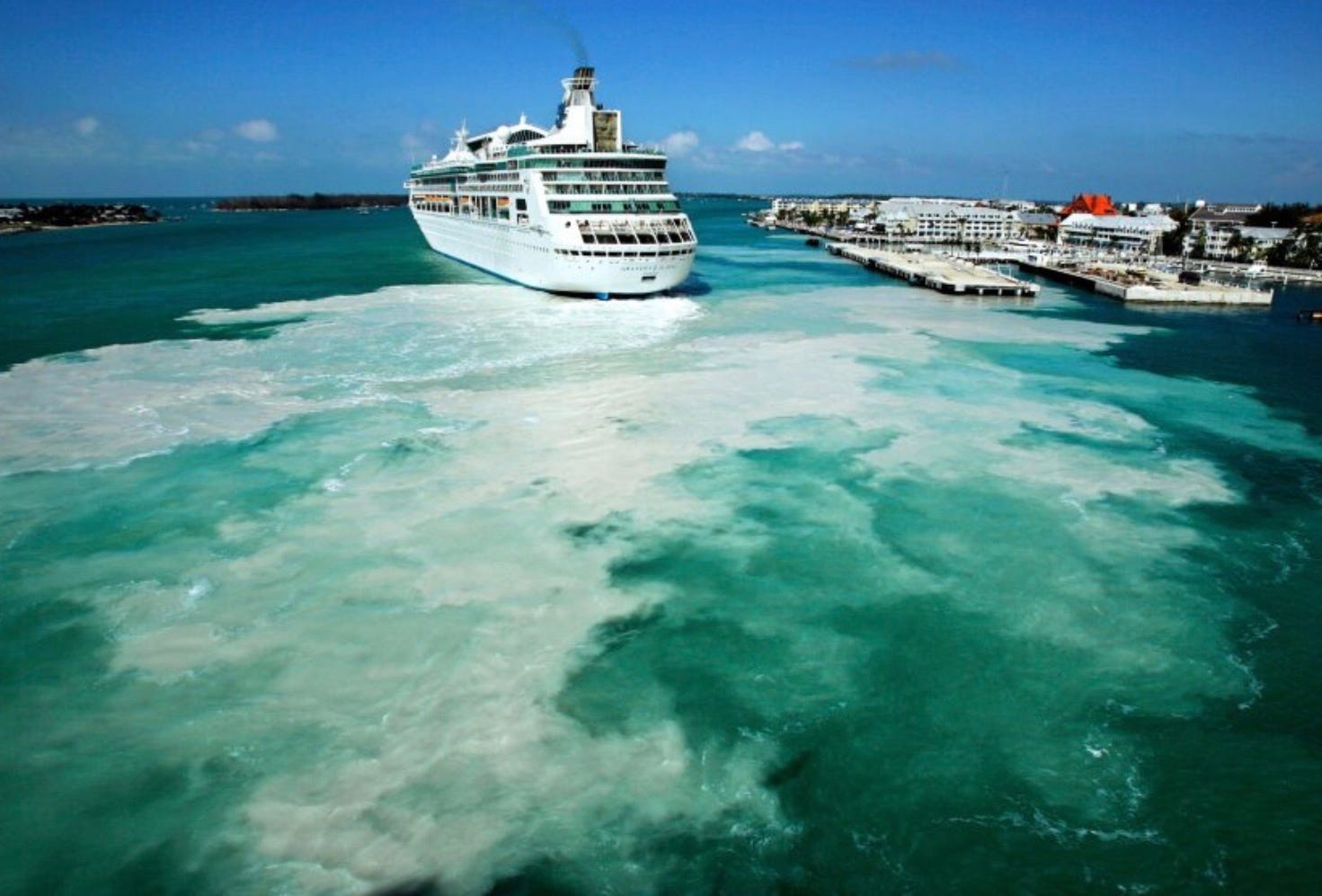
An email obtained and reviewed by Above the Fold shows a Key West resident formally challenging city officials after turbidity testing was removed from a long-awaited proposed water-quality monitoring contract, arguing the move contradicts state law, the city’s own governing documents, and further delays comprehensive testing of harbor waters.
The email, sent Tuesday to Commissioner Lissette Carey, was written by Jordan Mannix-Lachner, who noted she was responding as a private citizen, not in a formal capacity, even though she also serves as executive director of the environmental advocacy group Last Stand of the Florida Keys.
“I am writing to you as a citizen, not in any formal capacity,” Mannix-Lachner wrote. “This information has been provided to commissioners in the past, and it was provided again today.”
The correspondence followed comments at City Hall and actions by commissioners and the city attorney that eliminated turbidity as a testing parameter from a water-quality proposal submitted by engineering firm Stantec.
“In response to your comments today, I wanted to provide you with the legal reference that defines excessive turbidity as pollution per the State of Florida and the City of Key West Comprehensive Plan,” Mannix-Lachner wrote. “I hope the record can be publicly corrected.”
Mannix-Lachner cited Florida Administrative Code Rule 62-302.500(2)(e), which states that a violation of any surface water quality criterion constitutes pollution. She also referenced Rule 62-302.530, which sets the numeric criterion for turbidity at 29 nephelometric turbidity units (NTUs).
“Therefore, turbidity that exceeds 29 NTUs constitutes pollution,” the email states.
The message further notes that turbidity is explicitly identified as pollution in local law, including the City of Key West Comprehensive Plan under Policy 5-1.1.4 — which references “turbidity and other forms of pollution” — and in the city’s Code of Ordinances, Section 110-183.
The email was sent after remarks during the meeting by Commissioner Aaron Castillo that critics say conflicted with the factual and legal record on water-quality oversight.
While Mannix-Lachner did not reference Castillo by name, his comments sought to correct what he described as misstatements of law governing turbidity.
Except he was wrong.
The City of Key West ended a long-running water quality testing program with the College of the Florida Keys after it demonstrated high turbidity was an issue.
Not the other way around.
According to information reviewed by Above the Fold, the decision to “massage” Stantec’s scope of work by removing turbidity testing was pushed by Mark Walsh, whose company operates the Opal Key Resort & Marina and cruise-ship docking operations at Pier B, and by attorney Barton Smith, who also operates Key West Resort Utilities on Stock Island.
In 2025, Last Stand documented endangered Florida manatees ingesting effluent discharged by KWRU into shallow water injection wells of in the near shore waters of Stock Island.
The winnowing away of the testing scope has further delayed the launch of comprehensive water-quality monitoring, a delay that has fueled frustration among some commissioners and environmental advocates.
At the same time, the removal of turbidity testing appeared to be welcomed by Walsh, Smith and other proponents of the cruise-ship industry, who have opposed expanded scrutiny tied to vessel operations in Key West Harbor.
“I hate to see our own Comprehensive Plan misrepresented, let alone Florida Administrative Code,” Mannix-Lachner wrote.
There appears to be no timeline on when testing will begin other than before the Fall of 2026.
The dispute comes amid heightened scrutiny of water quality in and around Key West Harbor, where vessel traffic, cruise-ship operations and shoreline development have raised ongoing concerns about sediment disturbance, seagrass impacts and compliance with state water-quality requirements.
Sadly, Aaron Castillo has been purchased.