

BREAKING: Key West Advances Fire Assessment Plan To Fund Department
Proposed fees could shift millions in costs to property owners seeing as much as a $612 levy annually.

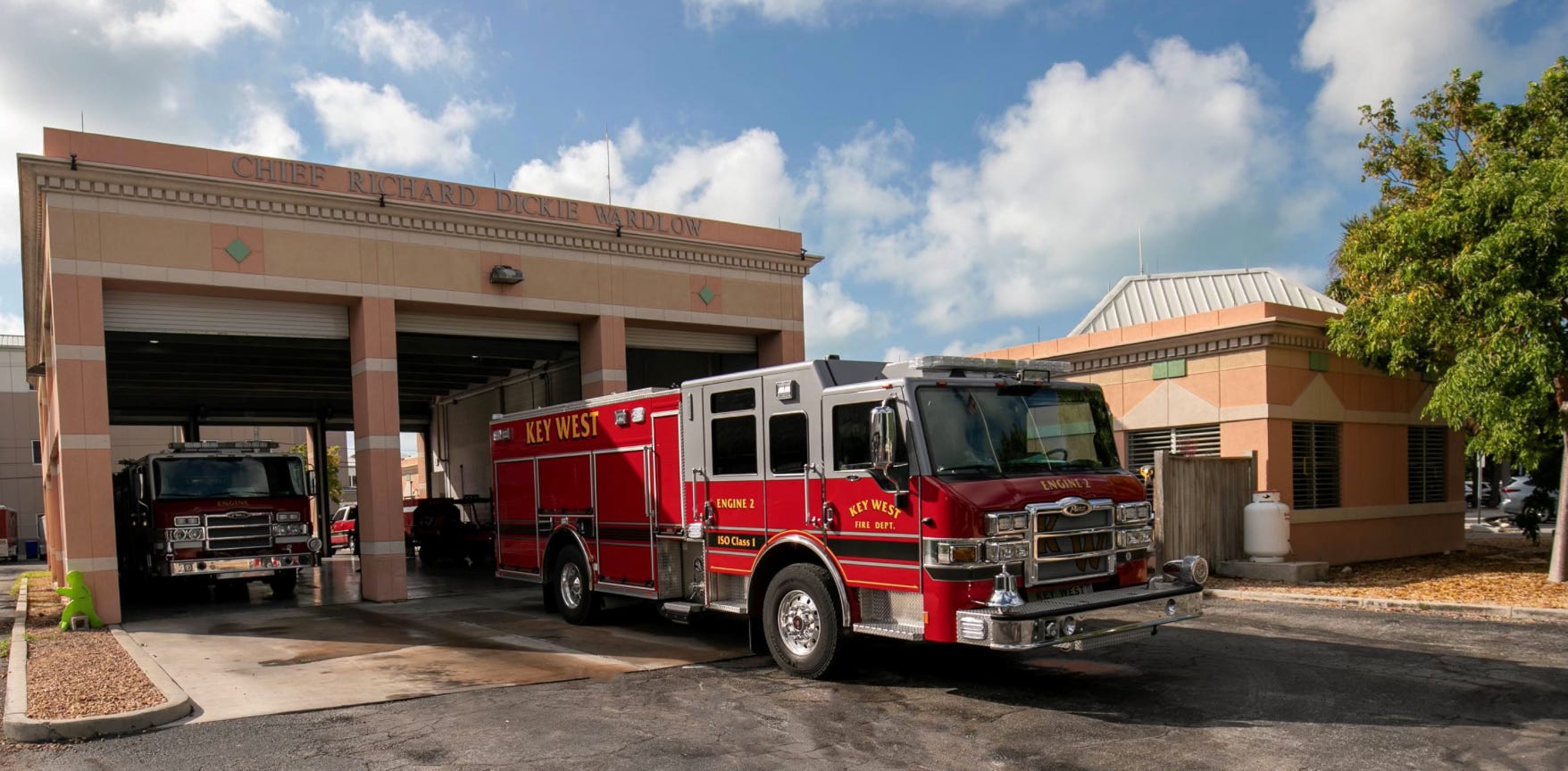
KEY WEST, Fla. — The Key West City Commission on Wednesday evening approved a proposal to implement a citywide fire assessment that could generate millions of dollars annually to fund fire protection services, marking a significant shift in how the city pays for its fire department.
The commission approved the ordinance on second reading by a 6–1 vote, with Commissioner and mayoral candidate Sam Kaufman casting the lone dissent.
The plan, advanced during the April 1 meeting, imposes a non-ad valorem assessment on property owners based on demand for fire services rather than property value, with projected assessable costs totaling about $19 million over a five-year period.
In theory, that would be backed out of property taxes — depending on the outcome of efforts to eliminate property taxes in the legislature in Tallahassee.
Commissioner Greg Veliz, addressing the structure of the assessment, underscored the debate over how the charge is characterized.
“You can call a tax anything you want, you could call it a ham sandwich,” Veliz said. “It is still a tax.”
Kaufman echoed that concern and urged a slower approach before the final vote.
“I agree with the Chamber of Commerce on this, and I agree with Commissioner Veliz — call it what you want, it is a tax,” Kaufman said. “Maybe we postpone and work on a policy statement, then maybe I will be a yes on this.”
Former City Commissioner Margaret Romero spoke after the vote saying that it didn’t matter “If you put the money in a blue bucket or a red bucket. It still comes out of our pockets.”
City officials said the assessment is designed to create a stable, legally restricted funding source for fire protection services while reducing reliance on traditional property taxes.
Lower-rate scenarios under consideration could reduce the residential cost to between $50 and $150 annually, depending on policy decisions by the commission.
The methodology relies on historical demand for fire services, using call data and property classifications to allocate costs among residential, commercial, industrial and institutional users. Commercial properties account for the largest share of demand at roughly 46.5%, followed by residential properties at about 43%.
Officials emphasized the structure is designed to comply with Florida case law requiring that assessments provide a special benefit to property and be fairly apportioned.
Emergency medical services costs are excluded from the assessment, reflecting legal precedent that EMS transport services do not provide the same direct benefit to property as fire protection.
Key West Chamber of Commerce Executive Director Kerry Baker spoke in opposition to the proposal, raising concerns about the potential financial impact on local businesses.
Assistant City Manager Mike Turner said that even with passage of the ordinance, commissioners will still have additional opportunities to set and approve the actual rate structure in subsequent votes.
“If the ordinance is passed, the commission will have two more opportunities to approve a proposed fee,” Turner said, noting those decisions are expected to coincide with upcoming summer budget workshops.
Proposed Fire Assessment Timeline
March 5, 2026 — First reading of ordinance
March 21, 2026 — Public notice advertised
April 1, 2026 — Workshop and second reading/adoption of ordinance
May 7, 2026 — Initial assessment resolution
By June 11, 2026 — Notices mailed and published
July 2, 2026 — Final assessment resolution
By Sept. 15, 2026 — Assessment roll certified to tax collector
November 2026 — Fire assessment appears on tax bills
City Manager Brian L. Barroso urged commissioners to move forward, framing the proposal as part of broader long-term planning efforts.
“If not approved tonight, we lose the opportunity to be proactive this year,” Barroso said.
Barroso said the fire assessment was contemplated as part of the city’s strategic planning process, even as staff indicated that the full strategic plan is not expected to be publicly released until October with likely little or any public input.
He also said the assessment would appear as a separate line item on property owners’ tax bills, but emphasized that he anticipates the cost would be offset within the overall tax structure.
Barroso said the intent is for the assessment to be effectively redirected within the existing tax bill rather than added entirely on top of it.
City staff indicated the timeline was driven in part by a desire to have the assessment in place by September — before adoption of the city’s annual budget — but commissioners raised questions about that sequencing.
Commissioner Lissette Carey and Mayor Danise Henriquez both noted that the assessment rate would ultimately be set ahead of any potential legislative changes in Tallahassee related to property taxes, pushing back on the notion that the timeline was tied solely to state-level uncertainty.
Vice Mayor Donie Lee expressed hesitation during deliberations, saying additional work was needed before adoption.
Lee said he believed there was still significant work to be done on the ordinance.
In the end however, the dais, sans Kaufman chose to approve the ordinance on its second reading.
If adopted, the assessment will be listed as a separate line item on annual property tax bills beginning in November 2026.
City commissioners have not yet set final rates or exemption policies, including how government-owned and tax-exempt properties will be treated. That is expected to occur by July 2, giving the commission two more chances not to impose the assessment.
Cities and Counties with Fire Assessments
assessm,entSimilar assessments are being implemented statewide by other municipalities.
These are direct, city-run fire assessments, not county overlays.
City of Gainesville — structured fire assessment based on property demand and square footage
City of Cape Coral — two-tier fire services assessment funding operations and capital
City of Palatka — tiered fire service assessment adopted annually by commission
City of Leesburg — annual fire protection assessment program
City of Kissimmee — active municipal fire assessment program
City of Milton — municipal fire assessment structure
City of Panama City — adopted fire assessment funding system
These counties levy fire assessments countywide or in unincorporated areas:
Sarasota County — one of the longest-running systems (since 1996)
Citrus County — countywide fire-related non-ad valorem assessments
Pasco County — referenced fire assessment structure for funding fire services
Santa Rosa County — MSBU fire assessment system in parts of county
Lake County — uses special assessments including fire services
Hernando County — fire assessment framework discussed/implemented
This is an evolving story. Watch this space.