


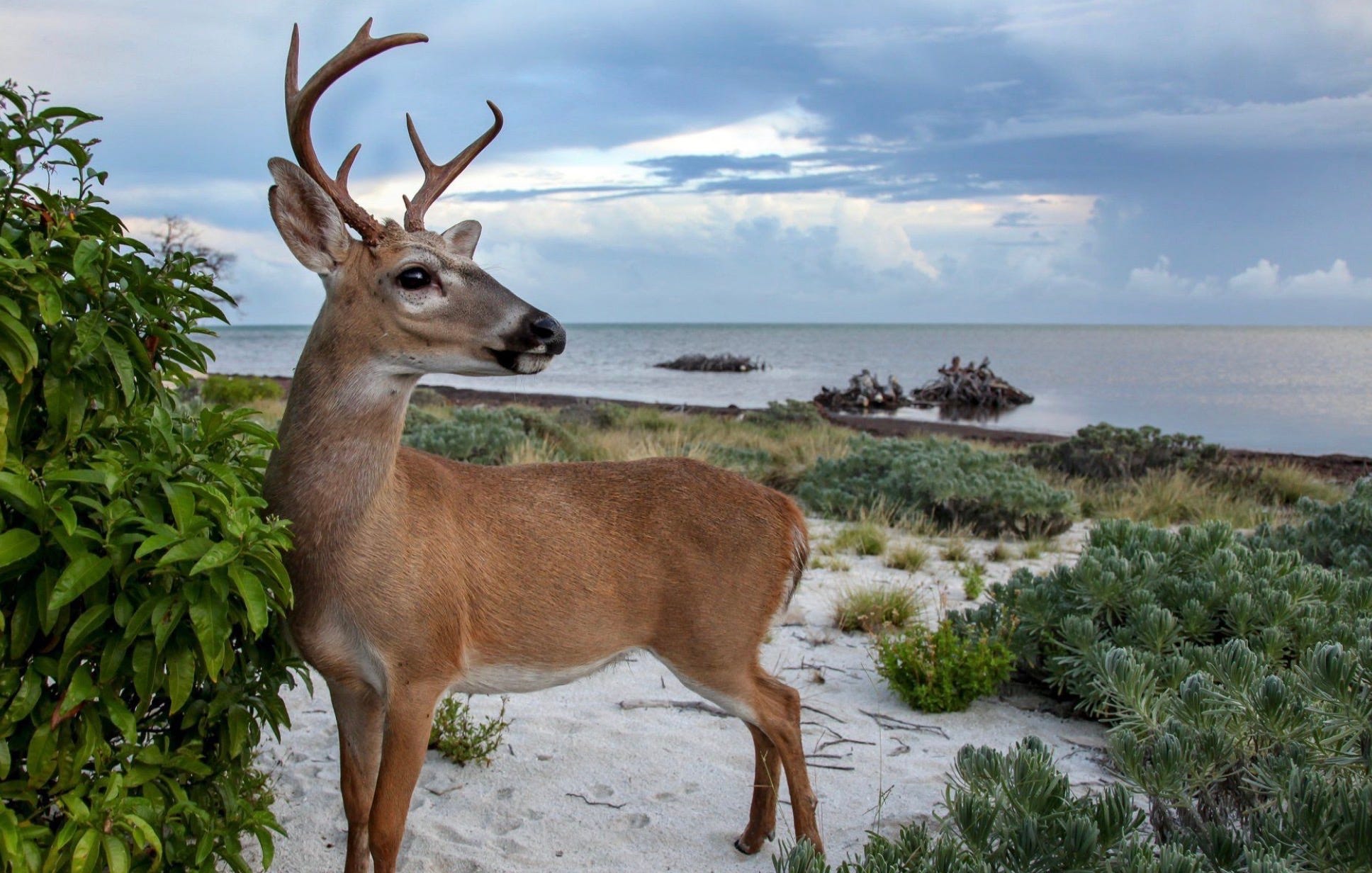
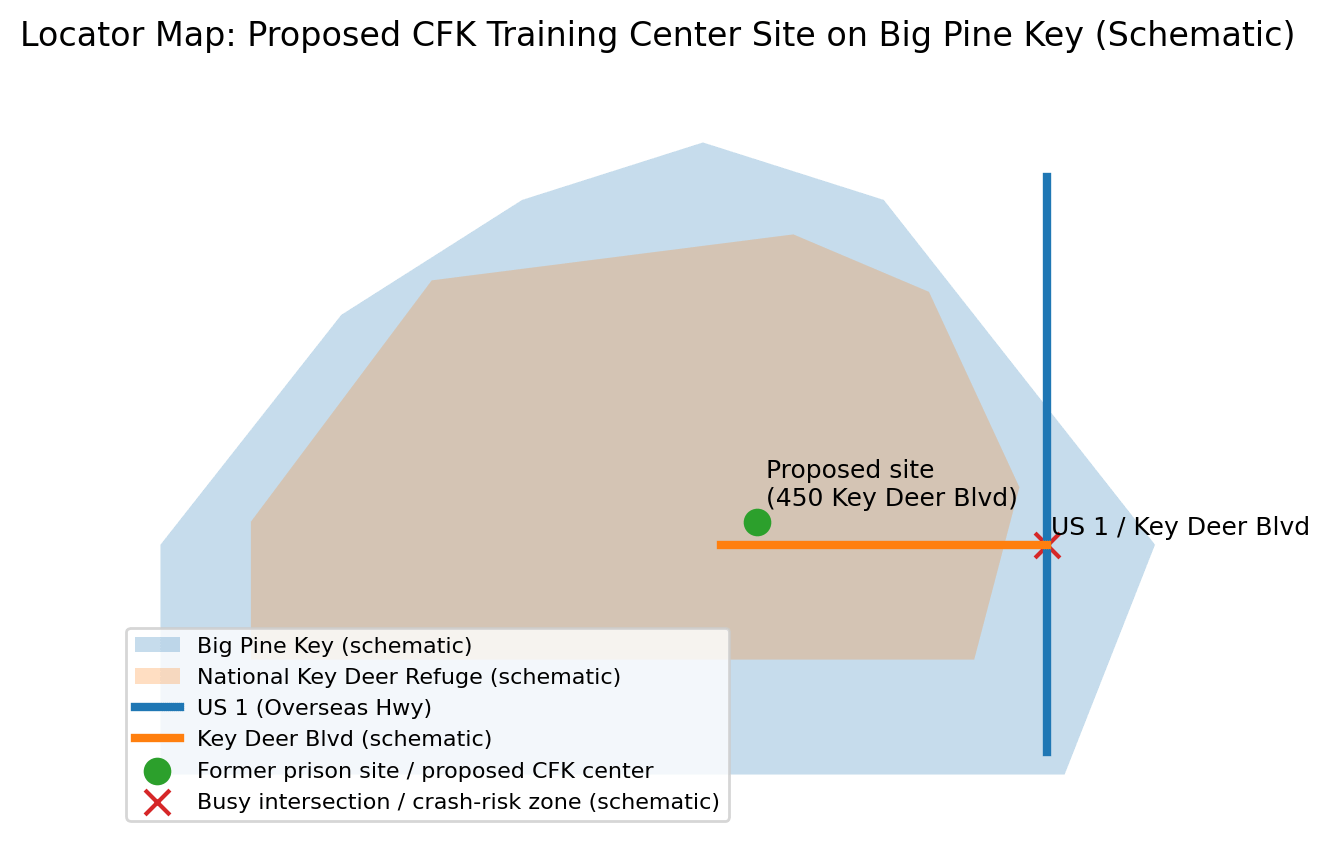
A proposed workforce training project by the College of the Florida Keys at 450 Key Deer Blvd. on Big Pine Key, a site that lies within the National Key Deer Refuge, is drawing mounting opposition from wildlife advocates who warn the development would place a commercial driver training facility in the middle of federally protected endangered species habitat.
The project, planned for the former state prison property, includes a commercial driver’s license training track and related facilities near a busy intersection already identified as one of the island’s highest wildlife mortality zones for endangered Key deer.
Save Our Key Deer says the proposal would significantly increase traffic — including student drivers and large vehicles — in an area where Key deer already face frequent vehicle strikes.
“Placing a truck driving school in the heart of Big Pine Key is outrageous. Our endangered Key deer already suffer from vehicle strikes here—adding student drivers and semi trucks is unthinkable,” said Valerie Preziosi, president of Save Our Key Deer.
Preziosi also criticized the public review process tied to the project.
“We were given just days over a holiday week to review a 90-page Environmental Review Record and submit comments, while the office at the CFK (where the County is now directing us to send our comments to) is CLOSED past the deadline. Residents deserve more time and a fair process,” she said.
Monroe County has issued a Notice of Finding of No Significant Impact and a Notice of Intent to Request Release of Funds, which would allow Florida Commerce, acting on behalf of the U.S. Department of Housing and Urban Development, to release $2 million in federal funding to the college for the project.
County officials say the land is owned by the State of Florida and leased to the College of the Florida Keys, limiting the county’s authority over the site.
In an email obtained and reviewed by Above the Fold, County Mayor Michelle Lincoln emphasized that point.
“The State of Florida owns the property. The College of the Florida Keys leases the land from the State and intends to develop it for college programs,” Lincoln wrote.
Lincoln said county officials have participated in discussions with the college but are not directing the project.
“Although the Board of County Commissioners does not have authority over what occurs on this property, we have met with the College and attended community meetings hosted by President Dr. Gueverra,” she wrote.
She said broader community uses were discussed but said the current plan is more limited.
“At this time, the initial plan is to establish a CDL Truck Driving School,” Lincoln wrote.
Lincoln also described the county’s role in the environmental review.
“The County’s only role in this project is to review the Environmental Assessment for completeness and accuracy,” she wrote.
The National Key Deer Refuge was established in 1957 to protect and preserve the national interest in Key deer and other wildlife resources in the Lower Florida Keys. The refuge includes diverse habitats such as pine rockland forests, tropical hardwood hammocks, freshwater wetlands, salt marsh wetlands and mangrove forests. It is home to more than 20 endangered and threatened plant and animal species, and the endangered Key deer are found nowhere else in the world.
Environmental advocates argue Monroe County’s determination of “no significant impact” conflicts with existing federal protections already governing Big Pine Key and No Name Key, which are subject to a federally approved Habitat Conservation Plan and Incidental Take Permit designed to limit development that could push endangered species toward extinction.
They say the Environmental Review Record does not reference that permit or an existing biological opinion issued by the U.S. Fish and Wildlife Service, despite federal rules requiring such consultation if a project may affect listed species or critical habitat.
Supporting documents show the proposal includes more than a driving track. Plans reference construction of a 6,000-square-foot building with classrooms, simulators, administrative offices, community space and restrooms, as well as possible future uses including law-enforcement facilities, youth programming and athletic fields.
And little or no mitigation for stormwater runoff.
The College of the Florida Keys did not respond to requests for comment and is closed until after the holiday weekend, according to county officials.
Public comments on the Environmental Review Record must be submitted by Friday, Jan. 2, before Monroe County authorizes the request for release of federal funds.
Species At Risk And What It Could Mean For Residents
Wildlife advocates say development at 450 Key Deer Blvd., within the National Key Deer Refuge, could affect a broad array of federally protected wildlife and sensitive native species that form the ecological foundation of Big Pine Key:
Key deer (endangered)
Lower Keys marsh rabbit (endangered)
Silver rice rat (endangered)
Florida bonneted bat (endangered)
Eastern indigo snake (threatened)
Wood stork (threatened)
Multiple native bat species, which rely on intact habitat and dark corridors
Native pollinators, essential to pine rockland and hammock plant communities
Green anoles and other native reptiles dependent on understory and canopy habitat
Big Pine Key and No Name Key are subject to strict development limits under a Habitat Conservation Plan and Incidental Take Permit, which use population-viability modeling to cap the amount and intensity of development that can occur without risking extinction of protected species.
Environmental advocates warn that if Monroe County is found to have violated the Endangered Species Act by approving or facilitating a federally funded project without required consultation, the consequences could extend beyond environmental enforcement.
Such a finding could jeopardize Monroe County’s participation in the National Flood Insurance Program, potentially affecting flood-insurance availability and rates for residents in Big Pine Key and other parts of the Florida Keys — a consequence that has followed ESA violations in other coastal communities nationwide.
Resident Action: How To Comment On The Big Pine Key Project
Public comment deadline: Friday, Jan. 2
Residents, organizations and agencies may submit written comments or objections related to the Environmental Review Record and the proposed release of federal funds through the following channels:
Monroe County Planning & Environmental Resources Department
Marathon Government Center
2798 Overseas Highway, Suite 400
Marathon, FL 33050
Email: Roberts-Michael@MonroeCounty-fl.gov
(Comments received by Jan. 2 will be included in the official Environmental Review Record.)
Federal Environmental Review Portal (HUD)
College of the Florida Keys (Project Sponsor):
(County officials have directed inquiries and comments regarding project use to CFK.)
Objections to Release of Funds:
Formal objections may also be submitted to Florida Commerce or HUD in accordance with 24 CFR Part 58, limited to procedural and legal grounds outlined in federal regulations.
This is an evolving story. Watch this space.