



A meeting of the College of the Florida Keys Board of Trustees on Tuesday drew sharp criticism from residents and environmental advocates after the board initially declined to place a proposed commercial truck driver training center on its official agenda, then limited public access while considering the issue.
Valerie Preziosi, president of the Save Our Key Deer Foundation, said her organization formally requested that the college list the Big Pine Key truck training center as an agenda item so the public could meaningfully participate. The request was denied.
As a result, concerned residents arrived early to the meeting and filled out public comment cards in order to ensure their objections were heard once the issue arose.
The board initially was not planning to take public comment on the proposal at all, but relented after residents objected, allowing testimony that ultimately underscored near-unanimous opposition and raised questions about whether the meeting itself complied with Florida’s Sunshine Law.
More than 30 residents traveled to Key West to speak despite short notice and a weekday meeting time. Attendees said they were escorted into a separate waiting room and told only a limited number of people (9) could enter the boardroom at one time, preventing many from hearing comments live.
Requests to move the meeting into a larger available space were denied.
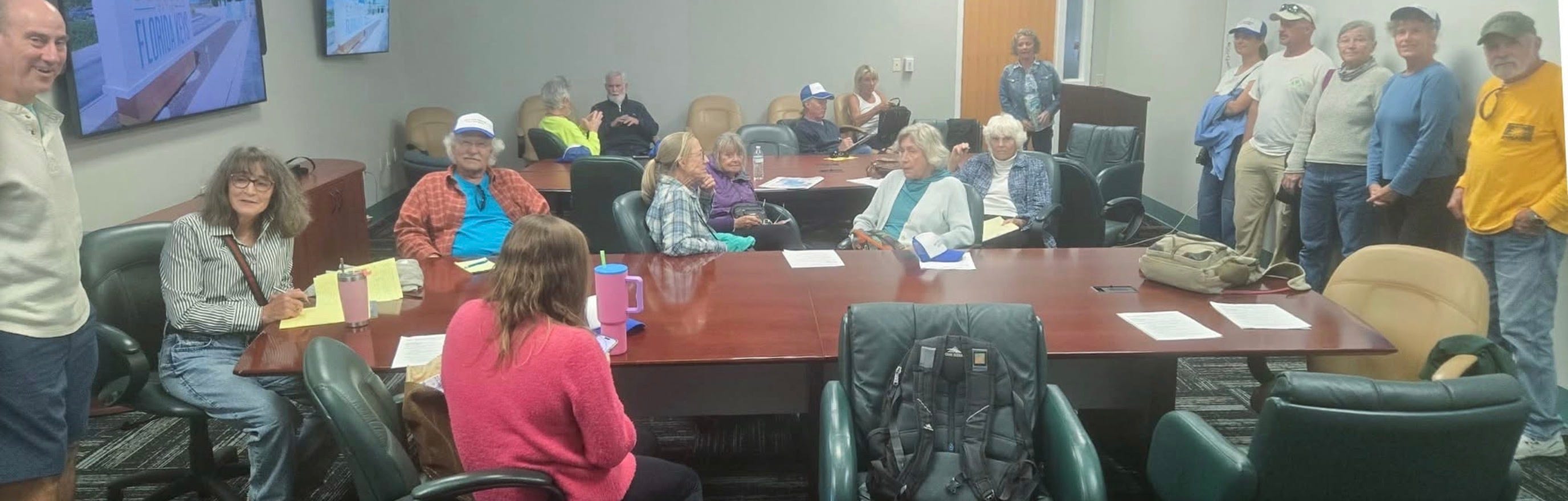
Florida’s Sunshine Law, Chapter 286 of the Florida Statutes, requires meetings of public boards to be open and reasonably accessible to the public. While fire-code capacity limits are permitted, legal guidance indicates that failing to relocate a meeting when a larger space is available and significant public attendance is anticipated may constitute an unreasonable restriction of access. Actions taken at meetings found to violate the law can be declared void by a court.
Of the 31 speakers who ultimately addressed the board, 30 opposed the truck training center. One spoke in favor.
Preziosi then turned to the substance of the proposal, formally objecting to the county’s proposed “Finding of No Significant Impact” associated with the HUD-funded workforce training project.
“Any additional habitat loss on Big Pine Key is significant and irreversible,” Preziosi told trustees. She said the state-owned property the college is leasing contains critical wildlife habitat, including a freshwater solution hole and a well connected to the underground freshwater lens that sustains endangered species.
She said the biological analysis submitted for the project inaccurately states there are no freshwater resources on site, undermining the environmental review, and fails to adequately analyze stormwater runoff, traffic impacts and freshwater effects. The proposal would pave large areas of sensitive habitat, she said, including areas frequented by endangered Key deer since fencing was damaged in 2017.
“The size and location of this footprint are completely incompatible with the environmental sensitivity of Big Pine Key,” Preziosi said.
She also raised flood-risk concerns, noting the site lies within a FEMA-designated Special Flood Hazard Area with an average elevation of about two feet above sea level. Project documents confirm the federally required HUD eight-step floodplain management process has not been completed.
Motor-vehicle strikes are the leading cause of death for Key deer, killing roughly 15 percent of the population annually, Preziosi said. The proposed training program would place student truck drivers on residential roads used daily by children and wildlife.
“That risk is unacceptable,” she said, adding that Endangered Species Act compliance requires a valid biological opinion that has not been obtained and that approving a finding of no significant impact under those conditions could expose the county to legal action.
Several Big Pine residents echoed those concerns.
Kimberly Oxendale, a former trucking company owner with more than 45 years in the industry, said Big Pine Key is ill-suited for meaningful CDL instruction.
“The biggest fear and complaint from CDL drivers was navigating large cities like Raleigh, Columbus and Chicago,” Oxendale said. “Big Pine Key would not be able to provide this extremely necessary training. Another major concern is runoff from heavy-use vehicles. Fuel and oil leaks are inevitable, and EPA cleanup can be extremely expensive. I know from experience.”
Others pointed to the scale of local opposition. Jenny Dunkle said a grassroots petition effort quickly gained traction.
“Within the first two days, the online petition had over 500 signatures,” Dunkle said. “As of Tuesday morning, it had 1,180 online plus 120 on paper — about 1,300 people who do not want this. Of those, 813 are Monroe County residents and 430 are Big Pine residents.”
Ann Lugbill cited federal requirements tied to the HUD grant, saying the college failed to notify interested parties, including nearby residents, Key deer protection groups and the U.S. Fish and Wildlife Service.
“Public comments must be considered and plans modified before completing environmental certification,” Lugbill said. “The college is ignoring the public and the law.”
Several speakers emphasized they were not opposed to workforce education itself, but to the type and location of the proposed program. Jana Wiggins urged the college to pursue alternatives better aligned with local needs.
“Our community desperately needs contractor skills, home health care, physical therapy and nursing,” Wiggins said. “Seniors are leaving the Keys for long-term care. This facility could address real local shortages instead of creating new risks.”
Anne Press said the proposal falls short of the environmental protections residents expect.
“Our community needs the highest environmental standards,” Press said. “Those standards are not being met by the county or the college’s grant process.”
Preziosi said community opposition remains unified and prepared to challenge the project if it moves forward.
“At this point, the county cannot lawfully approve a finding of no significant impact,” she told trustees. “Local residents and environmental organizations are engaged and ready to act.”
It is unclear what action the college will now take.
This is an evolving story. Watch this space.