

At Least Three Key Deer Trapped in Months-long Fence Dispute on Big Pine Key
Save Our Key Deer says endangered deer remain inside the former prison property where the College of the Florida Keys hopes to build a workforce training center with commercial driver training.

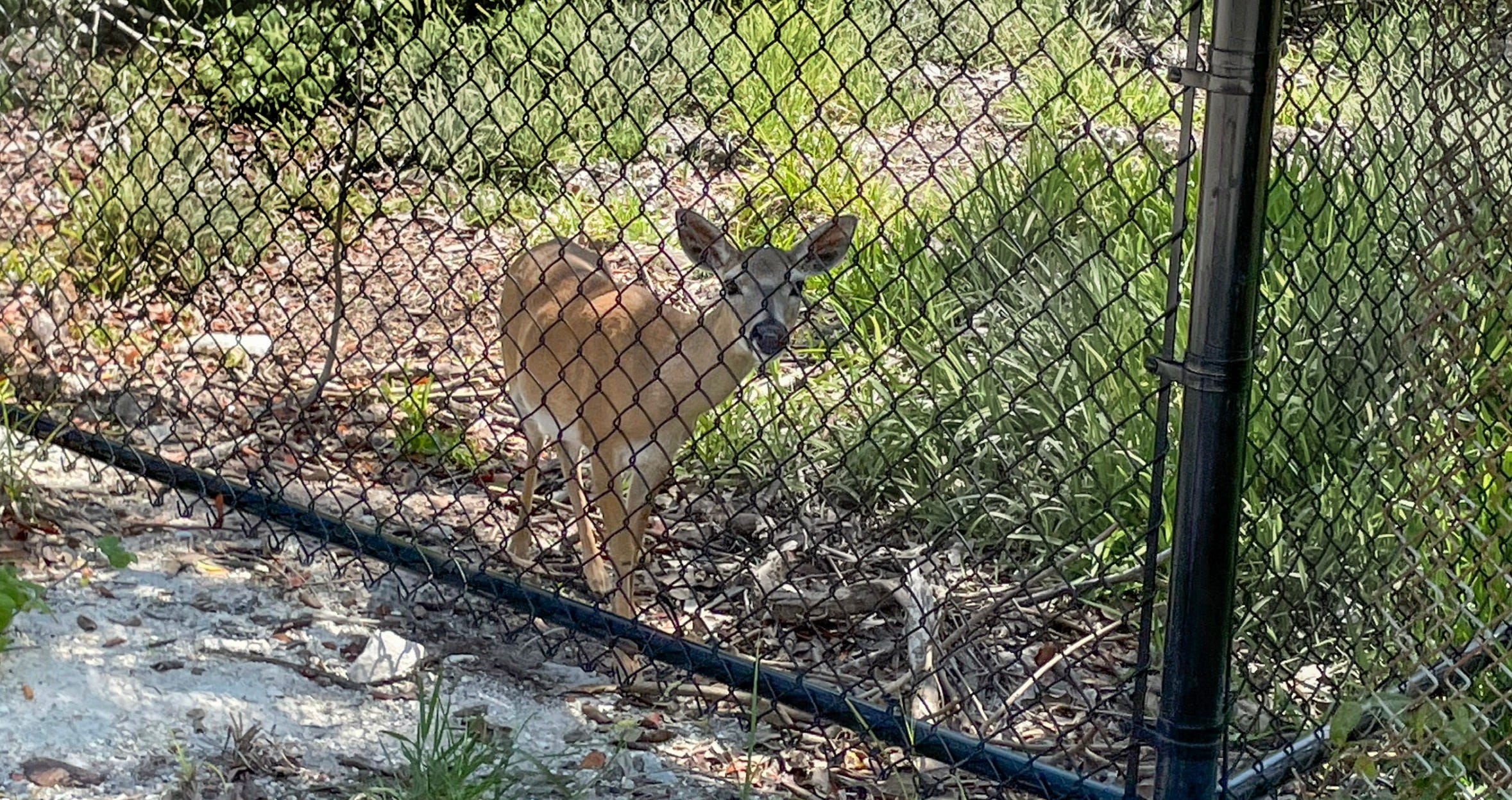
BIG PINE KEY, Fla. — At least three endangered Key deer are trapped inside a fenced former prison property on Big Pine Key where the College of the Florida Keys hopes to build a vocational training center that could include commercial truck driver training, according to Save Our Key Deer.
The deer are at the center of a months-long dispute involving residents, wildlife agencies and the college over whether the animals are able to leave the property and whether the fence is appropriate for land in the heart of Key deer habitat.
“This has been going on for a long time,” Valerie Preziosi of Save Our Key Deer wrote in an April 24 email exchange provided to Above the Fold.
The property is the former Big Pine Key correctional facility site at 450 Key Deer Boulevard. A federal environmental notice for the CFK-Big-Pine-Key Workforce Training Center says the former correctional facility was listed as state surplus in 2020 and leased to the College of the Florida Keys in 2021, and that the project would include demolition, site cleanup and construction of a 400-by-400-foot concrete pad for vehicle training, including commercial driver’s license classes and law enforcement motor vehicle training, according to a Monroe County public notice.
The college has said potential uses for the Big Pine Key site include a marine aquaculture facility, shared community spaces, construction apprenticeships, Commercial Driver’s License training and motor vehicle training for law enforcement, according to the College of the Florida Keys. CFK has also said the site is not within the boundary of the National Key Deer Refuge and that it replaced the perimeter fence “to secure the property and keep wildlife outside,” according to the college.
But Preziosi and other residents say the fence has become the problem.
In an April 20 email to Preziosi and other concerned residents, U.S. Fish and Wildlife Service official Nikki Colangelo said the agency had been monitoring Key deer observed on the old prison property and had confirmed there were “two freshwater sources and plenty of food available for these deer.”
“They also appear healthy, are exhibiting normal behavior, and are in no imminent danger,” wrote Colangelo, manager of the Division of Classification and Recovery for the service’s Florida Ecological Services Field Office.
Colangelo wrote that the Fish and Wildlife Service remained in communication with the Florida Fish and Wildlife Conservation Commission and the college. She said an FWC officer had looked at the fence the previous week and that “it appears there is a limited access point on the property that the deer may be using to move freely into and out of the property.”
“As the property owner, it is up to the College if they want make adjustments to their legally permitted fence to keep deer out of the property or install a deer-sized lockable gate as suggested,” Colangelo wrote. “If they decide they would like to make adjustments to the fence to keep deer out of the property, we will work with them to ensure the deer that are currently there are out of the property before making modifications.”
Preziosi challenged that response in an April 24 follow-up email to federal wildlife officials, state wildlife officials and college representatives.
She said her understanding is that the land is state-owned and leased by the college, a distinction she said is significant for legal responsibility and regulatory oversight. She also asked officials to provide documentation showing the fence is legally permitted, saying she had not been able to locate a permit on record with Monroe County.
Preziosi also questioned whether the “limited access” point cited by officials is large enough for an adult doe to pass through safely.
“This could result in an adult deer becoming stuck, especially if a fawn manages to wander out and the doe attempts to follow,” she wrote.
Preziosi said adult deer likely entered the property when gates were left open for extended periods and are now trapped behind locked gates.
“I am worried that USFWS is setting a precedent that it is acceptable to keep deer confined in a fenced area simply because they entered through an open gate and have food and water,” she wrote. “This approach does not address the animals’ need to move freely within their natural habitat.”
She asked the Fish and Wildlife Service and CFK to “immediately facilitate the safe release of all trapped deer” and conduct a comprehensive review of the fencing and access points.
Key deer are federally endangered and found only in the Florida Keys, with the greatest concentrations on Big Pine Key and No Name Key, according to the Florida Fish and Wildlife Conservation Commission. FWC estimates the current population at 700 to 800 deer and says the population is considered stable for now, though the species remains federally endangered, according to the agency.
The National Key Deer Refuge was established in 1957 to protect Key deer and other wildlife resources in the Florida Keys, according to the U.S. Fish and Wildlife Service. The service says an estimated 75% of the Key deer population lives on Big Pine and No Name keys, while FWC says vehicle strikes are the primary cause of Key deer mortality and fences can obstruct migration routes, according to FWS and FWC.
The college says the proposed Big Pine Key expansion would bring workforce training closer to Lower Keys residents, including CDL and law enforcement vehicle training that otherwise may require travel to the mainland, according to CFK. CFK President Jonathan Gueverra said in January that the college is “dedicated to partnering with our Florida Keys community” and that its programs are meant to benefit residents, including “both economic prosperity and respecting what makes the Keys special,” according to the college.
In an earlier April 17 email, Preziosi proposed baiting the deer toward an open gate, then moving the bait outside the gate and monitoring the site to see whether the animals would leave. She also proposed installing a deer-sized lockable gate on the Sandy Circle side of the property, saying Save Our Key Deer would pay for the gate and installation if officials accepted the proposal.
As of April 27, the dispute remained unresolved.